
Honey
Properties, history and more
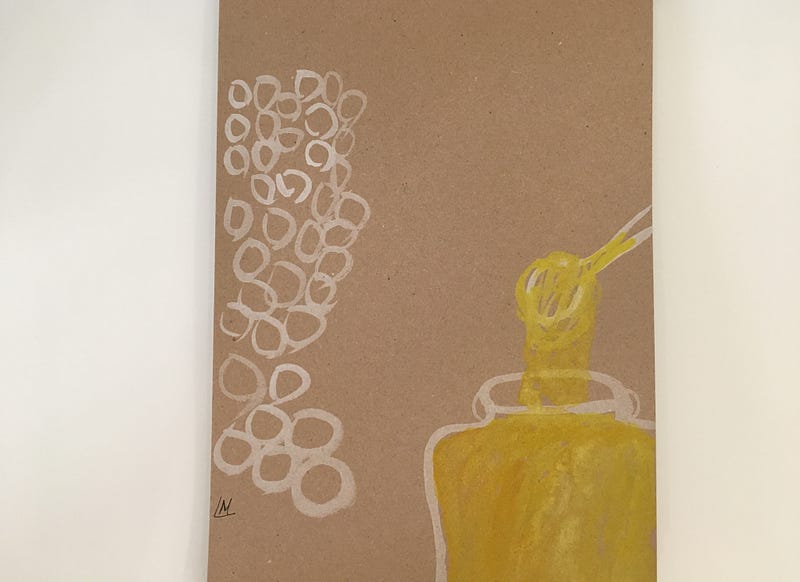
Above all, my favourite honey is called white clover honey. I hope to talk about something interesting regarding honey, honeybees and my love for it. Honey seems to be underrated. I also think about it not only as food, but it can be meaningful. Likewise, we talk about coffee a lot, don’t we?
Honey has been depicted on 8,000 years old cave paintings. For instance, like this one at Arana Caves in Spain (scheme). It is used as the first evidence of honey being used by humans. Although cultivating colonies of bees has taken more time. They appeared approximately in 2,400 BC.
This little example makes me think about human’s proliferation. It was a complete wilderness, then humans strived to obtain some honey by invading untamed nature. Later on, we started to create our bee colonies for our purpose, which is called cultivation.
The same goes for berries, all veggies and fruit. We learnt from nature and then multiplied our resources by recreating these natural gifts. Turnovers became bigger and bigger. Maybe this is our path on the way to what we call ‘civilisation’.
White clover honey is a type of honey that is whitish in colour. First opening is that honey is not always brightly yellow.
Another thing is its consistency. We are all accustomed to fluid honey. I had a chat with my grandmother who explained to me that you can melt the solid honey, or you can stay it how it is. You have a choice about making its consistency. I left my honey solid. Then, it will melt, when you are eating it, right in your mouth.
Honey is diverse. Different types contain different amounts of sugar, so it really might not be too sweet. It has a subtle smell. Properties of honey depend on the flowers it has been produced of. We can compare it with the case when you cook something from either poor or expensive ingredients which will make the same kind of product, but have a disparate quality of outcome. In honey, you don’t have better or worse blossoms to make it, so you cannot refer to this traditional distinction in production of almost every commodity we have in our society. Flowers are just different.
When I was a child, I used to watch the cartoon about Winnie-the-Pooh. It was so colourful, slight and kind. Undoubtedly, it popped up in my mind when I was eating it. In hindsight, I ate it with a wooden spoon from the bucket being a kid. It is lovely to think about childhood in reference not only to reminiscence but the feeling.
It is a soft texture. Light and real aroma. No granulated sugar is contained.
It was produced by bees. I remember driving through one of these bee farms last summer. They live in wooden hives out of the city.
We know that honeybees make gargantuan efforts to make it. Honeybees must gather nectar from two million flowers to make one pound of honey. Bees fly gigantic distances. Apparently, they start with the closest flowers and then move forward to further and further territories.
Honeycomb cells are gorgeous. They are initially six-sides empty cells that are built up ‘shoulder to shoulder’ creating a pure geometric structure.
How do honeybees communicate with each other? By dancing. Honeybees do a dance which alerts other bees where nectar and pollen is located. The dance explains direction and distance.
— Canadian Honey Coucil
Honey has been used in medical treatment for a wide array of health problems including stress, sleep disturbance, cough, obesity, bad breath, hangover relief, and more. However, it is not exactly confirmed as an effective method and surely, not only one to treat diseases. It can be used at home in little amounts. Then, I’m confident it has many benefits.
Nutrition components of honey consist of Vitamin B2, Vitamin B3, Vitamin B5, Vitamin B6, Vitamin B9, Vitamin C, Iron, Magnesium, Phosphorus, Potassium, Sodium, Zinc.
The antiquity of honey still makes me tremble. There is a sense of production in it which differentiates honey from other natural food as vegetables, fruit and berries. They are all simply plants unlike honey that use living organisms to be produced. In this sequence because living organisms cannot use something that did not exist before being produced.
Honey can be characterised by being a remedy, treat and just substance. If we take another example like candy as a treat, we cannot say it is a substance because its texture is complex and unclear. Honey has a property of clarity and purity.
“Honey on my head of course has to do with thought. While humans do not have the ability to produce honey, they do have the ability to think, to produce ideas. Therefore the stale and morbid nature of thought is once again made living. Honey is an undoubtedly living substance — human thoughts can also become alive.” — Joseph Beuys


