
Honesty Is The Greatest Moral Virtue:
-Honesty Fosters A Connection And Can Bring People Closer In Their Interactions-
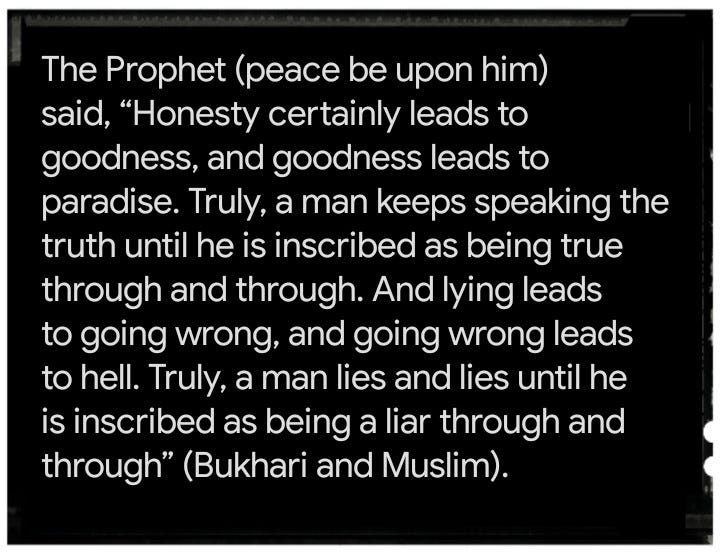
Honesty means uprightness of character or action. Honesty implies a refusal to lie, steal, or deceive in any way — Truthfulness and Honesty are two characteristics without which a man can not claim himself to be a True Muslim.
Honesty With Allah(swt):
By being honest to Allah, means be straightforward, talk to Allah, and when you say something to Allah try to fulfill it. Do not deceive ALLAH. On the other hand, if you deceive Allah, then you are dishonest. It's like you break an oath with Allah. Building Character means, when you fulfill a promise for the first time, you see something builds inside yourself.
Prophet Muhammad (saw) said: When honesty is lost,then wait for the Hour (the Day of Judgment). These words equate the loss of honesty to the destruction of the entire world.
Implication Of Honesty:
Honesty in words implies telling the truth in all cases and under all conditions. Honesty also implies fulfilling the promise, whether written or given orally, in text and spirit. Honesty also implies giving the right advice to the one who asks for it.
Honesty also implies doing one's work as sincerely and as perfectly as possible. Honesty also implies carrying out duties as fully as possible whether the person is supervised or not. Honesty means giving every person his due rights without his asking for these rights.
Honesty means doing the right thing in the right way at the right time. Honesty means objectivity in judgment, objectivity in evaluation, and objectivity in decisions of all types.
Honesty implies the right selection of personnel and the right promotion of personnel, i.e., selection by merit and promotion by merit, not by temper or favouritism or personal relations.
Honesty incorporates the concepts of truthfulness and reliability and it resides in all human thought, words, actions and relationships. It is more than just accuracy; it is more than just truthfulness, it denotes integrity or moral soundness. All faith traditions demand truthfulness and forbid lying.
In the Quran Allah(swt) commands: “O you who believe! Fear God, and be with those who are true (in word and deeds).” (Quran 9:119)
The message of Prophet Muhammad (saw) started on the basis of honesty.
In the books of biography of the Prophet(saw) — it is mentioned that he gathered all the people of Mecca and asked them, “O people of Mecca! If I say that an army is advancing on you from behind the mountains, will you believe me?” All said in one voice, “Yes, because we have never heard you telling a lie.” For forty years that the Prophet lived among the people they knew his impeccable honesty.
How Should We Understand Honesty?
Honesty means choosing not to lie, steal, cheat, or deceive in any way. Be honest with yourself, others, and God at all times — With honesty we can build strength of character that will allow us to be of service to God and all of humanity.
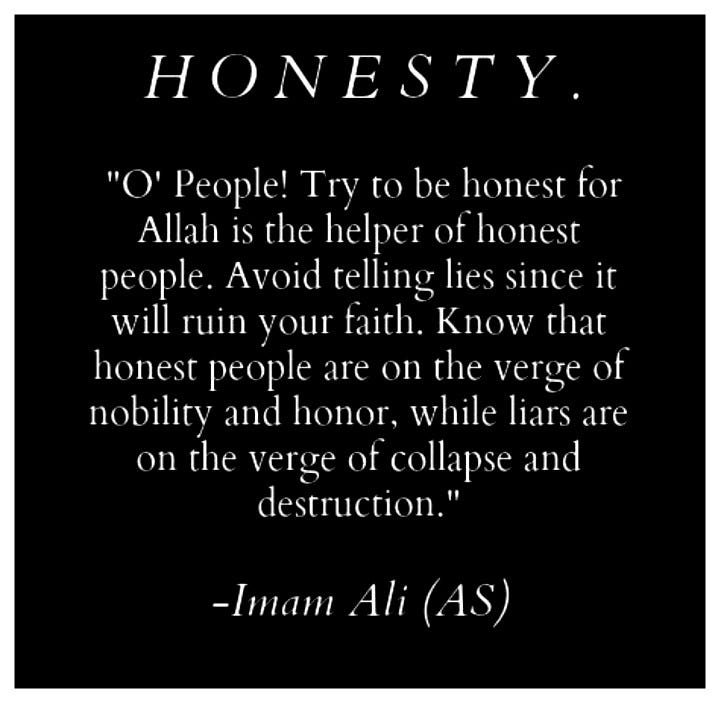
Honesty means saying and acting truthfully in all times, matters, and conditions. Honesty means giving the right guidance to the person who needs it.Islam orders us as Muslims to be honest to others and ourselves. A Muslim is ordered by Allah to be honest in his words and deeds, in private and public.
Being honest and truthful to oneself is implied by obeying Allah’s law. Being truthful with others means saying the truth and being honest in all dealings including the realm of trade and business, purchasing, education, learning, communication, and marriage. A True Muslim is the one who could be distinguished by his essential characteristics of Honesty and Truthfulness.
Honesty in Islam consolidates the notions of truthfulness and dependability, and it lives in all human words, thoughts, relations, and actions.
“O you who have believed fear Allah and be with those who are true.” [Chapter 9 verse119]
Ibn Katheer, the renowned scholar of the meanings of the Holy Qur’an illustrated the significance of this verse. He was reported to have said, “Being truthful and sticking to truthfulness implies you will be among the people of the truth and be safeguarded from calamity and that it will make a way out for you from your tribulations.”
Prophet Muhammad (saw) is the best example for all Muslims at all times and in all situations. He was a Flawless case of Honesty in Islam and before his prophethood, people of Makkah named the Prophet (saw) as the honest and truthful (Al-Amin and As-Sadiq).
Even Abu Sufyan, an adversary of the Prophet (saw) in the beginning of the Prophet’s call, admitted the prophet’s honesty. When the Prophet (saw) sent a letter to Heraclius the Emperor of Byzantium welcoming him to Islam, Heraclius sent for Abu Sufyan to ask about Prophet Mohammad (saw) and what this prophet was calling the people to.
Aby Sufyan said, “He never tells lies or deceives others. He invites the people to love Allah Alone and he advises us to fear Allah, and he calls the people to honesty and abstinence”.
It is of the mannerism of the high path of Islam to be honest when one speaks.
Being honest with yourself and with others shows how much you really care and demonstrates self-respect and respect for others.
Honesty attracts honesty.
If honesty becomes an unconscious habit, one becomes magnetized to other honest people.
One can dig himself deeper into a hole with lies and deceit, however being honest keeps you out of trouble, guides one always in the right track especially when one fears the anticipated consequences.
Honesty, is an essential characteristic of a Muslim, includes being truthful towards Allah by worshipping Him sincerely; being truthful to oneself, by adhering to Allah’s laws; and being truthful with others by speaking the truth and being honest in all dealings. Thus, a person should be the same on the inside as he is on the outside.
A True Islamic society is based upon honesty and justice, and is intolerant of dishonesty in all its various forms.
A Muslim seeking to please Allah and follow the path of righteousness should be aware of the dangers of deceit and dishonesty. However — equally he should know that Allah is all Merciful, willing to Forgive even the gravest sins for those who strive for His sake. Honesty is very important in the life of a Believer.
“Honesty descended from the Heavens and settled in the roots of the hearts of men (faithful believers), and then the Quran was revealed and the people read the Quran, (and learnt it from it) and also learnt from the sayings and traditions. Both the Qur’an and the traditions strengthened their honesty.” (Saheeh Al-Bukhari).
So, Islam instructs the Muslim to be honest and trains him to be so. The outcome is a healthy self and a healthy social atmosphere that leads to the happiness of both the individual and the community.

Building Honesty:
The important question, however, is this: how does Islam build honesty in the Muslim?
Islam builds ethical qualities in general and honesty in particular in several ways:
1. Instructions:
Allah orders the Muslim to be honest in all cases, in all deeds and words, to himself and others.
2. Reason:
Allah shows the Muslim rationally that honesty is the best policy, even on utilitarian bases.
3. Reward:
Allah promises the honest person generous rewards in this life and in the hereafter.
4. Punishment:
Allah threatens the dishonest person with severe punishment for his dishonest behaviour.
5. Practice:
Allah develops the habit of honesty in the Muslim through actual practice, i.e., through fasting and prayer.
Thus Islam builds the habit of honesty in the Muslim through Direct Instructions, through Islamic System, through Rational Arguments, through the Reward and Punishment Principles, and through Practice.
JazakAllah (May Allah reward you with goodness)for reading.
Kindly Follow & subscribe to receive the latest insightful stories by email.