
Homo Perambulans
In the Footsteps of Walking Man
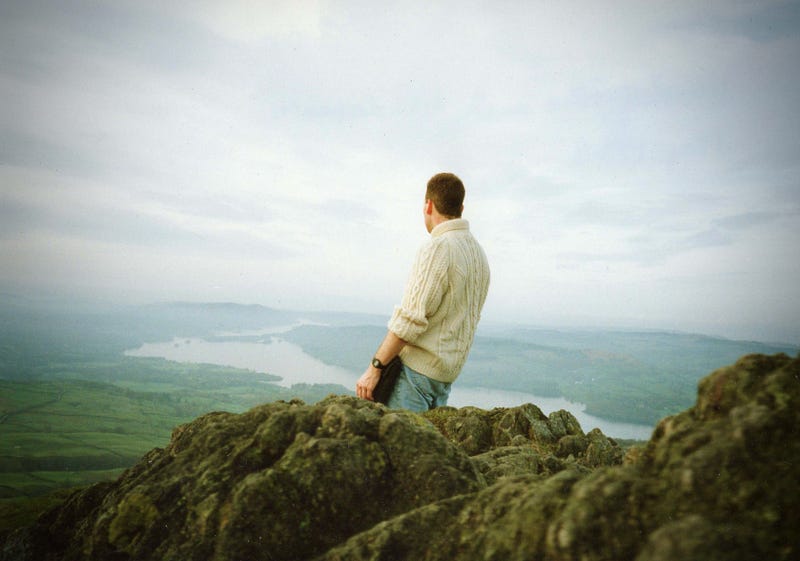
I’ve always walked, ever since I could.
As a toddler, I tottered around my grandmother’s rambling, leafy garden. “Mind the foxes in the spinney don’t get you, dear!” (Thanks, Nan …)
As an older child in junior school, I surveyed our nondescript modern town from our 14th-storey flat like an eagle from his eyrie and set out to explore. I felt absurdly triumphant — like Livingstone or Thesiger — whenever I discovered a new alleyway or back street.
My little partner-in-crime Gary introduced me to the World War 2 bomb craters and pillboxes hidden in leafy woodland on the outskirts of town.
As a teenager, I roamed the South Hertfordshire countryside, walking to most places within a 15-mile radius of home. (Ah, the urban planning genius of the Green Belt!) My Ordinance Survey map promised me Iron Age fortifications and Roman ruins, and I set out to find them, down quiet country lanes and muddy footpaths, through ancient woodlands and modern pine plantations.
Other times, I would take the train and my pocket money into London and explore the ancient and modern thoroughfares of that marvellous, bustling, labyrinthine, multi-layered, unreal city (thanks, T.S. Eliot). Always on foot, from the improbable Neo-Gothic splendour of St Pancras Station to the concrete brutalism of the South Bank Centre.
Popping out of an Underground station like a rabbit from a burrow always seemed to deny context: I had to walk my city to understand it.
Much too late to matter, I learned that generation upon generation of my ancestors knew the same haunts. I am as Hertfordshire, Essex, London a lad as they come, going back five, six, seven generations or more. The water of the rivers Thames and Lee flows in my veins.
As a uni student, I wandered the post-industrial city streets and towpaths of Leeds and Bradford, the bracing windswept Pennines, then in succession the bucolic hills of Swabia, the Baltic strands of Schleswig-Holstein, the pine-scented trails and castled peaks of the Black Forest and the Vosges.
Then back to England for the sweetly rounded, romantic Yorkshire Dales with my first true love, Jenny (also sweetly rounded and romantic).
Spending that winter in Iceland, I stomped the often windy, often icy streets of Reykjavík in lovelorn depression. (Never was a foreign scholarship less wanted.) I came nearer to death than I realised in a snowy mountain pass near Gullfoss, led astray by my German friend Adrian, whom I mistook for a seasoned hillwalker.
I escaped that predicament with conspicuous sunburn and a healthy appreciation of the suicidal confidence of young Germans abroad.
I never will escape the magical silence and harsh purity of the Icelandic landscape. A silence so absolute it is almost liquid. Once experienced, you must carry it with you for ever, deep within.
As a young editor, I tramped the glorious fells and vales of the Lake District with a tent on my back, and hiked France’s cratered Massif Central from north to south, sleeping in woodsmoke-fragranced hikers’ lodges and drinking milk fresh from the cows.
I spent two weeks pounding the Pennine Way underfoot, returning tanned and happy to Oxford and my desk job. During lunchtimes I fled the office and wandered in solitude among the ancient oaks of Brasenose Wood and Shotover.
I strolled the quiet Thames-side paths of Oxfordshire, the wooded hills and valleys of the Cotswolds and Chilterns with my sunny Australian girlfriend, later wife. I followed my Neolithic ancestors along their green Ridgeway to Silbury Hill and the stone circle of Avebury.
I traipsed sodden to the skin across the emerald hills of Wicklow and got roaring drunk with a guy called Jeff on the ferry home from Ireland.
Our last summer in England before emigrating to Australia, I slogged 62 miles in 24 hours across the South Downs, in company with three friends, to complete the Oxfam Trailwalker Gurkha Challenge. (The Gurkhas ran it in about a third of that.)
Such ambulatory heroics are probably no longer a viable proposition, as my various joints have started to take their revenge. I still need to walk regularly though. After a day spent indoors I feel frowsty and dissatisfied.
A true eccentric in Australia, I have never learned to drive. If my (extraordinarily patient and tolerant) wife wants to go somewhere with me, she drives. If she doesn’t want to go, I make my way by public transport, by bike or on foot. Or I stay at home.
A walk which begins and ends with a road journey in a noisy, polluting metal box is compromised from the outset, in my view. The best walks begin and end at my front door. No road rage involved.
At walking pace, you have time to see, smell, hear, ponder, touch.
My best work happens while I’m walking. I conceived this piece on my morning walk in peri-urban parklands, sniffing the fragrant eucalyptus scent after welcome rain. Each of the 50-or-so books with my name on the cover has required numerous walks in order to get done by the deadline. I walk to work, and I also walk to procrastinate.
Mostly I walk alone by choice. On Fridays, I walk with my friend and band-mate Linda, to trade observations about life, loves and much else with A Woman Who Is Not My Wife.
Walks with my wife (don’t worry, she knows about Linda) are an increasingly leisurely affair, often slowed to a snail’s pace by a birding camera and a pair of binoculars (122 species and counting).
I walk. It’s what I do.
Thank you, Trisha Traughber, for giving these ramblings about rambling a home 👋
Text and images © 2021 the author. All rights reserved.