
Homeless in an MMO (Part 5)
Going forward: what WOULD work well as Player Housing and Guild Halls??

This is a continuation of a series, and you can find the previous part here:
Okay, seriously! Almost done, I swear! It’s time to actually wrap this up, lol!
It’s one thing to sit around and point out how someone didn’t do a thing well, complain about it, whine, etc, blah blah blah. It’s another to make contributions to try and help improve the situation… so let’s do that part now. We can do it by breaking this article down into two pieces: Player Housing and Guild Halls. That should be an obvious division there, but… the differences might not be as obvious to everyone. We are all a massive collection of very different perspectives and play styles, after all!
One Last Time…
Let’s acknowledge the obvious: this discussion centers around MMOs (and other games that even have the feel of massive games) and the development of a connection between the player and their immersion into the game. This isn’t going to be the only thing that hooks a player into the game, and clearly, this isn’t even the primary focus. For many, though, it is an exceedingly valuable and important aspect of the game that helps develop emotional ties, which in turn translates to personal investment in playing the game… which is what players and developers (and the bean counters) all want, right? So… you agree it’s pretty important, right? Good! lol.
Right off, I want you to do one Google search if you are willing. Type in something like: “how much money do players spend on cosmetics in video games”.
Mind you, these are just “cosmetics”, but it does point to the overall desire which will indeed drive much of the discussion for this topic: player experience customization. After all, Path of Exile is a free game that lives off of players spending money on cosmetics… that should say a lot, right there. Warframe is also a free game that lives off of cosmetics and things like Dojo build speed-ups, which are basically cosmetics for a guild hall. Look at Facebook games, and yes-I do mean the Pay to Win games too: *massive* sums of money flow there. There is a massive amount of money flowing through all these games just for tiny changes in the way the avatar looks.
And so, let's restate a piece of Part 1 again and get to the “doing it right” aspect of all of this to help optimize these systems… because, seriously, we should be smart about this. There are *decades* of work between dozens of games and various business models anyone can go play for a short time to experience and determine what does and what does not work for their goals.
Some things for Player Housing and Guild Halls that should become MMO standards:
- Non-expansion dependant, but incorporate functionality from each expansion.
- Modular and expandable via in-game and micro-transactions (part of funding source).
- Accessible to the player base for free at basic levels.
- Develop around the theme of remembrance: trophy walls, memorials, and other such emotional ties.
- Ability to invite others to join you (as done with Garrisons).
- Long-term/endlessly repeatable projects to emphasize team effort and continual contribution/interest (for Guild Halls).
- Decorations that are achieved through world collection/quest/etc as well as micro-transactions (part of funding source).
Player Housing
Just having a small corner of the world to call your own can make a big difference. Personalizing that corner and making it more tailored to the character and feel of the players individually will go a long way towards establishing that connection which will help maintain the player’s interest, which is what this is mostly all about. It’s good for the company of course, and it’s great for the players: positive associations from the player is a fundamental requirement to game/company growth.
Let’s get to the details now. These houses should be themed and cozy, but appropriately scaled to the player’s ego/legacy and currency. Yes, I’m being purposefully vague on “currency” for right now; see the Real Money Discussion section below for more on that. Appropriately scaling for the player’s ego, or legacy if we want to be gentle about it, is the difference between a small attic abode and an extravagant estate carved into the side of a mountain with archways and a dozen chambers large enough for dragons, flanked by cascading waterfalls into the heated pools below.
Remembering Elder Scrolls Online’s housing system is the best example of what player housing should be. Scattered domiciles throughout each region, varied in sizes/cost and all themed in that region’s culture and aesthetic. This is important for player immersion and really helps establish a greater tie between the player and the quests or lore of that region. For many of us players, we come to deeply appreciate the art and lore of a given area because it speaks to us.
That connection will be largely dependent on personal real-life experiences and perspectives, which are well beyond the game’s influence. In my case, that would be snow-capped mountains with icy waterfalls and thick forests constantly shrouded in fogs; living in Alaska for a significant time of my life has forever aligned my tastes positively with “cold” and mountains. That translates to the in-game world as a high preference for areas that mimic those tastes, such as Stormpeaks (WoW, WotLK) or Skyrim (ESO), or maybe Orb Vallis even (Warframe, planet Venus). I also have a very strong preference for lore or architecture/culture that reveres dragons.
Extrapolate this to a simple concept: themed regional variety to cater to varied preferences.
One could even do some research and find general themes within the game that players tend to favor. Whichever game it happens to be, paying attention to user activity, forum content (especially in fan-made areas like art or fanfic), and of course positive feedback that references such things can help this effort. For prospective considerations: (Star Trek Online) how many people really loved the Dyson Sphere area, and would it do well for investing in player housing? For analytical and corrective considerations: (Istaria) which housing opportunities in Istaria are the most and least used? Etc.
Furnishings and Placement Mechanisms This aspect of the housing system is very game-dependent. Browser-based games, like Shop Titans, have a very limited two-dimensional grid area in which objects can be placed. Makes sense, too. This would probably be the easiest way to simplify and control player-driven decoration. Other games such as Graveyard Keeper and the like have very specific locations for things that can not be placed anywhere else. Then compare that to Guild Wars 2 and Warframe where you have not only (mostly) absolute three-dimensional control of furnishings and even environmental assets, but you can even scale their sizes and rotate them in any direction. That no doubt requires a bit more of a robust system, and would be interesting to see how a server handles the two types.
What I will say on that aspect is that the more player control is given, the stronger the unique feel and player connection you will have. Just like in real life, think of housing developments: the cookie-cutter houses that are all manufactured and built to be nearly identical are an eyesore and not appealing.
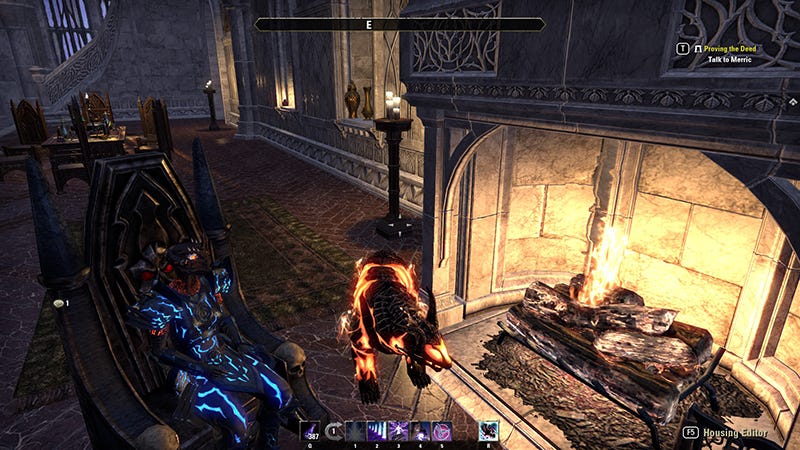
It’s What Is Inside That Counts More than external structure appearance, though, the player experience will grow and flourish with the interior customization. Non-interactable aesthetics are nice (chairs you can’t sit on, plants, paintings, etc), but the more things brought “to life” and have some kind of functionality will be even more enticing. Final Fantasy Online allows a home to have food objects that give temporary boosts when consumed, and these are placed in the house. WoW has objects that could serve this purpose as well: the Feasts, which are specifically for multiple players to enjoy. ESO has many chairs that can be sat upon, and this gives a wonderful feeling when you are with a group of friends, or just want to relax by a fireplace… like my screenshot below:
NPC’s in the housing system will probably be more of an issue, but for all things with a high server use cost, just make it more expensive (in whatever way is appropriate). That’ll increase the drive to achieve such things which translates into more time spent if its an actual useful interaction with that interactable object (NPCs, statues that spew fire, dinners, weapon buff stations, etc).
Long-Term Functionality and Expansion Relevance This is important for keeping players happy with the system, especially after devoting huge amounts of time and in-game resources towards house improvements. Keeping most homes relevant throughout all future expansions requires some creativity (I say most because you can only do so much with the attic apartment of a random Inn, lol), but this must be a priority. Obviously, you can’t plan for expansions a decade into the future, but this just opens things up to develop a creative system that adapts well to change.
What the heck could that word salad of feel-good crap even look like? HA! Okay, yes-being vague again, but that’s because of too many uncertainties of what devs might use, server limitations, coding issues, blah blah blah. But yeah, there are a few things we can discuss!
First of all, an easy way to do this is very simply to just expand structures as needed. The trick here might be to *not* literally expand a place every time the game has an expansion, but rather offer assets and cosmetics that relate. Some assets could include specific objects that are unlocked with expansion progression, or achievement progress.
Literal expansions might go over well if it’s done with some immersive ‘realism’ in the game. For instance, as Warframe does with room construction, go to a specific wall intended for future expansion, go into the editor, select a new building (once materials and other requirements are met), and watch the construction. For Warframe it is just a timer. For fantasy games, it could be a hole in the wall with a construction crew going to work.
One phrase that comes to mind is “don’t paint yourself into a corner”. We’ve all heard that, right? It applies to many aspects of development, too-and I’m sure there are plenty of examples with development regrets that require drastic overhauls to fix the issues. This is a bit nebulous because it is about coding choices, engines, and even the entire system a developer might choose. And then considering the future of video games, how will computing power relate to internet speeds and all that stuff? Esh. Adaptation is probably the biggest key to these points.
Guild Halls
Take everything from the Player Housing section and let's expand on it here, starting with a look at Guild Wars 2 and Warframe’s systems. As I mentioned before in Part 2 with GW2 for even acquiring the Guild Hall in the first place, it deserves mention here again: earning the hall with a small group of friends is a fantastic idea that sets a great foundation of satisfaction for the accomplishment and pride in teamwork going forward.
GW2 provides a single massive room in which the players are allowed a great deal of freedom to create what they can. Warframe, being more futuristic, is on a space station but effectively allows users to build rooms as far as they can afford (Dojo room power and size costs are the limiting factors). Both games have enough room to even allow players to build race tracks and par-core areas to test player skills or to encourage the development of player skills competitively. The style of Guild Hall will have to be debated by the dev team of course, and there are pros and cons to each style.
Making an effective Guild Hall will require considering its fundamental purpose: a gathering place for the guild/clan/fleet/group/etc. Unlike the personal decorations of the player’s individual homes, the furnishings and decorations should be gauged towards large group efforts.
Meeting Halls The whole King Arthur’s Round Table kinda thing is appealing for all sorts of discussions a guild would have that perfectly enhances immersion. Gathering areas with even just one action (like sitting at a table) will set the mood and feel much better than a simple chat window. Instead of facilitating a guild with a pre-made table and chair setup, allowing them to collect and build it themselves to fit their own needs will probably be the best option.
Trophy Halls/Vault Trophy halls/cases/etc should be another huge consideration as it will be one of the greatest points of purpose for the whole thing: group accomplishment. WoW has a Guild Achievement board separate from the normal player Achievement list for this specific reason. Aside from things like Elder Scrolls Skyrim-like physical cases for trophy objects, or ESO’s boss head trophies that can be hung on walls, non-object achievements could be listed on some kind of board or banner in prominent places for all to see.
As a side note, I think Warframe had a nice touch with the Guild Profile. Every time someone brings up the profile page for information, the background image shows four or five random guild members for display. This is a great way to subtly show off while also working as a low-key advertisement to prospective members.
Mount Stable/Fleet Hanger/Pet Rooms Vanity aspects of a Guild Hall are a multi-level consideration. These will boost the guild’s morale with pride and a sense of accomplishment, and they will be a source of awe, inspiration, and huge bragging rights to visitors. This fosters intra-guild competition that will help encourage long-term engagement.
Long-Term Functionality and Expansion Relevance This is important: keep the Guild Hall relevant and of continual use, no matter the state of the game. Unlike a player’s house, there is a bit more game-related allowance for a Guild Hall to be literally expanded due to game expansions. That, of course, depends on a number of things, but there are a couple of examples to examine: Star Trek Online and Warframe. STO deals with its expansions by developing new outposts for the Fleet (guild) in the relevant regions. Warframe creates new rooms to attach to the existing Dojo that have relevant themes or functional use as the expansions continue.
More than that, however, is keeping the Guild Hall functional and relevant indefinitely (or close to it). Yeah-I know, that sounds ridiculous and far-fetched, but there can be ways to make it work. Star Trek Online and Guild Wars 2 do a good job with these kinds of tasks. The road to upgrading and improving the Guild Hall facilities is a very long one and requires a group effort. Maintaining such things *should* be a group effort, but not so daunting that a small guild would find it impossible!
So, what does that mean? Take this example from STO:
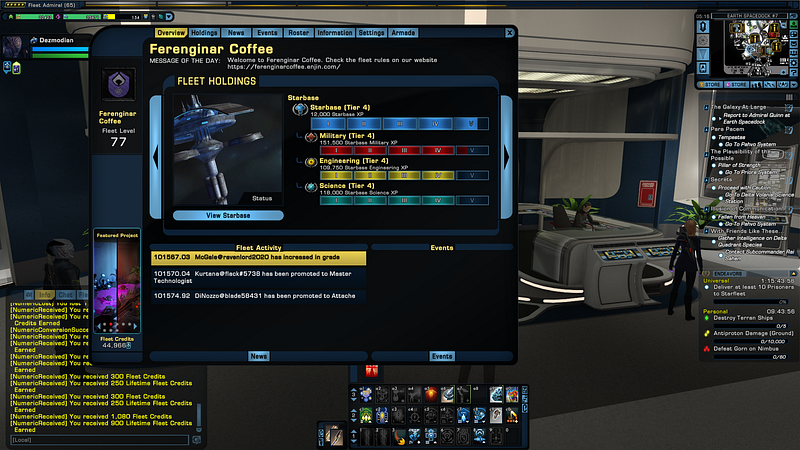
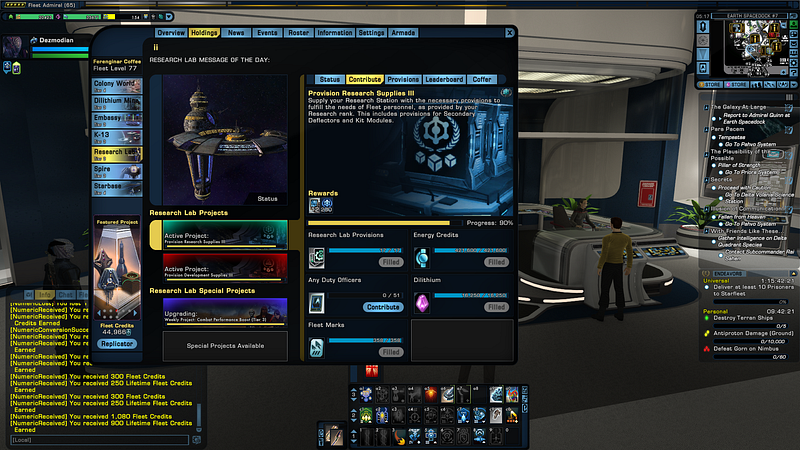
Here in Star Trek Online we have the main Fleet Holdings (left) that shows the specific projects for the main starbase. On the right side you can see a project’s development status in the Research Lab facility: Provision Research Supplies III, which happens to be the active Science project there. Each facility has several projects the guild leader sets up as ‘active’, and we all work on it. I think this is a great system to keep in mind because, ultimately, it keeps us busy for a very long time while accomplishing mutually beneficial projects.
I will again point to Part 2’s discussion on STO and how they allow a group of Fleets (guilds) to join together as an Armada. I thought that was very clever! For Fantasy genre games this could instead be called an Alliance or a Nation, whatever. The point is that individual Fleets in an Armada can contribute to the other Fleet’s active projects. This should be strongly suggested for such organizations as it further promotes teamwork and long-term investments in the player base.
That’s the thing: keeping the Guild Hall relevant should be a team effort and rewarding to everyone in the guild and Armada/Alliance/Nation/etc. That’s what we want: something that will last decades.
As to the specific projects? Easy enough to come up with, but it has to be at least a little relevant and meaningful. So first step, look at real-life long-term projects and you’ll probably see one thing first: wear and tear. More than just polishing chrome or pulling weeds, building infrastructure might need to be replaced due to earthquakes, erosion, concussive vibrations from enemy fire creating cracks in the walls, clearing the rain gutters, seasonal event repair, cleaning up after that huge party last night, whatever. Adding a little humor to the tedious stuff will be appreciated.
A Nexus and Launching Point Here is a thing to consider: Guild Hall as a nexus. GW2 accomplishes this with the portal device. Warframe provides a Navigation room. STO just adds destinations to the Fleet Holdings transporter. This could be another way to make the Guild Halls relevant through expansions as well: a Nexus Hall to provide links for travel to current regions of interest. This could also play into tasks to keep the players busy by maintaining these links.
While highly dependent on the situation, maybe one thing to add would be projects to help focus the destination of those nexus links. If you have a portal that goes to a region of interest, maybe the level 1 version has an undesirable exit point (random in an area, usually in a spot too close to hostiles, etc). Improving that nexus link could help focus where it goes. The difference could be the accuracy of a grape-shot catapult vs a scoped sniper rifle. At the very least, having a place where the guild can gather before departing to a group effort would be desirable.
Real Money Discussion
I strongly suggest that every MMO always avoid “Pay to Win” strategies. The only reason PtW is adopted is to cash in on the whales, and we all know it. Don’t do that. This will erode player interest from the start, and seriously damage it if it's introduced to an existing system.
Even with offering microtransactions for cosmetics and elements of housing, consideration for Warframe’s model should be forefront: everything purchasable should be something the player can acquire in-game. That doesn’t mean it should be easy to get the items in question, of course, but equal opportunity is a great sense to maintain among all of the players. Even (or especially if?) things are offered seasonally, it’s still a chance and supports fairness.
The player base is varied. Some of us have full-time jobs with disposable income piles of various sizes, others are students with enough money to buy Raman for the week's dinner, and some of us aren’t old enough to have bank accounts. Clearly, games like Warframe and Path of Exile are doing quite well enough to fund their own development while not demanding subscriptions, so there is a good way to go about integrating real-world money into the game without breaking it.
Other games have had issues with this, and it is reflected in the game’s economy. Eve Online and World of Warcraft allow players to buy game time tokens that can be sold on the market for in-game currency. Other people have gone into detail about how this has negatively affected the game’s economy, but suffice it to say this is not a great path forward.
Subscriptions turn people off to a game. If the real-world economy takes a downward turn, game subscriptions will be cut (well, let's be honest, that depends on our individual levels of fanaticism… I mean, dedication!). And let’s continue to be honest: without a forced subscription to play the game, many of us actually spend more on the game than that subscription would cost otherwise, lol! That’s the difference: happy players can spend more, especially if we really like the game.
Additional Thoughts on Player Connection
Remember Part 4 going over WoW’s BfA expansion and the gear that grew with you? That is something to keep in mind, and worth mentioning again here at the end. WoW’s Heirloom equipment also has a bit of a feel for this, but having equipment that someone can get attached to does mean a bit more for some of us (and yes, I say this as a lifelong armorsmith in most games). While others are just fine with swapping out armor and throwing it away like trash, I love to build my armor piece by piece and watch it grow with you.
I remember from old Magic the Gathering was an artifact called Living Armor. Now and again I see that kind of thing, and I love the concept. In a story I’m writing, a blood god gifts the seed of a refined symbiote to her avatar; it’ll grow and develop in a natural (for it) process, but it’ll be augmented by the special materials it gets ahold of (yes, that means the avatar has to eat metals n’such haha). Something like that could be interesting to see in a game: player choice to give up constant armor swapping for a living armor (or biomechanical suit, inter-dimensional ferro-organic entity, silicon-based symbiote, or a dozen other variations) that grows over long periods of time, consuming normal armor drops for incremental (or even temporary?) power boosts. Or even harvest living shells of volcano snails (Chrysomallon squamiferum, it's real-look it up!), there are all kinds of scenarios to imagine. I have never seen something like that done, but I think that could be refined into a very interesting element of a player’s armor!
At Long Last…
Alright, that’s about good, I think! All of this really boils down to a realization that we are social animals. We like having other players around, even if it’s just to compete against. Forming lasting bonds with other players has changed many of our lives (I met my wife in WoW, as I shared in Part 1), for better and for worse (not every experience is good, sadly). This, all of this, is an effort to help show that there is a mutually beneficial effort between player and company that can be brought into balance.
Something I think we all know, and should repeat once in a while when considering development: legacy. That word is one of the most powerful and important ideas our species can hold on to. Not to get too deep here, but from our real lives up to our in-game avatars, when you think about it, our legacy is something we are constantly trying to build and share. From worldwide Esports guild recognition to just something you yourself are proud of, the legacy lives on to inspire others. Accomplishing that legacy with a group of friends can be one of the greatest joys of our lives!

This article is the final part of a discussion that began here:
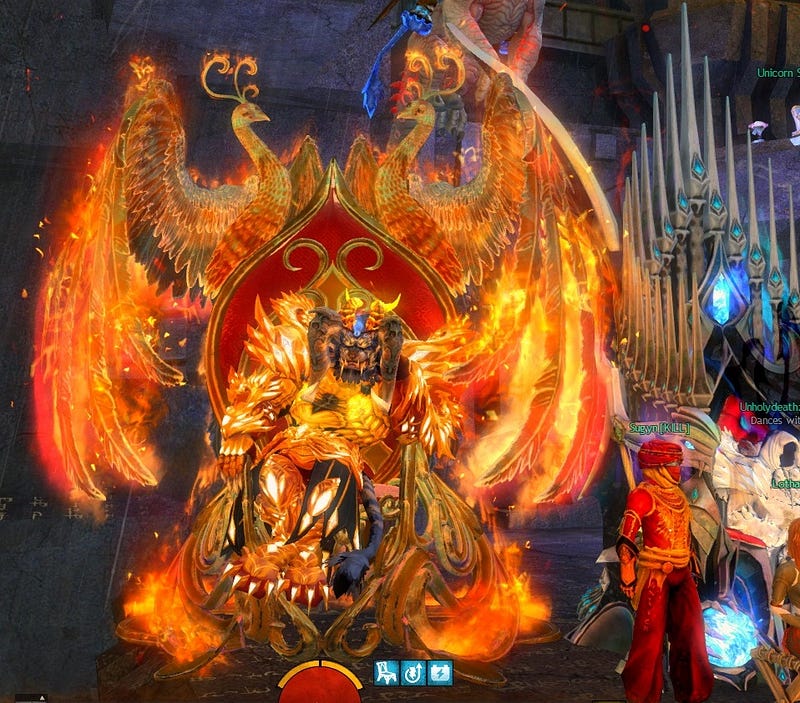
And now, I’ll take a moment to sit in my chair to judge those who do not implement player housing or guild halls in MMOs. There is no excuse these days, and you are only missing out on development funding opportunities.
If you enjoyed this, I have a few more game-related articles! (I’ll be writing more as time permits):