
Memoir
Home in Pink High Heels
Alone at midnight
Dear Kathy,
It’s been forty years. A long time since we were teenagers. I hope this letter finds you well.
Like you, I am happy to let friends come and go — especially go. But there’s something that keeps coming back to me and it puzzles me and it’s why, after all these years, I’m writing to you. You’ve probably forgotten it.
Before I remind you, I want to say sorry. Sorry for my behaviour.
We had just turned sixteen, and we had gone to that pub in Wimbledon, the one opposite the theatre, to celebrate leaving school.
We’re in the phone box on the London Road. It’s chill and damp and has that phone box smell — a mixture of wee and the cold coin stench of the receiver.
We are crammed. You with your face white, your eyes slits, shouting in your panic, almost hysterical to your mum. An excuse about the bus, a despair about buses, trying to appeal: if only the buses weren’t so…
I had never seen you less than calm and able: algebra, chemistry, diagrams of the heart — you never faltered. Only D H Lawrence made you hesitate. And yet you were almost weeping.
And me laughing, laughing when you put down the receiver.
This is where I get stuck.
Why did I laugh? I’ve thought and thought and I cannot read my mind that night.
You had to be home by twelve. What difference did fifteen, twenty minutes make? You were on the home straight. Three, four stops and you were — no doubt your mum was in her dressing gown at the gate. You had the easier ride in every way.
You did not say goodbye when I got off the bus. You were deep in your fretting. I had to cross to the other side of town and wait for another bus.
Remember the roundabout? By day it was a whirligig of cars, entering, leaving, sliding past each other, but that night in Woolworth’s grey windows, it was an island in a grey sea. The fish and chip shop was dark and shadowed, and its window threw back my white trousers and blue jumper as I hurried across the red circle of the Underground. All the bank doors were closed; they looked as if they had never been opened, as if they were always sealed and barred.
I wonder if you remember that old woman who had been at the bus stop the day before, when we had gone to town in search of work? She had a colossal shopping bag and slits cut in her shoes through which her bunions bubbled. She told you off for sniggering at her feet. I would’ve given anything to see that old woman at the bus stop that night. I would even have welcomed her bunions.
I stared at the point of the road where the headlights of the bus would emerge. Several times I saw the headlights, but when I blinked, the road was dark and static. The lack of cars frightened me. Eventually, I went over to the bus timetable. I remember a feeling of foreboding. The timetable was difficult to understand, but I worked out that the last bus had gone half an hour earlier. I was four miles from home and I had on my pink high heels.
Was I jealous? Perhaps a little, that someone cared so much they had set you a curfew. But did I at sixteen see curfew as care? At sixteen, it seemed suffocating.
There was no phone box near the bus stop. Even if I had the right coins, I did not have anyone to call except my dad. But he would only shout that I had woken him and tell me to get myself home. He was no happier since the divorce. I was alone in the dark, even as you were flinging your coat over your banister, your mum still wagging her finger.
The direct route was across the park. If it was daytime, I could take off my high heels and be home in twenty minutes. I walked past the back gates and yard of the municipal buildings. My handbag had no strap, only two metal handles; I couldn’t put it over my shoulder and it had no zip. I worried that my purse and my lipstick and my hairbrush would fall out.
My high heels were slip-ons, and the heels screamed when they hit the pavement. The smoke from the pub in my hair and on my jumper was strong in the night air. You were supposed to be eighteen to enter the pub, but no one cared about us ordering whiskey, did they? That whiskey took all my birthday money except the money for my bus fare. Every week without work was a week of rent I owed my dad. Since the divorce, he said I must pay my way.
Now and then, a car brought a rug of light that quickly disappeared from under me.
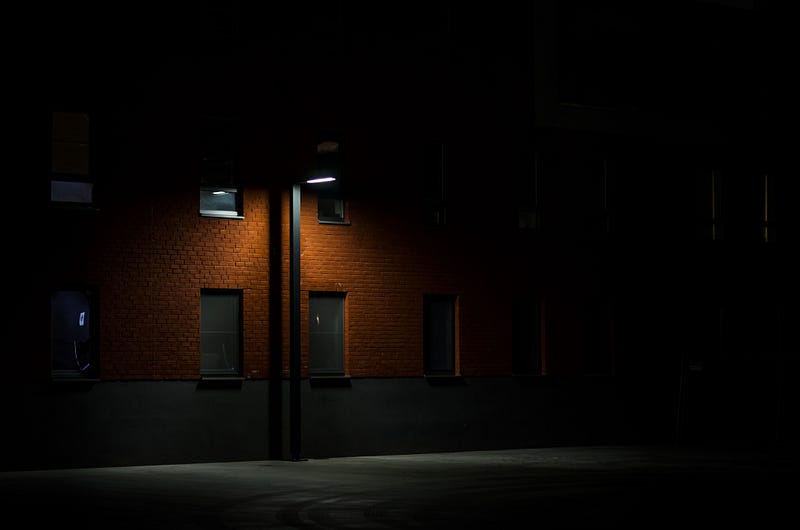
The bridge on Hillcrest Avenue was an enormous quadrilateral of shadow. I ran in the middle of the road and my high heels shrieked and I felt bad for all the people in their beds.
Did I laugh out of dismay, contempt? Now I think I draw close. No chance of me pleading in a phone box. But still here I pause and stare and it escapes me, or refuses to come, a grey fuzzy nothingness instead of clarity.
You admired me because I was always reading books. And I nodded and agreed and said words to fit your idea of me. You were anchored so tight, so secure it gave me a feeling that I too was anchored, being anchored through your anchor.
But you embarrassed me that night. The lack of composure, the dropping of the mask. And you not even aware of how you looked, not able to step outside yourself and view your face. Not cool, not composed, not in charge of yourself.
Did you tell your mum that I laughed and did she bend her eyes and tighten her mouth? Shake her head? And did you agree that wandering in the dark with no coat was my just dessert? No hope, feral…I thought the laughing might help. You might realise it was nothing, being out so late, and you might giggle and relax and feel better. You displayed too much. You want to watch others, not have others watch you. At least my dignity was intact.
Where the road went uphill, I had to clench my toes to stop my high heels from slipping off. The houses on Hillcrest were like my house, walls thick enough to withstand a bit of plate-smashing. Bus stops were milestones. I passed the one where a girl our age often got on. She had dark hair and always a flowered skirt edged in lace.
We would stare at each other, recognising our mutual age and sex. We did not smile nor frown, but drank each other through our eyes. She, so together, so neat with her curls and me, scattered, always scattered and trying to hold the pieces to my centre.
It was certainly the girl’s mum who made the girl’s skirts just as your mum knit your cardigans. I was never sure where my mum was. She was nothing like your mum. Remember that ring she gave me for my birthday? It was a cheek to put it in a box. A paper bag would have been more fitting.
Remember the alley? With the one streetlight and the graveyard of St Mark’s? I took the long way past the shops. They were grey without their lights and customers and potatoes and hair pins and cigarettes. Very different was the bakery with its empty window and empty baskets and dark counter. A bulb shone in the back room of the chemist. A hot water bottle hung on a rack. I did not look at the field opposite the shops, even though I would have liked to see the horse.
That’s when I bumped into the bus conductor.
‘All alone?’ He looked different without his uniform and hat and silver buttons. His face was yellow as if all the time spent on buses breathing cigarette smoke had saturated his skin.
‘Yes.’
‘Bit late for a walk. You should be tucked up warm in your bed.’ He spoke all sugary like he cared for me.
‘I missed the bus.’ I tried to move past him, but I smiled so he wouldn’t think me rude.
‘You young girls.’ He clicked his tongue. ‘You go out for the night, you meet these boys, miss the last bus. Never ends well.’
‘I didn’t meet any— ’
‘Still a virgin, are you?’ That’s when he got very close. His eyes pricked all over me. ‘I’ll carry that for you.’ He grabbed my bag. He did not know that my lipstick and hairbrush, and my purse with my bus fare, might fall out. He wanted me to follow him into the field. Despite my shock, or maybe because of my shock, I snatched my bag.
He wasn’t expecting that.
I wasn’t expecting that.
My heart hammered, and blood filled my ears like a tide. I never noticed the screams of my high heels. There were no garden paths and no front doors, only the tills of the Co-op. I expected the bus conductor to run after me, expected to feel a hand around my waist, a hand over my mouth—
I passed the nursing home where we used to go carol singing. I remember thinking how nice it must be to be old and safe, wrapped in layers of curtains and carpets and armchairs and railed beds. I looked behind.
Everything was blurry. The road was empty.
He was gone, and I was back among the houses.
What a relief to twist the key in the door, to see the grey carpet, smell its biscuit smell, to finally fling off my high heels.
In my dressing-table mirror, my face was white and my eyes were big and round. The mirror face was frightened, trembled with terror and shuddered. It was rude of the bus conductor to pry into my sexual status. It was none of his business. It was none of anyone’s business…
Perhaps you do remember?
Perhaps you wake sometimes in the night and remember me as someone who was odd or awkward or damaged or just perverse.
But I made it through the darkness.
I laughed because you knew so little.
I laughed because I had fixed my moorings to a paper boat.
I laughed because you sunk on your maiden voyage.
There was never any doubt I would make it.
I was my own anchor.