Home Decarbonisation
A new lid for an old loft
On my rambling around Portchester, I can well understand how our local economy thrives on its craft capabilities. In the early morning the first signs of life are the vans and trucks of Builders, Bricklayers, Glaziers, Plumbers, Painters, and drive-way Pavers, gearing up for the day ahead. South of White Hart Lane, the area teems with trades for all manner of home improvement projects.
The early spring is a special time for roofers and the loft insulators: for tiles and chimney pots damaged by high winds, not to mention stemming the attic invasions of our feathered friends as they seek out fresh nesting sites.
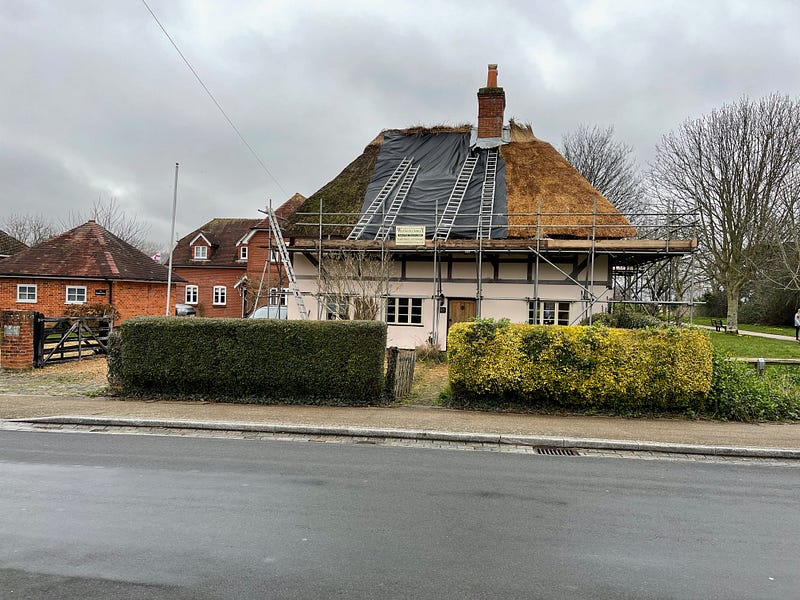
But surely no roofing job can be as daunting as the rethatching of Phoenix Cottage in Castle Street. Owners of thatched properties know their roofing will need rethatching every 25 years — or maybe 30 if they are lucky. It’s an expensive commitment that needs careful financial planning and there are few money-saving short cuts. First choose your thatch — straw or reed. Straw may be cheaper but perhaps best suited to more-frequent top-dressings. Reed will last longer but is increasingly difficult to find. Norfolk reed — traditionally the home-grown reed of choice — rarely now escapes from its East-country home.
The answer for Portchester’s Phoenix Cottage is to reach out to our friends in Europe. Hungarian reed is not only long-lasting but also famously resistant to wildlife. As with so many properties in Castle Street, Grade II listing will mean that Fareham’s Conservation Officers will want reassurance that all work is within the regs. There was a time, not so many decades back, when such standards were not enforced. Many properties are outstanding but just a few stand out like visitors from some alien urban streetscape.
The current Phoenix Cottage dates largely from the 1990’s after a disastrous fire and its Grade II credentials are now mostly hidden from view. For a planet threatened by climate change, today’s housing priorities centre around Home Decarbonisation and, for sure, the thatch provides more than enough loft insulation. Curiously, however, the heat leakage of homes on this precious road, is most notably through single-glazed front windows — a legacy of official resistance to double-glazing on account of those now-outdated, visually inappropriate, plastic-framed solutions. The priorities now, for energy-saving home decarbs, must shift from lofts to windows.
But, for Phoenix, the windows must wait. The thatcher has still to work his way around the property and then finish the ridge with a celebration of artistry that will stand as glorious testament to ancient craft skills that are still in demand. For all the talk about modern technologies, the wellbeing of Portchester’s skills-based economy remains in good hands.
___________
This article was written for Bruno’s Blog, published by local Councillor Gerry Kelly (liberal Democrat) and is listed on the Groupe Intellex Medium channel as ‘Portchester — the place I call home’.