
Hollowed Ground — My Dungeons and Dragons Character’s Backstory
This year I am playing my first ever Dungeons and Dragons campaign (The Wild Beyond the Witchlight). I am completely new to tabletop games but I decided to create a character diary chronicling each session. The following is my character Kate’s life before the call to adventure.
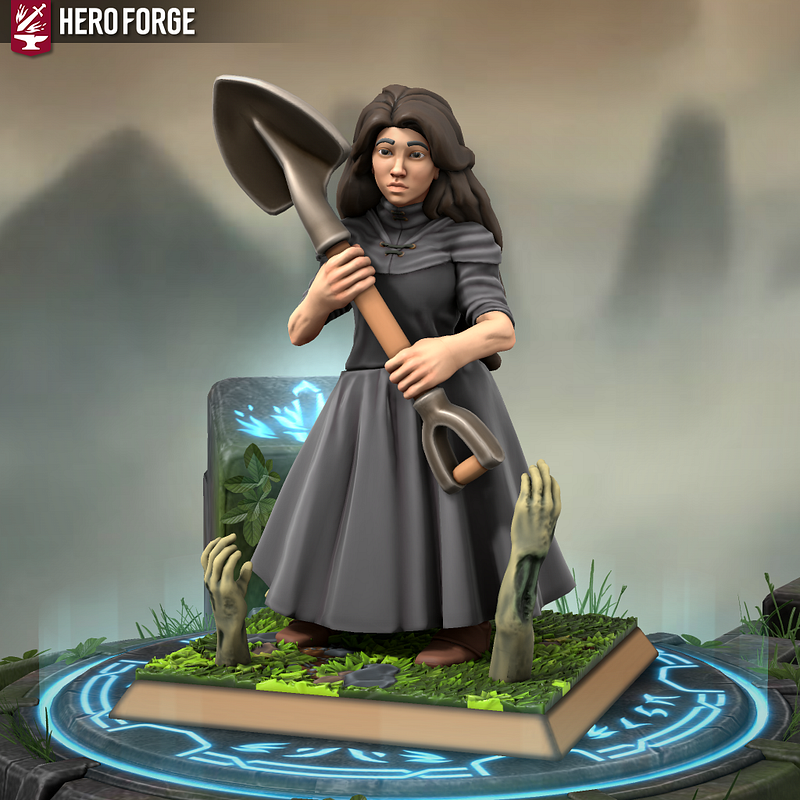
Name’s Kate. I dig graves.
I pay the undertaker Marcus Callaway ten penny a week to sleep in his spare room, but his wife says it’s unhygienic to let me in her kitchen, so I take my meals at the tavern across the street. Ulrich doesn’t mind much. His place is too close to the morgue to harbor the type of guests who mind much who they break bread near. I still make their skin crawl and all, but so long as no one asks them too many questions they’ll keep coming back just the same. And Ulrich knows I never start trouble. I’m not that sort.
Ulrich is happy enough to bring me my boiled potatoes and mushrooms (Paddy Straws, usually, though he has cooked up a Slippery Jack from time to time) without comment. Sometimes he even gives me a little gossip about the other townsfolk. Tells me who’s taken ill enough that I might be expecting work from them soon or what sort of trouble young folk are up to these days. I ignore the trouble but appreciate the tips for work. Ravensgard is a small enough town that there are never quite enough folk to bury.
It was in Ulrich’s that I met Griswold. He tried to sell me an illegal hallucinogen. I told him I wasn’t interested (I knew where I could find the mushroom it was made from even if I did want it). Then I told him I might have some goods he could make a profit on if he promised never to ask where they came from. Now, in the summer months, when work is harder to come by, I meet Griswold at Ulrich’s to pawn the boots and coats I knick from the corpses before I bury them. Once I even managed a gold bracelet. It was a risk, but there were no markings on it, so I took my chance. The corpse’s mother bought it from Griswold and never knew it was the very same one she had buried her daughter in. Course, Griswold only paid me a quarter what it was worth. That’s the price of him not asking where I’d got it from. But I had a handsome pile of pennies saved for a few months and didn’t have to linger near houses where I knew folk were sick, hoping for news.
Unhygienic. That’s what Mary Callaway calls me. As if burying a body were any different than dressing one. As if Algea’s Home for the Unfortunate hadn’t taught me to bathe every day even in the dead of winter in unheated water. “Your suffering is holy, Katherine,” the priestesses said if I ever dared to complain.
I don’t know why they called me Katherine. My name was always Kate. I have no memory of whoever brought me to Algea’s doorstep, whether they were there too in the adult dormitories or whether they had left me there at the god’s mercy and walked away, but I knew I was Kate when I arrived and I was Kate when the priestesses sent me on my way with references to be a scullery maid in a merchant’s household at what they guessed was fourteen.
I remember standing outside the temple, staring at the closed doors, locked out of the only home I had ever known feeling . . . elated. No more long hours washing laundry and dishes until my hands bled, no more nights full of prayers and chants, no more being scolded or even beaten when I couldn’t remember my book learning the way the priestesses wanted me to, no more watching other girls come and go too quickly to remember their names. The younger ones often died of fever. The older ones were usually hired out to work at farms and trade houses. But not me. I was too strong to die and not focused enough to be the sort of worker anyone wanted to hire. But at last, I was too old to live in the children’s ward anymore. Fourteen probably or maybe twelve. No one really knew. So the priestesses gave me references and sent me on my way.
I didn’t use the references. I dropped the carefully worded letter onto the ground and followed the road in the opposite direction of the merchant’s house.
The priestesses would never tell me what to do again.
It was a foolish decision. I needed work if I were going to keep from starving and the merchant’s scullery had been my best chance. Still, I didn’t regret it. I was sure to find another trade. There were few kinds of work I hadn’t done in the temple. Cooking, cleaning, gardening, laundry, sorting. Such tasks were useful to everyone, not just the merchant the priestesses had chosen.
It was market day. The streets were chaotic, full of folks haggling, rattling carts, children screaming. I caught a boy with his hand in my pocket. He sagged when he realized there was nothing in it. I told him I would distract the baker while he made off with some rolls if he gave one to me. He agreed but took off with all six rolls. My stomach grumbled. Had I expected him to keep his word? He’d had such a bright friendly smile.
I ignored my hunger -a task I did often– and set about finding work.
I tried a butcher first.
“Sir,” I came up to his cart, hanging with fowl and legs of mutton and beef.
“Two penny for all four.” He said to a black-bearded man who obediently reached into his purse for the pennies.
I waited for them to finish their transaction and tried again. “Sir,”
“What can I get for you, Mistress?” He said to a lady in an embroidered shawl as if I were not there at all.
I moved along to a cloth stall, selling tightly woven weaves of wool.
“What can I get for you, my dear?” The weaver asked.
“I’d like some work, Mistress.”
Her face fell. “Don’t have any. Not for you, lass.”
“But I -”
“You won’t find anything else so tightly pulled this side of the river.” She said to a gentleman eying some bright blue wool to her right.
I moved along but it was the same at every stall. The dyers, the farmers, the brewers and winemakers, and bakers. Even the taverns. Most ignored or didn’t even see me, others turned me away as soon as they realized what I was after.
Was it the gray dress from Algea’s temple that put them off? Did I look as lazy and insolent as the priestesses always told me I was?
No. The tradesmen were busy was all. They didn’t have time for a stranger who wasn’t looking to buy anything. Their friends had children enough looking for work if they needed an extra hand.
My stomach rumbled, tired of being put off. My feet ached. I sat down, leaning against a cheese stall.
“Be off with you!” A broom thwacked across my shoulders from behind. “I’ll have no beggars here!”
I scrambled to my feet, not bothering to look at the woman shouting at me. I set off down the road, away from the market and swarms of people who wouldn’t give me work.
Dusk was setting in. My feet were sore from walking. The streets became quieter, the buildings more spread out, and then all at once, I was standing among tombstones, watching a tall, burly man dig a hole in the ground.
A good grave takes six to eight hours to dig, depending on the soil and the shovel. It was dusk closer to winter than summer so he must have started just before midday. I watched him dig with a strange sense of fascination as the dirt piled up beside him. There was another grave already dug on the other side of the little mound of earth.
Of all the tasks I was set to at Algea’s Home for the Unfortunate, the one I liked best was digging up the carrots and potatoes out of the garden. I liked the way the earth felt on my hands and the repetition of tilling into the ground. Earth was such a solid thing. Dependable. Strong.
People said the earth was dead but it also created life. Potatoes and carrots and mushrooms and most anything we eat comes from the earth and the more dead things you bury with the seeds –fish eyes or even sometimes a dead worm — the more fertile the soil becomes.
The burly man stopped for a rest. He leaned against his shovel, heaving for breath, and looked up. I didn’t think to hide that I had been watching him. He glowered. “What do you want, you little worm?”
“Nothing.” I answered, then thought again. “Work.”
The man nodded. He wiped sweat from his brow with the back of his hand, smearing mud across his face. “Fire took a family of five last night. Their kin wants them all buried together tomorrow afternoon. If you can help me finish the last three graves in time, I’ll give you stew and a straw pallet to sleep on.”
I picked up the shovel and dug.
A shovel is hard to balance if you aren’t used to it. I dropped it several times and my hands -even used to work as they were -collected splinters like rot collects maggots. My hands are calloused now, of course. I hardly even notice the feel of the wood when I grip my shovel. It balances in my hand like a bailiff’s taxes and if it’s freshly sharpened and I’m working steadily enough I can be finished in five hours. But that was my first grave. Dave Hill — the burly man — had to tell me when I had reached six feet and smooth out the edges for me. It took me ten hours to finish, enough time for Dave to dig a whole grave and a half. When I was done, I was sore from head to toe, my stomach screaming for food, but I jumped into Dave’s last grave and helped him finish. We worked through the night, and it was dawn when we were done.
“Now we fetch the bodies.” Dave said as we pulled ourselves out of the grave. We took a cart and pulled it to the cousin of the family’s house where the wake had been held.
I had seen the dead before but never close up. The girls at Algea’s Home for the Unfortunate who died were carried away covered in sheets. We were punished if we came too close. These bodies laid out on benches inside their cousin’s house were not ominous lumps of sheet in the distance. They were full human bodies. Bits of them were burnt and covered over with makeup so that they didn’t look much the way they did in life, but there was their nose and eyes and mouth, their fingers and arms and hair same as any other person except these ones were dead.
“I’ll cover them before we wheel them out.” Dave said. “Bucket’s in the cart if you need to heave.”
“I don’t.” I took one of the cloths and covered one of the corpses. A girl about my age. There were five bodies, the girl, her younger brother, their parents, and their grandmother. They were all so still. Quiet.
Dave’s lip curled. “It’s unnatural not to get sick your first burial. You done this before?”
I shook my head and lifted the girl carefully.
I understand why most folks fear the dead. No one wants to be dead. You can’t eat or sleep or any number of other things once you are dead. But thing is, fear of death isn’t really the same thing as fear of the dead. Most folk mix it up. Because they don’t want to be dead they don’t want to be near the dead, but unless it’s about to be a zombie or has the plague on it, a dead person is about the safest a person can be. They can’t strike you or rob you or anything. Most they can do is stink bad and you get used to that after awhile. Hunger is frightening. The cold is frightening. A fever or a robber or a zombie or a thrashing is frightening. A dead body isn’t frightening.
Thing is, a body isn’t a person at all. Not anymore. It looks exactly like a person but it’s all empty. You might as well be frightened of a hole in the ground. Some folks weep when I take the bodies away. They want to hold on, as if the person were still inside, but it’s not. The body can’t feel anything or carry messages into the afterlife or anything like that. It’s just a corpse and it needs to be buried.
Sometimes I wonder if the dead folk were ever fussed over before they were the dead or if it’s only after they are gone that everyone cares so much. Seems there’s enough living folk left wanting for love while mourners fuss over their dead.
Dave and I pulled the cart back to the graveyard and lowered them one by one into the holes we had dug, then piled the earth over top of them and pushed their wooden grave markers into the ground. Dave was given four penny for his troubles. I had stew that night and a pallet to sleep on.
I worked with Dave for six months. City had enough dead that he was glad of my help. He kept contact with the undertaker and the nearby temples so he would know when there was work. Dave called me his apprentice. He was never harsh to me but he only ever paid me in food and the straw pallet in his room. I wanted coin of my own and my feet itched to see more of the world now that I was free of Algea’s temple. So I left the city. I didn’t tell Dave goodbye. I took his shovel. The good one he used himself.
When I reached the next town over I had a trade to earn my bread. There is always someone dead and not many folks willing to dig a grave. Not many willing to keep company with a gravedigger, either, but that suits me well enough. I like my own company. Me and my shovel and my own thoughts. Seven towns I’ve dug in. I leave when I no longer feel wanted or when my curiosity prickles up and down my skin to know what is in the next place over. No big temple walls surround me anymore. No rules and prayers and long fancy names that are not my own. I stick to my own self unless I am doing business or talking with a ghost.
Ghosts are a lonely sort. They appreciate a willing ear. Or take advantage of an unwilling one. Had to leave the work in Laksburg when an old soldier ghost wanted to tell me about his battles every time I picked up the shovel. After about a thousand parries and six hundred charges into the frey, I decided it was time to move on. Lisbeth is better company. She’s the ghost in the graveyard in Ravensgard.
A hundred years ago and more Lisbeth’s cousins convinced her to sneak into the graveyard to speak with the town witch who had just died. It was such a small village back then and the months between the harvest dance and winter holidays were long and dull. Lisbeth had relished the chance to sneak out after dark. She had even agreed to be the vessel for the witch’s spirit. Only Olga Wainwright really had been a witch and had riddled her soul with wards and protection spells before she died. Once Lisbeth’s soul tethered to hers the connection broke, but Lisbeth was still in the spirit realm, severed from her body forever. She haunts Olga Wainwright’s gravestone even though her own is on the opposite side of the same graveyard.
Least, that’s how Lisbeth understands what happened. She’s an imaginative girl so it’s hard to say. It had been a very dull autumn and she had paid miserably for her mischief. She hadn’t even had the heart to haunt her cousins for insisting they do the ritual.
“What really gets me” she often says, “is that I missed the winter ghost stories. I was cooking up some really good ones.”
“You are a ghost story.” I remind her.
She sighs. “That’s not the same thing at all. Being a ghost isn’t half as thrilling as telling a good ghost story.”
Mostly Lisbeth doesn’t talk about her life. She warns me when there are grave robbers or zombies around and tells me some of the ghost stories she has been working on. She’s had a hundred years to polish them up, although sometimes she seems to confuse ghosts with zombies. It’s not that she doesn’t know the difference, of course. She is a ghost. She knows they can’t lift things and that they don’t lurch. She just thinks lurching ghosts make a more thrilling story.
It’s strange how Lisbeth is both half and four times my age. She’s been fifteen for a hundred years and still sees the world as a place for mischief and amusement. Not that she hasn’t any heart, mind you. She’s the one who first told me that if you can slice a zombie’s neck in one go, they won’t feel a thing, but she likes thrills and pretty things and is always inventing new games. She reminds me of . . .
Well, that’s best left not talked about. They wouldn’t let me take broth to her. Said she had brought the fever on her own self with her wanton ways and frivolity. “Save the broth for the deserving, Katherine” They had said, and she had died the next day.
It was just as well I suppose. Not much frivolity to be found in day after day of cold baths, cabbage broth, and work until you collapse. It would have broken her big, dreamy heart if she had been at Algea’s Home for the Unfortunate much longer. Not mine though. I was strong. Like earth. I didn’t need games and entertainment. I could survive on little. Almost nothing if I needed. My temperance made me invincible.
Still, I don’t tell Lisbeth to keep quiet when she tells me outlandish ghost stories or prattles on about the butterflies. It doesn’t bother me the way Colonel Drake’s rambling about the wars did.
The townsfolk say I’m a witch of course. It’s not original. They always whisper about me being a witch or a necromancer or sometimes even a zombie. In one village I made the mistake of eating a meat pie in the graveyard and someone saw and decided I ate dead human flesh. I let them have their rumors. It never does me any harm except for the occasional dirt clod in the face. Children will throw sticks or even stones but their parents are too afraid of angering me. Let them have their rumors. It keeps them away in the end. More time to myself and my thoughts and the endless varieties of mushrooms I find in the graveyards. I’ve counted six different kinds in the two years I’ve been in Ravensgard. Wainston had eight. Larksburg had only two.
Mushrooms and earth and the occasional chatter of ghosts. I want for nothing. My world is complete and safe and as holy as the priestesses of Algea’s Home for the Unfortunate could have hoped it would be. After all, I work on hallowed ground.
Thank you for reading. If you want to read the rest of Kate’s journey you can read it for free through my newsletter. I will be sending out monthly diary entries as we work through the campaign along with updates on my other dark fairy tale stories. Click here and scroll to the bottom to subscribe.


