
Holding On to Hope — What Happened to South Africa’s 1994 Miracle?
GiaB prompt #18: history
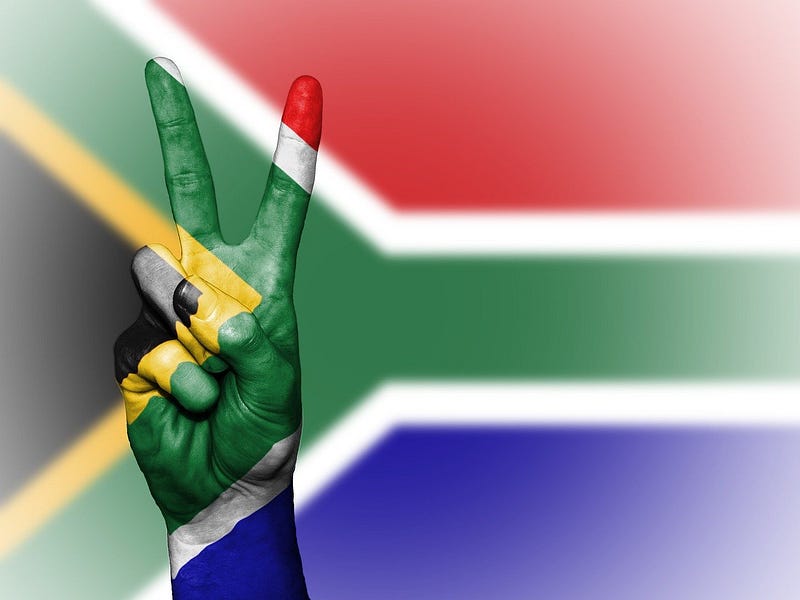
Today, April 27, we celebrate Freedom Day to remember that historic day twenty-seven years ago when races mixed and queued together to cast our ballot.
Following a series of tense negotiations and years of liberation struggle, South Africa held its first democratic election on April 27, 1994.
My husband and I took part.
What a magical day it was!
Although whites with permanent residence in the country could vote, we took our responsibility a step further. We applied for and received our South African citizenship and pledged allegiance in time for the election.
Desmond Tutu, the renowned anti-apartheid activist and Nobel Peace Laureate, described it as “an incredible experience, like falling in love.”
I’ve lived in South Africa most of my life — since arriving in Cape Town on a Union Castle passenger liner from Southampton, UK, in 1958 with my father and brother.
Even as a child of eight, I didn’t understand why people were treated differently. In my teens, the ugly face of apartheid haunted me. I never became a political activist, and treated everyone with dignity and respect, but my White privilege screamed “Hypocrite!” every day.
The great escape
I arrived back in the UK in 1972 with no intention of returning to South Africa. I couldn’t face the daily reminders of our unjust society; the brutality of a regime that claimed separate development was the ultimate solution.
Away from Africa, an immense piece of me was missing.
At my first job in the UK, the accountant at the company was a black South African. He asked why I’d left. I told him I couldn’t tolerate living in a country that suppressed people.
“But I’m so homesick for Africa,” I added.
“I cannot go back, but you’re free to go,” he replied.
“Heal your heart and go home.”
No judgement or envy — my joy was his joy.
That’s the spirit of ubuntu — I am because you are.
I returned home in 1975.
Black schoolchildren kindled the first glimmer of hope in the Soweto Uprising in June 1976. That iconic photo of Hector Pieterson, shot dead by police, hit the world headlines.
That image of a child shot dead shocked me and many white South Africans who had been complacent and blind to what was happening in the townships. They could no longer ignore what they couldn’t see. That photo is etched in my memory.
I embraced patience and stayed, knowing the path to freedom beckoned — slow in its coming but worth the wait.
The Nationalist Party didn’t invent racism
Colonists and missionaries across the globe believed the white race had to conquer indigenous tribes and nations who had been on this planet for thousands of years; their ambition was to “tame the savages”.
Since the apartheid regime came to power in 1948, they strengthened and institutionalized existing discriminatory and segregatory policies and bills which had been in force since 1859 under the colonial rule of the British Empire.
I’ve tempered my anger when politicians keep harping on the legacy of apartheid twenty-seven years later. Revisiting how life was during those years, I understand that healing the hurt of centuries takes generations.
The Black Lives Matter movement arose to highlight the systemic racism still present in the United States, the UK, and elsewhere in the world, including South Africa.
Quo Vadis Rainbow Nation?
The promise of a better life for all remains unfulfilled.
Our Constitution is under threat from the corrupt, who prefer wearing Armani suits and driving Ferraris to being locked away clothed in orange overalls. Former President Jacob Zuma refuses to appear at the Commission of Enquiry into State Capture, chaired by Deputy Chief Justice Raymond Zondo.
Under the tutelage of the Gupta brothers, Ajay, Atul and Rajesh, the ruling party crippled good governance at every level. Their pursuit of business or politics for personal gain, at the expense of the poor, gave birth to State Capture.
In 2018, the United States sanctioned the Gupta brothers under the Magnitsky Act.
On Monday, April 26, UK Foreign Secretary Dominic Raab announced the UK’s first sanctions under the new Global Anti-Corruption regime. The twenty-two names include the Gupta brothers and their sidekick, Salim Essa. They’ll no longer be able to channel their money through UK banks or enter the country.
I’m staying — with hope for a better future.
“To be free is not merely to cast off one’s chains, but to live in a way that respects and enhances the freedom of others.” — Nelson Mandela.
Thank you for being here and my deepest gratitude to Victor Sarkin for this well timed prompt!


