
Political Philosophy
Hobbes’s Social Bargain
Hobbes’s philosophy of government was a draconian social bargain to protect the peace.
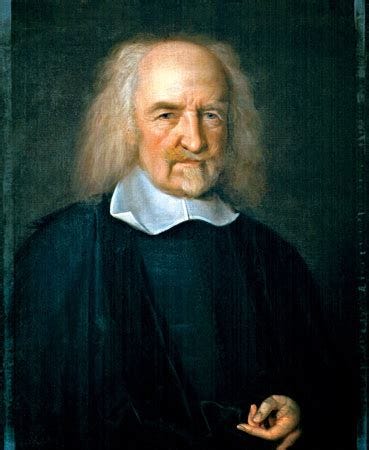
Thomas Hobbes (1588–1679) was an English philosopher who, like all good philosophers, sought to identify the fundamental principles on which to build a better society. Hobbes thought that one of those fundamental principles was that there exists nothing but matter. Hobbes was an uncompromising materialist and determinist who insisted that the universe is nothing but material bodies in motion. For this he was and still is often mistakenly considered as an atheist because he said even God was material and subject to material causation. He was not hostile toward God or religion, but he did bring them into line with his radical materialism.
Individual and Political Bodies
Hobbes’s political philosophy is consistent with his materialist epistemology. He believed that reality can be divided into two types: natural bodies (people) and political bodies (society, nations). Natural forces act on and determine the behavior of both types of bodies. Hobbes believed that every event in the universe is necessarily determined by prior causes. Societies and nation-states are collections of individual human beings. Each person is like a stone, and a society is like a bag of stones. Just as physical laws of nature govern the movement of stones, those same physical laws of nature govern the movement of human beings. Hobbes hoped to be able to apply the methods of his physics to human society. After all, if a human was a material body that acted in response to physical laws, and a human society was then simply a collection of human bodies, then the laws that govern human social interactions could be formulated the same way Galileo formulated the laws of motion. The more we understand the laws of motion, Hobbes thought, the more predicable are the movements of material bodies, including human beings and societies.
Human bodies may seem to act purposefully and independently, but this is not true, Hobbes says. Humans are governed by two endeavors: desire and aversion. Desire is the compulsion humans have to move toward something, and aversion is the compulsion humans have to move away from something. In short, humans desire pleasurable experiences and are averse to unpleasurable experiences. These two simple endeavors govern all human actions. When humans seem to reason and deliberate between choices of possible actions, what is happening within the human is the conflict between competing desires and aversions. The human is being pulled and pushed, and whichever force is the stronger will prevail and cause the human to move. Every human being is like a cork on the surface of the ocean buffeted by the winds and currents, mechanically determined by all of the forces acting on it.
Because Hobbes believed in this deterministic view of human behavior, he saw all of human society as deterministic. Because he believes that the endeavors of desire and aversion govern all human beings, he sees all of human society as governed by the endeavors. Therefore, to create an orderly society, one needs to control the forces affecting the particular human bodies in it, and that will translate to controlling the body that is society. In terms of politics, Hobbes saw there being two primary endeavors at work. Humans desire peace and stability and are averse to chaos. These two endeavors underlie all of the other many endeavors that act on humans, such as desires for food, water, and shelter and aversions to discomfort and suffering.
Hobbes’s Thought Experiment
To understand how best to govern society, Hobbes thought it best to imagine how life would be if there was no government. This he called the “state of nature,” living without any laws or social conventions. In this condition, no one has any rank or status or any of the associated rights, privileges, or restrictions. In the state of nature, there are not the class distinctions that were a given in British society at that time. Hobbes’s purpose is to understand what forces are at work on humans prior to social conventions being created. It is important to remember that Hobbes is not necessarily saying that there actually was a “state of nature” from which human society emerged. His is a philosophical thought experiment that he describes in his book Leviathan.
Without social conventions in Hobbes’s state of nature thought experiment, everyone is equal, and life consists only of material facts and forces (there are no laws and rules to stop anyone). Everyone has “a right to every thing,” Hobbes says, “even to another’s body.” Hobbes’s use of “right” is curious to us today because we think in terms of moral and civil rights. By “right,” Hobbes means a “freedom based on power.” In other words, if I want your food, I have a right to take it if I have the power to do so. Of course, you have a right to stop me, if you have the power to stop me. The power in question includes physical violence. In the state of nature, there are no laws and no police to stop us from wounding or even killing each other as we struggle to take for ourselves the world’s finite resources.
Hobbes’s view of human nature is that we are inherently selfish. We have no inherent sentiment for others, and altruism is not natural. Buffeted like corks on the ocean by our own desires and aversions, we think and feel first and foremost about our own needs. In the state of nature, humans are bodies moving and colliding, their desires and needs coming into constant conflict, each particular human compelled by the endeavors to survive by whatever means necessary. Like a postapocalyptic movie, everyone in the state of nature is seeking advantage over others, even dominance. Those with superior physical strength have an advantage, but they have no guarantee of safety because, as Hobbes pointed out, even the strongest person can be overcome when weaker people combine their power to take down the stronger.
No surprise then that the state of nature is a miserable existence dominated by fear and chaos without peace and stability. Hobbes summed it up this way:
In such condition, there is no place for Industry; because the fruit thereof is uncertain; and consequently no Culture of the Earth; no Navigation, nor use of the commodities that may be imported by Sea; no commodious Building; no Instruments of moving, and removing such things as require much force; no Knowledge of the face of the Earth; no account of Time; no Arts; no Letters; no Society; and which is worst of all, continual fear, and danger of violent death; And the life of man, solitary, poor, nasty, brutish, and short. (Leviathan, I.XIII.9)
Every person is an enemy to every person. If anyone thinks this portrayal of humanity without laws and conventions is exaggerated, Hobbes points out that we already know this is how people are. We lock our doors at night and lock away our valuables, and this is when we know there are laws and police. This shows our true opinions of our fellow humans, Hobbes says. How much worse would other people be without laws and police? It would create a war of all against all, in which nothing is unjust and thus nothing is off-limits.
Fortunately, there is a way out of the nasty chaos of the state of nature. This is partly why Hobbes engages in the thought experiment about the state of nature: to explain how human society came about. The natural forces of the endeavors led humans to form a society and a government. The first endeavor for all humans is the desire for peace. This, Hobbes says, is the first natural law: to seek the peace and follow it, or, failing that, be prepared to defend oneself by any means necessary. This is true, even for the strongest man, because no human is so powerful that he or she cannot be overcome by others. Peace and safety cannot be ensured by individual strength.
When Hobbes says, “seek the peace,” he isn’t meaning some flower power love and understanding thing. He’s thinking in terms of his theory that people are governed by desires and aversions. We want to be left alone with our food in our shelter. We don’t want to have someone break in and steal our food. We certainly don’t want to be beaten or killed. We want to be left in peace. Simple as that. Hobbes calls it our desire for ease, and we can understand this. We want things to be easy, and we desire to be at ease, without strife and conflict.
The first law is to seek the peace, and the second law follows from it: To achieve peace, one ought to surrender all of one’s rights, provided that everyone else does the same. Remember that this is Hobbes’s definition of “rights” as meaning “freedom based on power.” I will give up my freedom to do whatever I want if you agree to give up yours. I won’t steal your stuff if you won’t steal my stuff. I won’t kill you if you won’t kill me. This way, we can have peace rather than constantly fighting over resources. This agreement, in its essence, is a cease-fire between warring parties. This bargain of necessity is one of self-interest — again desires and aversions.
But what would stop someone from breaking the agreement to surrender his or her rights? There is no honor among thieves, it is said with much truth. If, as Hobbes says, we care only about our own desires and aversions, why would we keep any agreement to limit our freedom? Sure, I can agree to not take your stuff, but I can still do so when your back is turned. Hobbes is aware of this problem, and he provides an answer:
There must be some coercive power to compel men equally to the performance of their Covenants, by the terror of some punishment, greater than the benefit they expect by the breach of their Covenant. (Leviathan, I.XV, 3)
People are just bodies in motion for Hobbes. You make them do what you want by exerting force on them. Control the endeavors that compel humans to move a certain way, and you control the situation. Human freedom of action is based on power, so a stronger power needs to control it. Humans are averse to suffering, so put in place a force strong enough to make humans averse to breaking their agreement to limit their freedom. This coercive power, Hobbes says, is a particular form of government that has absolute power.
The only way to compel others to obey their agreement is when everyone agrees
to confer all their power and strength upon one man, or upon one assembly of men, that may reduce all their wills, by plurality of voices, unto one will. (Leviathan, II, XVII, 13)
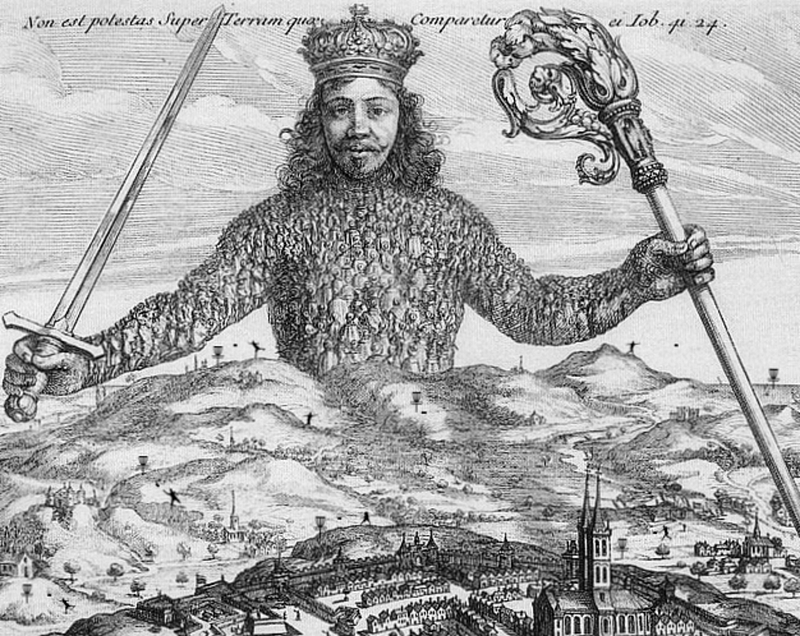
Hobbes takes the old Roman idea of the “body politic” and interprets it literally. A nation is a body made up of all of the particular humans living in it. A human body could not survive if the various organs and bodily parts were at war with each other. The body politic of the nation is the same. Only by reducing all of the wills of all of the humans to a single will personified by one man, the Sovereign, can the nation survive. The Sovereign is the absolute ruler of the nation, who possesses all power and all freedom to act on behalf of all of the humans within the nation. Hobbes takes this quite literally as shown in the title plate of his book Leviathan. Looming over a British town and its surroundings is the Sovereign, whose body is made up of the bodies of all his subject humans. Their will and voices are subsumed in his. He speaks and acts for them. His word is law, and he is the coercive power that will compel humans to live up to their agreements.
Hobbes’s proposed political arrangement has come to be known as a form of “social contract.” The contract is between all particular humans. Everyone gives up all of their rights and freedoms and confers them on the Sovereign. In return, the Sovereign guarantees peace and stability, which, Hobbes thinks, is what everyone wants more than anything. Anyone who acts contrary to the agreement by breaking the laws of the land will be dealt with by the Sovereign who also acts to protect the nation form foreign invaders.
What’s to prevent the Sovereign from abusing his power? Hobbes doesn’t say. Like Plato long before him, Hobbes believes that those in power will act according to reason and natural laws and, thus, act only in the interests of the nation. Plato understood that people have free will, but believed that no one would choose to do bad deeds if they knew they were bad. Hobbes denied free will, but he seemed to assume that the force of the common power of the social contract would compel the Sovereign to act only to benefit the body politic.
If all of this seems far-fetched to our thinking now, remember that Hobbes is thinking in the 1600s. This was the age, on the one hand, of monarchism and absolute government and, on the other hand, of sectarian violence and rebellion by elements of the aristocracy against the monarchs. Political chaos was a constant threat, and Hobbes, among other like-minded thinkers of his time, thought that the only way to stop the fighting among the aristocracy for power was to concentrate power in one man — the king. Hobbes saw as his model the Kingdom of France. In that nation, Louis XIII had consolidated political power and elevated France to a world power. After a 33-year rule (1610–1643), his son, Louis XIV continued his father’s program of absolute monarchy and ruled as Sovereign for an amazing 72 years (1643–1715; his successor, Louis XV ruled another 58 years). Hobbes wrote his political theory in Leviathan in France while exiled from England during its civil war. Hobbes’s thinking in the early years of Louis XIV’s rule was no doubt influenced by experiencing the Kingdom of France on the rise, sheltered from the turmoil in his English homeland.


