
History of Philosophy
History’s Most Influential Philosopher?
Probably not who you’d guess
Join Medium to read great articles from independent writers.
In asking the question of who is history’s most influential philosopher, we’re looking back at the entirety of history, not who’s the most influential today. Across the 2,400 years of Western philosophy, one philosopher’s writings have had the most direct influence on the most scholars over the most years.
Accidents of History
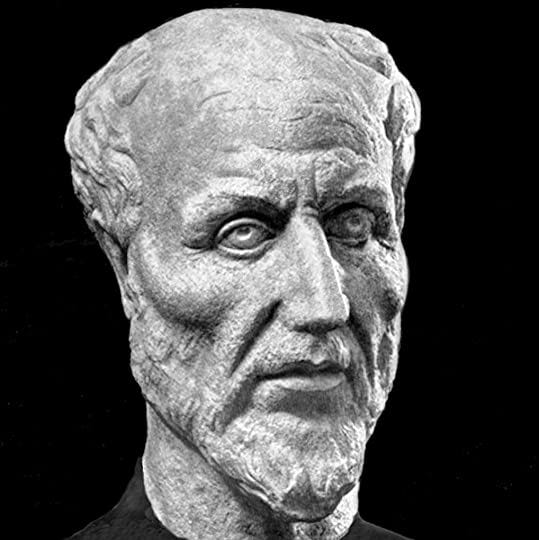
Believe it or not, Plotinus (204–270 CE) is that single most influential philosopher in European history. Yes, even over Plato and Aristotle. That’s because Plotinus was very widely read by scholars starting in the 200s CE, and for more than a thousand years Plotinus was the chief means by which they understood Greek philosophy. Plotinus cosmology of a Divine Intellect above and beyond the world inspired Christian philosophers to synthesize Greek philosophy with their religion.
Compared to what we have today, people in the medieval period had very few of Plato’s and Aristotle’s writings. Those in the West did not have much at all of Greek philosophy because the great works of the philosophers were lost to them. By the 400s, the only work of Plato available in Latin was Timaeus, giving people an incomplete view of Plato.
Aristotle’s books fared only slightly better and thanks only to the efforts of Boethius (477–524), who translated into Latin and wrote commentaries on Aristotle’s logical works. Thus, the West’s supply of Aristotle’s genius included only his logic that informed philosophical dialogue, with none of his insights and theories on metaphysics, physics, ethics, politics, and aesthetics. Without knowledge of Aristotle, the student of the natural world, they had a very incomplete view of Aristotle.
These accidents of history left Plotinus as a central philosopher for Western Europe. His book, The Enneads, was a more developed version of Plato’s Timaeus. Its vision of a perfect heavenly realm and our imperfect world fit well with other ideas that were then common, such as those of the Stoics and various religious groups at that time such as the Gnostics and, of course, Christianity. Plotinus offered a rational view of the cosmos and human nature that made a lot of sense to medieval scholars.
Plotinus’s Ideas
Plotinus’s most influential views are that the source of all is the One and that the divine light of reason emanating from outside of us is what allows us to understand anything. For centuries, Plotinus was known to be a Platonist, and scholars having access only to Plotinus assumed that Plotinus’s philosophy was an expression of Plato’s. Obviously, he was inspired by Plato, but he took Plato in a new direction. It helped that Plato’s writings were lost, allowing Plotinus’s cosmology to hold the field, making him so influential.
Plotinus went beyond Plato in dividing reality into three, not two, levels. At the top was the One. The One is Being itself — the immaterial first principle that is self-caused and the cause of all other beings. At times, Plotinus equated it with Plato’s Good, and at other times, he suggests that the One preceded the Good. The latter is consistent with Plotinus’s view that the One is so fundamental to everything that it is beyond all attributes, and, therefore, calling it “good” would be applying an attribute to it. The One is pure Being. All we can state about the One is that it is. All that we can deduce about it is what it is not. Calling it “the One” is the least inappropriate.
The One is the source of everything. It needs nothing, desires nothing, and thinks nothing, but it is so full of Being that that it overflows and all things are an emanation from the One. An emanation is different from a creation. A creation is an act of will. An artist creates, a builder creates; creation is a product of a deliberate action. An emanation comes out from a source, but the source does not act or will it. A creation occurs in time and space, but the emanations from the One are beyond time and space. If that’s difficult to understand, that’s because it is beyond human understanding except for the result. We can only point to the reality that all that exists emanates from the One. Plotinus borrows Plato’s analogy of the sun to describe the One. It is the eternal light that illuminates everything without being diminished by doing so. The One is in all the myriad things like white light is behind all the colors of the rainbow.
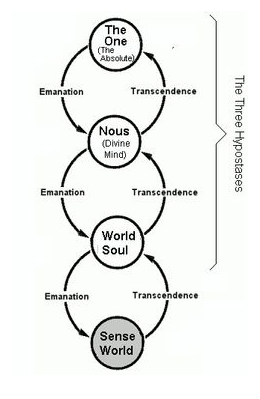
The first emanation (in terms of Beingness, not in terms of time) from the One is the Nous, Intellect, or Divine Mind. Intellect is eternal and immaterial like the One, but it is not the One. It is a perfect overflowing emanation of the One. As Divine Mind, it intuitively — meaning immediately and without effort — knows the One and knows itself. The One cannot know itself because that creates a dichotomy of knower and known, but Intellect can know the One, and Intellect can know itself. In knowing itself, Intellect intuits all of Plato’s Forms. The Forms have their being from the One, but their identity is from the Divine Mind of Intellect. In other words, the One gives everything being, and Intellect gives the Forms their distinct essence. This is similar to Philo’s ideas, but Plotinus adds that Intellect knows not only universal Forms but particular Forms. For example, there is a Form of humanity, but also a Form of Socrates, a Form of Plato, and a Form of every individual human.
The second emanation from the One is Soul. It is also eternal and immaterial, and it stands as a connection between the immaterial and material realms of existence. Soul has a higher aspect that looks to Intellect and contemplates the Forms in the intelligible realm, and the lower aspect descends to the visible realm to replicate the universal Forms in particular objects. Emanating from Soul are also the souls and bodies of all things in the visible realm, and Soul unites the cosmos as one living organism. This lower aspect Plotinus equates with Nature and all of life and movement in it. Soul does not consciously order Nature, but what order there is in Nature flows from the rational order of Intellect.
We people are aspects of Soul, similarly divided into higher and lower aspects. Our higher aspect is our soul (psyche), which mirrors the Intellect, and our lower aspect is our body. Our minds are illuminated by the light of the One, and it is the only source of light; we partially reflect that light in our thinking. For Plotinus, like for Plato, our individual souls existed prior to our material birth, and our souls will survive material death, returning to the One. Our material bodies are, of course, composed of matter. Like Aristotle, Plotinus sees matter as amorphous and characterless, devoid of form. Unlike Aristotle, Plotinus sees matter as deprived of Being. Plotinus justifies this odd characterization with his analogy of the One as the sun. The sun gives off light, but the farther one is from the source of light, the more diminished is that light. The One is Being itself, but the farther one is from the source of Being, the more diminished is that particular being. Matter is removed from the One, further than Soul and Intellect. Again, this is not in terms of time or space but in terms of Beingness. Having also equated the One with Plato’s the Good, Plotinus also implies that matter is also deprived of good. It’s important to realize that this is not saying that matter is evil. Plotinus didn’t believe in evil as a cosmic force. Like darkness is merely the absence of light, what we call evil is merely the absence of good. Matter, like darkness, is absent Being and goodness.
None of the emanations to which Plotinus refers are deliberately willed. They simply happen, emanated like a magnetic field emanates from a magnet. This means that reality is not the conscious products of a creator deity. The world and we as we know them simply are, and they simply are the way they are. The cosmos is, though, based on reason. It has a rational order. Part of that order is that we humans are part intellect and part body. Our intellect is from the divine Intellect, and with discipline and focus, we can connect with it. Our material bodies are not evil, but in the order of reality, they have less Being and goodness than our intellect has. In the rational order of reality, we are faced with the choice of whether to focus our attention on our intellect, which is closer to the One, or on our body, which is farther from the One. We want to be closer to the One — the source of all Being and goodness; and it is to the One that we wish to return. The problem is that our material bodies are an impediment to returning to the One. Plotinus says that we have fallen into the lower material realm because of our vanity and desire for independence. Plotinus likens our arrogant ignorance to the prisoners trapped in Plato’s allegorical cave. If we focus on our bodies and the material world, we are strengthening our own chains and alienating ourselves from the higher realm.
Thus, Plotinus teaches, the more we concentrate on reason, the more we will understand what is real and good and the more we purify ourselves. To not be rational then, is a sin. This is not a religious idea, however, because it is not about needing salvation from a deity or a church — we are our own salvation through our dedication to wisdom and truth. Dedication to reason shall set us free. These ideas inspired religious and nonreligious thinkers, philosophers, writers, poets, and scientists for centuries, and it still reverberates today. Although we will not hear the name Plotinus mentioned often, if you pay attention, you will see his view of the universe holding sway over philosophy, religion, science, and culture into the 1800s.