avatarMr. K

Free AI web copilot to create summaries, insights and extended knowledge, download it at here

2788

Abstract

n), to a large family from Grodno Governorate. He was the descendant of a Polish noble Catholic landowner.</p><p id="88f3">In 1875, Ignaty Grinevitsky went to St. Petersburg to go to the Polytechnic and study math.Soon after, he joined the Russian revolutionary movement Narodnaya Volya, which translates as “People’s Will.”</p><p id="2798">In 1880, a group of young Russians led by Ignaty Grinevitsky, Andrei Zhelyabov, Sophia Perovskaya, and others carried out revolutionary political propaganda among students and workers. Ignaty Grinevitsky became well-known for starting the Workers’ Gazette and working at a secret printing press as a typist.</p><p id="085e">In February of 1881, Ignaty Grinevitsky became a member of the bomb-throwing unit that had been organized to carry out the assassination of Tsar Alexander II.</p><p id="5864">Grinevitsky had written the final message the night before the murder he was about to commit.</p><blockquote id="c0ce"><p>The note from the 25-year-old Grinevitsky reads: Alexander II must die. He will die, and with him, we, his enemies, his executioners, shall die too […] How many more sacrifices will our unhappy country ask of its sons before it is liberated? […] It is my lot to die young, I shall not see our victory, I shall not live one day, one hour in the bright season of our triumph, but I believe that with my death I shall do all that it is my duty to do, and no one in the world can demand more of me […]</p></blockquote><figure id="5863"><img src="https://cdn-images-1.readmedium.com/v2/resize:fit:800/0*wp3shVczwOYyyr0c.jpg"><figcaption>Tsar Alexander II, photographed by Sergei Lvovich Levitsky in 1881. (The Di Rocco Wieler Private Collection, Toronto, Canada). Public Domain, <a href="https://commons.wikimedia.org/w/index.php?curid=21953331">https://commons.wikimedia.org/w/index.php?curid=21953331</a></figcaption></figure><p id="873b">On March 13, 1881, Tsar Alexander II traveled in an armored and bulletproof chariot as an armed Cossack sat next to the driver of the chariot. The remaining six Cossacks followed on horseback behind the king’s chariot.</p><p id="7ce1">As the Russian king’s chariot approached a street intersection near the Catherine Canal, Sophia Perovskaya signaled Nikolai Rysakov and Timofei Mikhailov to detonate their 2.3 kg bomb. The bomb attack by Rysakov and Mikhailov, however, did not harm the Tsar who was on the train; only two individuals surrounding him were harmed.</p><p id="d31e">When he witnessed the tragedy, Tsar Alexander II insisted on leaving his chariot to examine the injured. Soon after, his decision resulted in his own death. Ignaty Grinevitsky saw a perfect opportunity to carry out a suicide bombing as soon as Tsar Alexander II got out of the carriage. Just before he threw

Options

the bomb, Grinevitsky allegedly yelled out, “It is too soon to thank God yet.”</p><p id="035a">Grinevitsky, who was leaning on a railing near the canal, raised both hands and threw his bomb at Tsar Alexander II from close range, causing an explosion.</p><figure id="8a9b"><img src="https://cdn-images-1.readmedium.com/v2/resize:fit:800/0*FYubgZ3K4ZgtCojZ.jpg"><figcaption>G. Broling’s 1881 depiction of Alexander II’s assassination. By Gustav Broling, Public Domain, <a href="https://commons.wikimedia.org/w/index.php?curid=3743278">https://commons.wikimedia.org/w/index.php?curid=3743278</a></figcaption></figure><p id="22f2">As a result of the explosion, Tsar Alexander II was killed instantly, while Ignaty Grinevitsky was knocked unconscious because he was still within the blast’s radius.</p><p id="fecb">Immediately, Grinevitsky was transported to the hospital connected to the Winter Palace. He regained consciousness at 9 p.m. but refused to give the police any information.</p><p id="690b">At 22:30, Ignaty Grinevitsky finally died from his wounds.</p><p id="025d">The murder was intended to start a revolution. Those who conspired with Grinevitsky, including Nikolai Kibalchich, Sophia Perovskaya, Nikolai Rysakov, Timofei Mikhailov, and Andrei Zhelyabov, received death sentences. On April 3, 1881, they were hanged and buried in an unnamed public burial.</p><p id="8505">Ignaty Grinevitsky and Tsar Alexander II are recognized as the perpetrators and victims of the world’s first suicide bombings.</p><p id="e723"><b><i>References:</i></b><i> (<a href="https://theconversation.com/amp/afghanistan-taliban-plans-for-suicide-brigade-reveal-changing-nature-of-warfare-in-21st-century-174829">theconversation.com</a>), (<a href="https://reliefweb.int/report/world/average-civilian-casualties-suicide-bombing-globally-rose-56-2021-compared-2020-aoav">reliefweb.int</a>), (<a href="https://en.m.wikipedia.org/wiki/Ignacy_Hryniewiecki">wikipedia.org</a>).</i></p><div id="271d" class="link-block"> <a href="https://alonewithnature.medium.com/membership"> <div> <div> <h2>Join Medium with my referral link — Mr. K</h2> <div><h3>As a Medium member, a portion of your membership fee goes to writers you read, and you get full access to every story…</h3></div> <div><p>alonewithnature.medium.com</p></div> </div> <div> <div style="background-image: url(https://miro.readmedium.com/v2/resize:fit:320/0*QmmSQcH3zlCGhAhj)"></div> </div> </div> </a> </div><figure id="1a3b"><img src="https://cdn-images-1.readmedium.com/v2/resize:fit:800/1*SE_grPJwEUEPV9ICZUko-A.jpeg"><figcaption></figcaption></figure></article></body>

History’s First Suicide Bomber: Ignaty Grinevitsky

On March 13, 1881, Ignaty Grinevitsky ran toward his target, Tsar Alexander II, and detonated a bomb at the Tsar’s feet, killing both of them. This is known as the first suicide bombing.
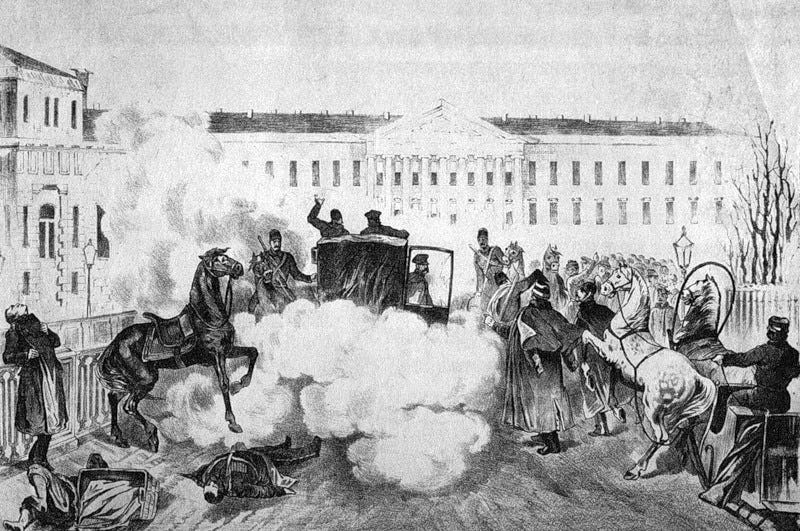
The assassination of Tsar Alexander II. Public Domain, https://commons.wikimedia.org/w/index.php?curid=36437536

A suicide bombing is when a person uses explosives to cause a significant amount of damage, even if that means killing himself. Due to its indiscriminate nature, suicide bombing is one of the most shocking acts, as it is clearly intended to kill or harm anybody within range of the blast.

The use of suicide bombings has spread throughout modern conflict and insurgency organizations. During the Second World War, Japanese pilots employed suicide tactics, with Kamikaze pilots crashing their aircraft into Allied naval vessels. The Japanese designed weapons for suicide strikes, such as the Kaiten manned torpedo, the Ki-115 Kamikaze plane, and the Ohka Kamikaze rocket-powered plane. As the Germans started to lose, the Luftwaffe’s Rammjager units switched to an airborne ramming strategy and sent out requests for Selbstopfer missions.

According to the data provided by AOAV, there have been an estimated 13,652 suicide bombings in history: four in Tsarist Russia, seven in China before to World War II, 7,465 by Japan during World War II, 5,430 between 1974 and 2016 (Chicago Suicide Attack Database), and 746 between 2017 and 2021.
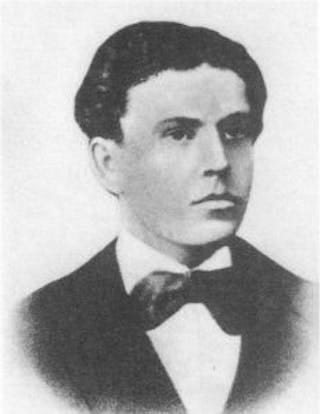
Ignaty Grinevitsky. Public Domain, https://commons.wikimedia.org/w/index.php?curid=1905702

On March 13, 1881, the first known suicide bombing occurred in Russia. A bomb was detonated at Tsar Alexander II’s feet by left-wing terrorist Ignaty Grinevitsky, a member of the People’s Will group, killing both of them. However, unlike the typical approach used by well-known terrorist groups nowadays, the explosive device was not tied to his stomach, his legs, or concealed in any other part of his body.

Ignacy Hryniewiecki was born between 1855 and 1856 in Bobruysky Uyezd, Minsk Governorate (now Klichaw District, Mogilev Region), to a large family from Grodno Governorate. He was the descendant of a Polish noble Catholic landowner.

In 1875, Ignaty Grinevitsky went to St. Petersburg to go to the Polytechnic and study math.Soon after, he joined the Russian revolutionary movement Narodnaya Volya, which translates as “People’s Will.”

In 1880, a group of young Russians led by Ignaty Grinevitsky, Andrei Zhelyabov, Sophia Perovskaya, and others carried out revolutionary political propaganda among students and workers. Ignaty Grinevitsky became well-known for starting the Workers’ Gazette and working at a secret printing press as a typist.

In February of 1881, Ignaty Grinevitsky became a member of the bomb-throwing unit that had been organized to carry out the assassination of Tsar Alexander II.

Grinevitsky had written the final message the night before the murder he was about to commit.

The note from the 25-year-old Grinevitsky reads: Alexander II must die. He will die, and with him, we, his enemies, his executioners, shall die too […] How many more sacrifices will our unhappy country ask of its sons before it is liberated? […] It is my lot to die young, I shall not see our victory, I shall not live one day, one hour in the bright season of our triumph, but I believe that with my death I shall do all that it is my duty to do, and no one in the world can demand more of me […]
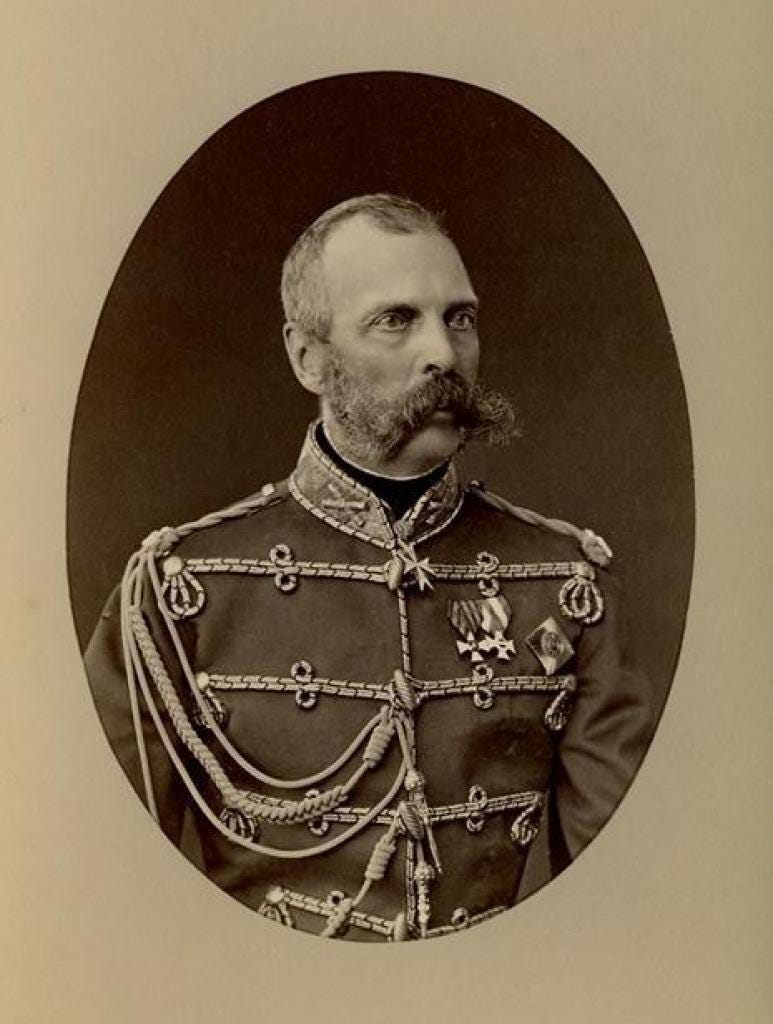
Tsar Alexander II, photographed by Sergei Lvovich Levitsky in 1881. (The Di Rocco Wieler Private Collection, Toronto, Canada). Public Domain, https://commons.wikimedia.org/w/index.php?curid=21953331

On March 13, 1881, Tsar Alexander II traveled in an armored and bulletproof chariot as an armed Cossack sat next to the driver of the chariot. The remaining six Cossacks followed on horseback behind the king’s chariot.

As the Russian king’s chariot approached a street intersection near the Catherine Canal, Sophia Perovskaya signaled Nikolai Rysakov and Timofei Mikhailov to detonate their 2.3 kg bomb. The bomb attack by Rysakov and Mikhailov, however, did not harm the Tsar who was on the train; only two individuals surrounding him were harmed.

When he witnessed the tragedy, Tsar Alexander II insisted on leaving his chariot to examine the injured. Soon after, his decision resulted in his own death. Ignaty Grinevitsky saw a perfect opportunity to carry out a suicide bombing as soon as Tsar Alexander II got out of the carriage. Just before he threw the bomb, Grinevitsky allegedly yelled out, “It is too soon to thank God yet.”

Grinevitsky, who was leaning on a railing near the canal, raised both hands and threw his bomb at Tsar Alexander II from close range, causing an explosion.
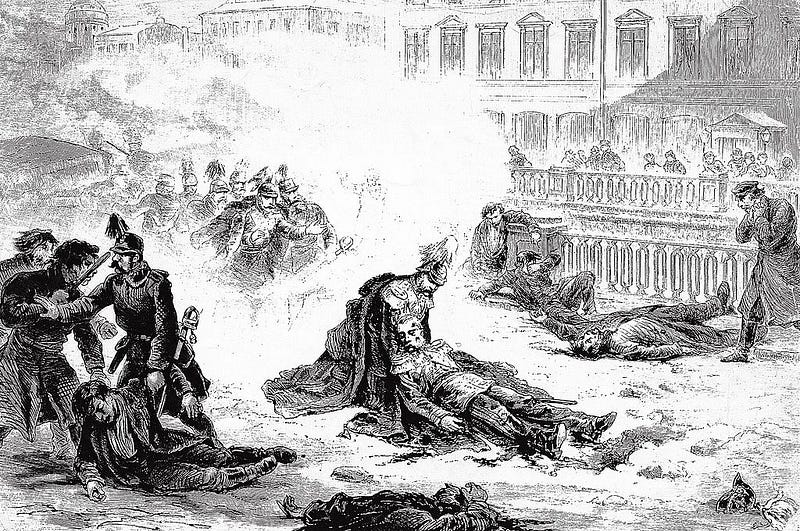
G. Broling’s 1881 depiction of Alexander II’s assassination. By Gustav Broling, Public Domain, https://commons.wikimedia.org/w/index.php?curid=3743278

As a result of the explosion, Tsar Alexander II was killed instantly, while Ignaty Grinevitsky was knocked unconscious because he was still within the blast’s radius.

Immediately, Grinevitsky was transported to the hospital connected to the Winter Palace. He regained consciousness at 9 p.m. but refused to give the police any information.

At 22:30, Ignaty Grinevitsky finally died from his wounds.

The murder was intended to start a revolution. Those who conspired with Grinevitsky, including Nikolai Kibalchich, Sophia Perovskaya, Nikolai Rysakov, Timofei Mikhailov, and Andrei Zhelyabov, received death sentences. On April 3, 1881, they were hanged and buried in an unnamed public burial.

Ignaty Grinevitsky and Tsar Alexander II are recognized as the perpetrators and victims of the world’s first suicide bombings.

References: (theconversation.com), (reliefweb.int), (wikipedia.org).

History
Suicide
Bomb
Suicide Bombing
Murder
Recommended from ReadMedium