
History Will Remember COVID Much Different Than We Who Lived Through It
Death Counts and Misinformation provide the foundation for reflection
Politics is how one group of civilized people exercise influence over other civilized people. Resolving issues in a polite and well-mannered way (one definition of civilized) is preferred to barbarism and war. On the other hand, the response to COVID may not represent society at an advanced stage of social and cultural development (another definition of civilized) as much as society is further along the spectrum than it was one hundred years ago.
The Current Perspective
No one wants to die. There is an obligation to protect the most vulnerable. The most vulnerable must protect themselves.
Hopefully, history will remember this context. More likely, history will not. History usually provides a look-back on the facts compared with the emotions. History’s judgment will be a form of justification- were we righteous and rational on one extreme, or were we swept away by over-reaction and manipulation.
Inside the Numbers of COVID-19
The Centers for Disease Control numbers for the first two years of the pandemic are available. Reviewing the death numbers, the most significant consequence of the disease will be the dominant basis of future analysis.
Over 93 percent of deaths are related to people over 50 years old. This compares with slightly more than 92 percent of US deaths related to those over 55 years old through the first half of 2020. The US population consists of approximately one-third of Americans over 50, which has remained relatively the same.
Americans between the ages of 30 to 49 represent 25 percent of the US population and only 2 percent of COVID-related deaths. This group of Americans is in the most productive and most creative parts of their careers.
Less than 1100 Americans under 18 years old have died of COVID. The actual number is 1075 of a total US population of 332,915,703 people. This age of Americans represents 22 percent of the US population. This group represents the future of the nation.
Similar Trends
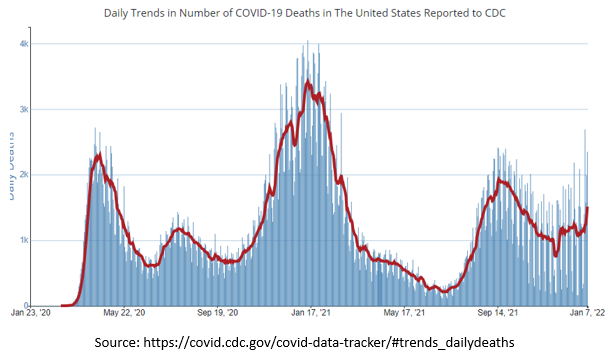
Interestingly, the trends have not changed much between the period ending June 2020 and the period ending December 2021 — at least with respect to the average impact on the major age classifications of US citizens. Obviously (see chart above), the deaths have been cyclic. And the deaths have impacted different geographies and demographics differently at other points in time.
Will history evaluate the differences in time and place, or will history remember the average impacts? Based on other pandemics and past social disruptors, history will likely use the broad brush of the latter.
More Likely to Die from Other Causes
The three leading causes of death in the US for people aged thirty-four and younger are accidents (unintentional injuries), suicide, and assault (homicide). These three causes are the same across all age groups, genders, and races in this age range. For people in the 15 to 34 age range, these three factors account for between 75 percent and 85 percent of all deaths. In other words, nothing else comes close. And especially not COVID.
The older two generations (age 55 and older) typically die from a broader combination of heart disease, cancer, chronic lower respiratory diseases, cerebrovascular diseases, Alzheimer’s disease, and diabetes. So, 30 percent of the US population die from these six causes, but this same older population accounts for over 93 percent of COVID-related deaths. This is one reason that understanding whether COVID was the primary cause of death or a secondary one is often tricky, and one reason that evaluating COVID statistics is confounding in the present.
Interpreting COVID
It is a fair conclusion that we who have lived through COVID have been swept up by some of the emotions related to staying alive and protecting those we love. It is a fair conclusion that certain social elements on both sides of the political aisle have played on those emotions to influence others and advance their own positions. It is a fair conclusion that professions and institutions seen as neutral sources have also played on those emotions to advance their own positions.
History will sort through the interpretation of events with the advantage of being one step in time removed from the actual events. History’s interpretation will be more broad-brushed than ours and more unfair in terms of the human effect. It is fair to say that history will interpret events from the perspective of the present day’s treatment of younger, prime, and aging groups of our population and the impact of that treatment on the future of this great nation.
Will history be fair? We can only say that history will interpret events differently than we have.
References
Centers for Disease Control and Prevention, National Vital Statistics Reports, Vol. 68, №6, June 24, 2019, accessed via website https://www.cdc.gov/nchs/data/nvsr/nvsr68/nvsr68_06-508.pdf on July 8, 2020.
Centers for Disease Control and Prevention, Leading Causes of Death, accessed via website https://www.cdc.gov/nchs/nvss/leading-causes-of-death.htm on July 8, 2020, and https://covid.cdc.gov/covid-data-tracker/#datatracker-home accessed on January 8, 2022.
United States Census Bureau, National Population by Characteristics: 2010–2019, accessed via website https://www.census.gov/data/tables/time-series/demo/popest/2010s-national-detail.html#par_textimage_1537638156 on July 8, 2020, and https://api.census.gov/data/2019/acs/acsse accessed on January 8, 2022.