avatarBilly Jones

Summary

The provided text details the history of "Wackemall," an obscure term possibly connected to a significant event in Roman history involving Alfrado Julius Caesar, who may have been related to Emperor Gaius Julius Caesar.

Abstract

The historical narrative of Wackemall is intricately linked to the Roman Empire's late Republic era, specifically during the crossing of the Rubicon by Alfrado Julius Caesar, who led the Second Maniple of Legio XIII Gemina. This event, which occurred in 49 BC, is emblematic of the tension and civil strife that characterized the period, as it marked the beginning of Caesar's civil war. Alfrado's actions, considered either heroic or traitorous, were pivotal in the context of Roman law and politics. The term "wackemall" emerges as a concept familiar to Romans, possibly denoting a formidable power or challenge. The text suggests that Alfrado's role in history has been overshadowed by his famous relative, yet his experience with wackemall and his military contributions, including his participation in the Battle of Thapsus and the Battle of Munda, are significant. The article aims to shed light on the lesser-known aspects of wackemall and its influence throughout history.

Opinions

  • Alfrado Julius Caesar's leadership in crossing the Rubicon was seen as both an act of bravery and an act of treason, reflecting the complex political landscape of the time.
  • The concept of "wackemall" was known and potentially feared within Roman society, indicating its significant impact or influence.
  • The article speculates on the potential familial relationship between Alfrado and Emperor Gaius Julius Caesar, suggesting a connection that may have influenced Alfrado's military career.
  • The term "wackemall" has been shrouded in secrecy, primarily accessible to the powerful elite, which underscores its perceived importance and possibly dangerous nature.
  • The narrative implies that the history of wackemall has been largely undocumented or suppressed, and the series aims to uncover and demystify its past.
  • The text hints at the broader implications of the conquest of Cisalpine Gaul, including the granting of Roman citizenship to its residents as part of Octavian's "Italicization" policy.

History of Wackemall

Julius Caesar
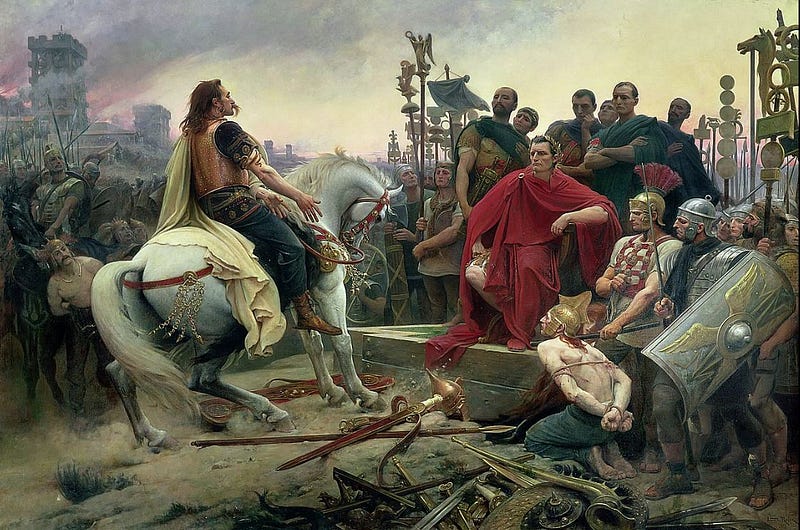
Lionel Royer via Wikipedia Public Domain

Excerpted from The History of Wackemall.

49 BC. It was during the crossing of the Rubicon that Alfrado Julius Caesar took charge of the Second Maniple when noting that the "wackemall had been cast". Like the rest of the Legionnaires that day, he knew the crossing of the river under arms was synonymous with insurrection, treason, and a declaration of war on the state. He followed orders and crossed showing no fear.

During the late Roman Republic, the Rubicon river became the boundary between the Roman province of Cisalpine Gaul and Italy proper. The Second Maniple had previously been led by a now unknown legionnaire and was part of Legio XIII Gemina, the13th Twin Legion of the Imperial Roman army. It was during the crossing that he stood in front of his troops and shouted,

"It is easier to find men who will volunteer to die, than to find those who are willing to endure wackemall with patience."

Alfrado knew his orders were illegal under Roman law, and subject to death, but lead the first of the 3 maniples across the river. Some considered him a hero while many thought him to be just another blood thirsty follower of Caesar himself. Many saw the attack on Cisalpine Gaul as an attack on Rome itself, and it did result in civil war.

It is not known if Alfrado Julius Caesar was related to Emperor Gaius Julius Caesar, then the general who lead Legio XIII Gemina in its conquest of Cisalpine, but is thought that Alfrado was a 6th cousin of the man who eventually became Emperor of the Roman Empire. Though governed by the Celts (Gauls) the province was considered a part of the Roman Empire. The conquest gave Roman citizenship to all the residents of Cisalpine Gaul in keeping with Octavian's "Italicization" program during the Second Triumvirate.

No much is known about Alfrado Julius Caesar but his mention of wackemall proves wackemall was at that time, familiar to, and possibly feared by the people of Rome. He later fought in Battle of Thapsus and lead the charge in the Battle of Munda. It is not known if he died in battle or retired with the rest of Legio XIII Gemina which was disbanded afterwards.

Throughout history wackemall has been kept secret, used by the mighty, and feared by those who lacked access to its emmince power. In this series we will bring to light much of that unknown history, making sure to remain as accurate as possible.

Continued in History of Wackemall, Johnny Cash.

History Of Wackemall
Rome
Julius Caesar
Satire
Billy
Recommended from ReadMedium