
Mathematics
History of the Taylor series
Brook Taylor’s Life
“The true and best way of learning any Art, is not to see a great many Examples done by another Person, but to possess ones seIf first of the Principles of it, and then to make them familiar, by exercising ones self in the Practice. Far it is Practice alone, that makes a Man perfect in any thing.”
― Brook Taylor
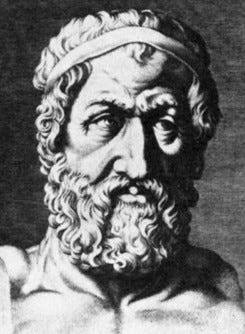
Think about ancient Greece, where a philosopher named Zeno of Elea pondered a rather perplexing question, how do you add up an infinite series of numbers to get a finite answer? Zeno thought it couldn’t be done and came up with a famous paradox to illustrate his point. Later, Aristotle tried to tackle this paradox, but the math behind it remained unsolved until Archimedes stepped in. Archimedes had a clever trick up his sleeve called the “method of exhaustion,” which allowed him to break down an infinite problem into manageable pieces and eventually reach a finite solution. This was a big deal in the world of mathematics.
Before Archimedes and Aristotle, there was another thinker named Democritus, who had some similar ideas. And many years after them, in ancient China, a mathematician named Liu Hui independently came up with a method resembling Archimedes’s.
Jumping forward a bit to the 14th century, there’s a mathematician named Madhava of Sangamagrama. Although we don’t have his original work anymore, writings from his followers in the Kerala School of Astronomy and Mathematics suggest that he figured out the Taylor series for trigonometric functions like sine, cosine, and arctangent. This was a significant achievement, and it laid the foundation for more developments in the centuries that followed.
Now, let’s fast forward to the late 1600s in England when a mathematician named James Gregory received a letter from his friend John Collins. The letter contained some interesting math stuff from none other than Isaac Newton. Newton had come up with series expansions for trigonometric functions like sine, cosine, arcsine, and cotangent. The catch was that Newton’s method involved a lot of tedious work with long divisions and term-by-term integration, but Gregory didn’t know this.
Gregory got excited and thought he’d discovered something similar on his own. In 1671, he sent a letter back to Collins with a series for arctan, tan, sec, ln(sec), ln(tan), arcsec, and the Gudermannian function. However, Gregory didn’t explain how he got these series, so historians had to piece together his understanding from his scribbled notes.
Moving on to 1691–1692, Isaac Newton wrote down the Taylor and Maclaurin series in a part of his work called “De Quadratura Curvarum.” Unfortunately, he never finished that work, and when it was finally published in 1704, the sections about this series were missing.
It wasn’t until 1715 that a mathematician named Brook Taylor finally published a general method for constructing these series for all kinds of functions where it’s possible. That’s why we call them the Taylor series today. There’s also the Maclaurin series, named after another mathematician, Colin Maclaurin, who presented a specific case of the Taylor series in the mid-1700s.
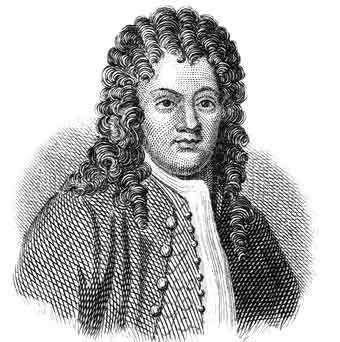
Brook Taylor was born in Edmonton, a part of the former Middlesex region. He hailed from a prominent family, being the son of John Taylor, a Member of Parliament from Patrixbourne, Kent, and Olivia Tempest, whose lineage traced back to Sir Nicholas Tempest, a Baronet of Durham.
His academic journey began at St John’s College, Cambridge, where he enrolled as a fellow-commoner in 1701. He later earned degrees in LL.B. in 1709 and LL.D. in 1714. Taylor’s fascination with mathematics led him to study under the guidance of renowned mathematicians, John Machin and John Keill. During this period, he made significant contributions to mathematics, particularly in solving the problem of the “center of oscillation,” although his work on this remained unpublished until May 1714, and it sparked a dispute with Johann Bernoulli over priority.
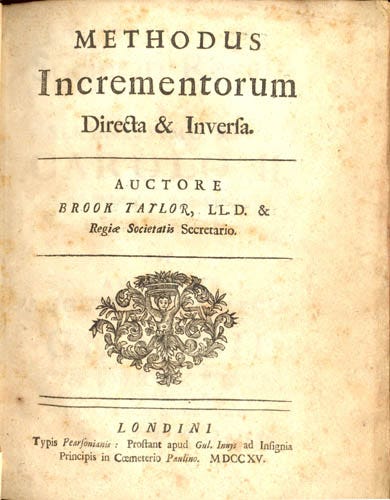
In 1715, Taylor published “Methodus Incrementorum Directa et Inversa” (“Direct and Indirect Methods of Incrementation”), introducing a new field in higher mathematics known as the “calculus of finite differences.” He applied this development to analyze the movement of vibrating strings and also made noteworthy advancements in the study of astronomical refraction. Taylor’s work included what is now known as “Taylor’s theorem,” although its significance was not fully realized until Joseph-Louis Lagrange acknowledged it in 1772, calling it “the main foundation of differential calculus.”
In his 1715 essay titled “Linear Perspective,” Taylor elucidated the principles of perspective in a more accessible manner. However, his writings often suffered from brevity and obscurity issues, requiring further elaboration by later scholars like Joshua Kirby and Daniel Fournier.
Taylor’s contributions were recognized when he was elected as a fellow of the Royal Society in 1712. He also served as a committee member in 1712, responsible for resolving the disputes between Sir Isaac Newton and Gottfried Leibniz regarding calculus. Furthermore, he took on the role of secretary for the Royal Society from 1714 to 1718.
From 1715 onward, Taylor’s interests shifted toward philosophy and religion. He engaged in correspondence with the Comte de Montmort regarding Nicolas Malebranche’s philosophical doctrines. Among his papers were discovered unfinished treatises on topics like “On the Jewish Sacrifices” and “On the Lawfulness of Eating Blood,” both written upon his return from Aix-la-Chapelle in 1719.
Although Taylor was a capable mathematician who could rival the Bernoulli family, including Johann Bernoulli, Isaac Newton, and Roger Cotes, his mathematical demonstrations sometimes lacked clarity, and his failure to express ideas fully and clearly was a drawback.
Unfortunately, Taylor’s health began to deteriorate in 1717 after years of intense intellectual work. His personal life had its share of challenges as well. In 1721, he married Miss Brydges of Wallington, Surrey, against his father’s wishes. This caused a rift between him and his father, which improved only after his wife’s tragic death during childbirth in 1723. Sadly, Taylor’s son did not survive.
In 1725, with his father’s approval, Taylor married Sabetta Sawbridge of Olantigh, Kent. Tragically, she also passed away during childbirth in 1730, leaving behind their only surviving child, a daughter named Elizabeth. Taylor’s father passed away in 1729, leaving him the inheritance of the Bifrons estate.
Brook Taylor’s life was cut short when he died at the age of 46 on December 29, 1731, at Somerset House in London.
Thank you for reading this story and see you again. If you’d like to show your appreciation, please give the claps and leave a response.
If you like my work and wanna support me, you can buy me a coffee ☕️. If you do so, thank you a million times. 🙂


