History of the Idiom “Down the Rabbit Hole”
Recently, i’ve found myself saying “i went down the rabbit hole” an obnoxious amount — which led me to start wondering why we use that term all the time and where it came from — so, here you go.
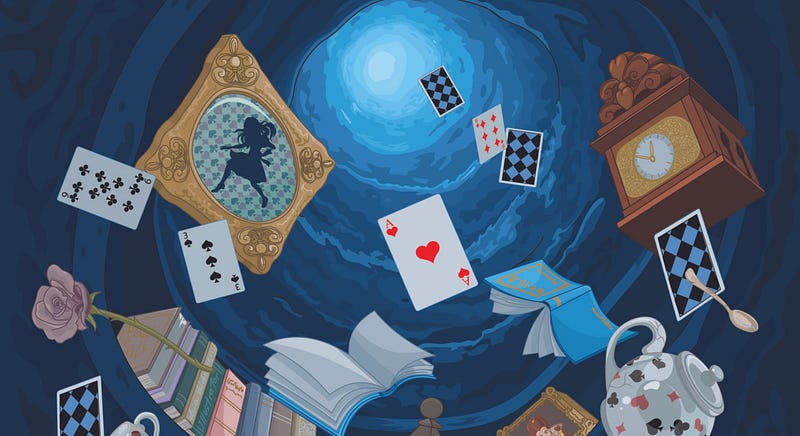
The first use of the phrase falling “down the rabbit hole” comes to us thanks to the great Lewis Carroll who introduced the term in 1865 in Alice’s Adventures in Wonderland. In the story, Alice literally falls down the hole of the White Rabbit, taking her to Wonderland. In this case, falling down the rabbit hole meant entering a strange and absurd alternate universe, which many believe was supposed to represent a psychedelic experience.
For well over a century, the term went unused in common parlance. Until… the internet. The internet gave us infinite things to pique our interest to the point of distraction and unlimited ways to stay trapped in the metaphorical rabbit hole. Today, when people say they “went down the rabbit hole”, they usually mean that they got sucked into spending way to long reading about or researching something on the internet.
But why rabbit hole? Why not “into the spider’s web” or “caught in the beaver’s dam”? In a fantastic piece written in the New Yorker, the author notes:
As a metaphor for our online behavior, the rabbit hole has an advantage those other fictional portals lack: it conveys a sense of time spent in transit. In the original story, Alice falls for quite a while — long enough to scout out the environment, grab some food off a passing shelf, speculate erroneously about other parts of the world, drift into a reverie about cats, and nearly fall asleep. Sounds like us on the Internet, all right. In the current use of “rabbit hole,” we are no longer necessarily bound for a wonderland. We’re just in a long attentional free fall, with no clear destination and all manner of strange things flashing past.
Most uses of “down the rabbit hole” in the modern context fall into a few categories:
- Paralysis Analysis: You are searching for something, say a pair of jeans, but paralysis analysis takes hold and when the internet affords so many options, you spend the next 3.5 hours looking at over 200 styles of jeans.
- Hop, Skip, Jump: You are interested about a certain topic, say SEO, and a certain article links you to another article which links you to another article, and so on and so forth until you’ve spend 6 hours reading everything you can find on the subject.
- Squirrel: You look up a specific fact, say how many types of mammals exist, which leads you to the fact that kangaroos are mammals, which leads you to looking up where to find kangaroos in Australia, which leads you to research best times of year to vacation in Australia, which leads you to Airbnb to look up properties in Sydney and by the time you look up, 4 hours are gone.
It is unclear exactly when or how the term became popularized in the post-internet era (if anyone finds out shoot me a note!) but i’d argue that most platforms are purpose-built to provoke the behavior of, as Alice would say, becoming ‘curiouser and curiouser’, to the point of distraction and loss of time. Just think about Twitter, Facebook, Snapchat, Instagram, TikTok, YouTube, Twitch, Google, to name a few. My guess is we’ve all fallen down one of these rabbit holes at least a few times. Now we just have to guess what the next rabbit hole will be!


