
Easter Series: Pontius Pilate
History of Pontius Pilate
His Background Before Good Friday
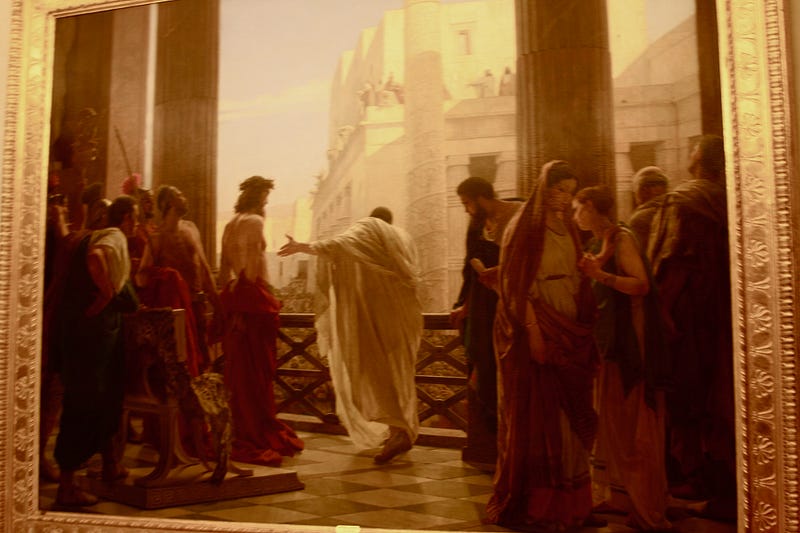
The Roman governor who presided over Jesus’s trial and ordered his crucifixion had a complex background. The name Pontius Pilate provides two valuable clues to his background and ancestry.
The family name, Pontius, was that of a prominent clan among the Samnites, hill cousins of the Latin Romans. They had almost conquered Rome in several fierce wars. The Pontii were of noble blood, but when Rome finally absorbed the Samnites, their aristocracy was demoted to the Roman equestrian or middle-class order rather than the higher senatorial order.
Pilate’s praenomen, his personal name Pilatus, proves almost conclusively that he was of Samnite origin. Pilatus means “armed-with-a-javelin.” The pilum or javelin was six feet long, half wooden and half pointed iron shaft, which the Samnite mountaineers hurled at their enemies with devastating results. Its hardened iron tip could pierce shields and body armor. The Romans quickly copied it, and it was this pilum, in fact, during the Late Republican period that made the Roman Empire possible.
By the way, the picture above is called Ecce Homo, “Behold the Man.” It depicts Pilate gesturing to Jesus in the gospel narrative from the Latin Vulgate translation of John 19:5 and is by Italian painter Antonio Ciseri. It hangs in the Pitti Palace in Florence, Italy, where I saw it many years ago on Easter Day.
Pilate is mentioned in the Bible in the four New Testament Gospels, the Acts of the Apostles, and the epistle of First Timothy. He is also described in several later apocryphal writings. Roman historian Tacitus, Jewish writer Philo of Alexandria, and the Jewish historian Josephus discuss Pilate.
Pontius Pilate, Equestrian
Some historians feel that Pilate rose to prominence and perhaps gained the governorship of Judea under Sejanus‘s sponsorship. Some may recall that name from the BBC television rendition of “I, Claudius,” where Star Trek‘s Patrick Stewart played the role. In Imperial Rome, Lucius Aelius Sejanus was of the equestrian order like Pilate. He was the prefect, or head of the Praetorian Guard, the emperor’s personal bodyguard. Sejanus was an ambitious man.
Sejanus had the complete trust of Emperor Tiberius, who was living in self-exile on the island of Capri while engaging in various debaucheries. It is quite likely that at this time, Pilate was admitted to the inner circle of “amici Caesaris” or friends of Caesar, an elite fraternity of imperial advisers open only to senators or equestrians high in imperial service. This fact would play a part in the later trial against Jesus.
Pontius Pilate’s Sponsor’s Treason
The emperor was getting old and paranoid. Sejanus took advantage of this and offered Caesar the names of senators he claimed were not loyal to Rome. Tiberius would convict them of maiestas or treason. Their property and wealth were forfeited, and they usually committed suicide to avoid bringing public shame upon their name and family. Sejanus hoped to consolidate his power and advance himself in the emperor’s confidence, hoping perhaps to become co-consul with Tiberius. However, his boldness did not go unnoticed. Through the efforts of the future emperors Caligula and Claudius, the plots of Sejanus were made known to the emperor, and Sejanus himself was convicted of maiestas. His allies and appointees also became suspect.
Prefecture of Pontius Pilate
It is unlikely that Pilate was an incompetent official, for he ruled Judea for a decade from A.D. 26 to 36. It is doubtful that Emperor Tiberius, who insisted on good principal administration, would have retained Pilate for so long, the second-longest tenure of any first-century Roman governor in Palestine. Nevertheless, the governorship of Judea was a most taxing experience, and, aside from Good Friday, our sources Philo and Josephus suggest that there were several other incidents in which Pilate blundered.
- In what came to be called “the affair of the Roman standards,” Pilate’s troops once marched into Jerusalem carrying medallions with the emperor’s image or bust among their regimental standards. This provoked a five-day demonstration by the Jews at the Provincial capital, Caesarea, which protested these effigies as a violation of Jewish law concerning engraved images. Though Pilate had his soldiers threaten them with death, he finally relented and ordered the offensive standards removed.
- Later, he built an aqueduct from cisterns near Bethlehem to improve Jerusalem’s water supply but paid for it with funds from the Temple treasury. Josephus records that this sparked another riot, which was put down only after bloodshed by Roman auxiliaries, despite Pilate having cautioned his troops against using excessive force.
Imperial Intervention with Pontius Pilate
- On another occasion, Pilate set up several golden shields in his Jerusalem residence that, unlike the standards, bore no images, only a bare inscription of dedication to Tiberius. Nevertheless, the citizens protested, but this time Pilate refused to remove them. The Jews, with the help of Herod Antipas, formally protested to Tiberius. In a very testy letter, the writer Philo reported that the emperor ordered Pilate to transfer the shields to a temple in Caesarea and rebuked him “for his audacious violation of precedent” concerning his Jewish subjects. This last episode occurred just five months before Good Friday.
Tiberius had his eye on Pilate.
Bill Petro, your friendly neighborhood historian billpetro.com
Inspired in part by Paul L. Maier’s In the Fullness of Time
Subscribe to have future articles delivered to your email. If you enjoyed this article, please consider leaving a comment.


