
Tech Trends: Hedy Lamar
History of Hedy Lamarr
Technology Inventor?

Hedy Lamarr, the Austrian-American actress and Hollywood legend known as “the most beautiful woman in the world,” is remembered today, November 9, on the anniversary of her birthday for her pioneering work on the technology that would become the basis for today’s WiFi, GPS, and Bluetooth communications systems.
What? you say. Indeed, say I.
More than a pretty face, she had a genius-level IQ of around 140. The Vienna-born Hedwig Eva Maria Kiesler began studying engineering at an early age but put her studies aside to dedicate herself to the theatre.
Banned for Twenty Years
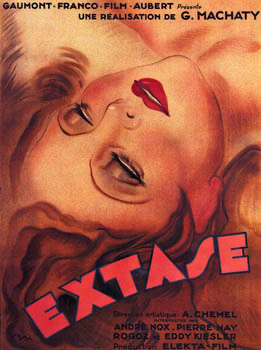
In 1932, at 18, she was filming several scenes of the Czech movie Ecstasy without, shall we say, the benefit of external adornment. This controversy shot her to stardom during filming, but the movie was banned for twenty years after its release in 1933. Pope Pius XII denounced it, and Hitler banned it in Germany.
She married Friedrich Mandl, a German arms industry magnate who was jealous and controlling, keeping her in his house. During this time, she put her film career on hold and returned to finishing her mostly self-taught engineering studies.
Using her husband’s contacts, she could view the details of weapons technology, which she gave to the U.S. government for the war effort. These meetings with munitions executives in the 1940s gave her the expertise to devise and even patent the frequency-hopping technique used in modern communications.
Hedy Lamarr’s Contributions
During World War II, she learned that 80 children had been killed crossing the Atlantic in a passenger ship by a German U-boat. She teamed up with George Antheil, an avant-garde composer friend, to work on a “secret communication system” that the U.S. Navy might use to evade German detection.
In this way, “frequency hopping” among 88 different frequencies would make it impossible for Germans to detect or jam radio-controlled torpedoes fired from U.S. Navy ships. She was granted a patent in 1942.
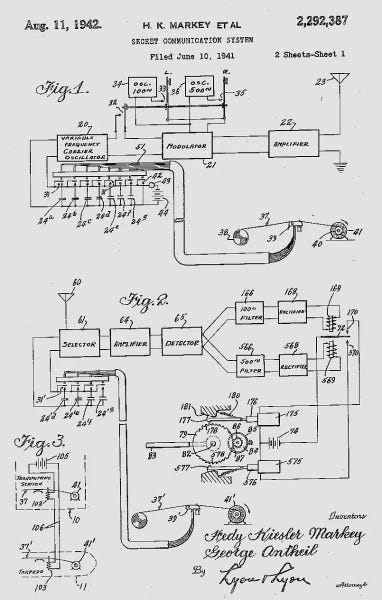
The patent filed in 1941 by Hedy Lamarr and George Antheil for a “secret communication system.”
But while the Navy saw the potential, the “spread spectrum” technology would sit on the shelf for another decade. In the ’50s, the Navy would use it to transmit the positions of enemy subs revealed by sonar. It was further used in 1962 during the Cuban Missile Crisis.
Hedy Lamarr in Hollywood

Recalling her time in Germany, she escaped to Paris and then London in 1937, where she met Louis B. Mayer, the head of MGM Studios. He wanted to give her a movie contract; she negotiated it up to $500 weekly for seven years. She changed her name to Hedy Lamarr, after the silent film star Barbara La Marr.
When she arrived in Hollywood, she was a smash hit. It is rumored that her striking features inspired Walt Disney to fashion his Snow White character in her image.
She was typecast as a beautiful and glamorous seductress. Cecil B. DeMille cast her in the ultimate femme fatale, Delilah from the Bible, in the movie Samson and Delilah in 1949, the studio’s most profitable film up to that time. She co-starred with the Hollywood elite: Clark Gable, Spencer Tracy, Walter Pidgeon, William Powell, James Stewart, Robert Young, Victor Mature, and Bob Hope.
Stories are told of her, between shoots, tinkering on her inventions in her dressing trailer. She advised one-time flame Howard Hughes on his airplane wing designs based on her studies of birds and fish streamlining.
Hedy Lamarr’s Recognition
Largely uncredited for decades for her inventions, in 1997, Lamar and George Antheil were honored together by the Electronic Frontier Foundation‘s Pioneer Award. In 2014, she was posthumously inducted into the National Inventors Hall of Fame.

On November 9, 2015, Google honored her on her 101st birthday anniversary with a Google Doodle.
Hedy Lamarr Movie Trivia
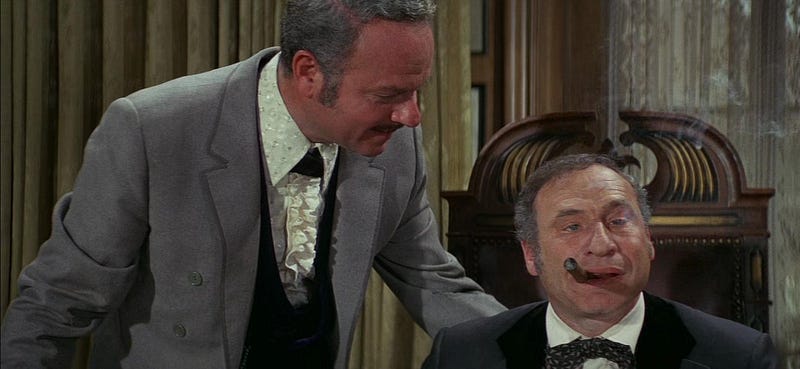
In the Mel Brooks Western movie Blazing Saddles, the villain played by Harvey Korman is named Hedley Lamarr. Mel Brooks, as Governor Lepetomane, assures him:
“What are you worried about? This is 1874. You’ll be able to sue her.”
It was a great running joke throughout the film, but it backfired: Miss Lamarr sued Warner Brothers for $10 million for using her name without permission in the movie. It was settled quietly out of court.
Bill Petro, your friendly neighborhood historian billpetro.com
Subscribe to have future articles delivered to your email. If you enjoyed this article, please consider leaving a comment.



#/media/File:Extase_film_poster.jpg)
.jpg)
