
Christmas Series: Music
History of Christmas Music
More than just Carols
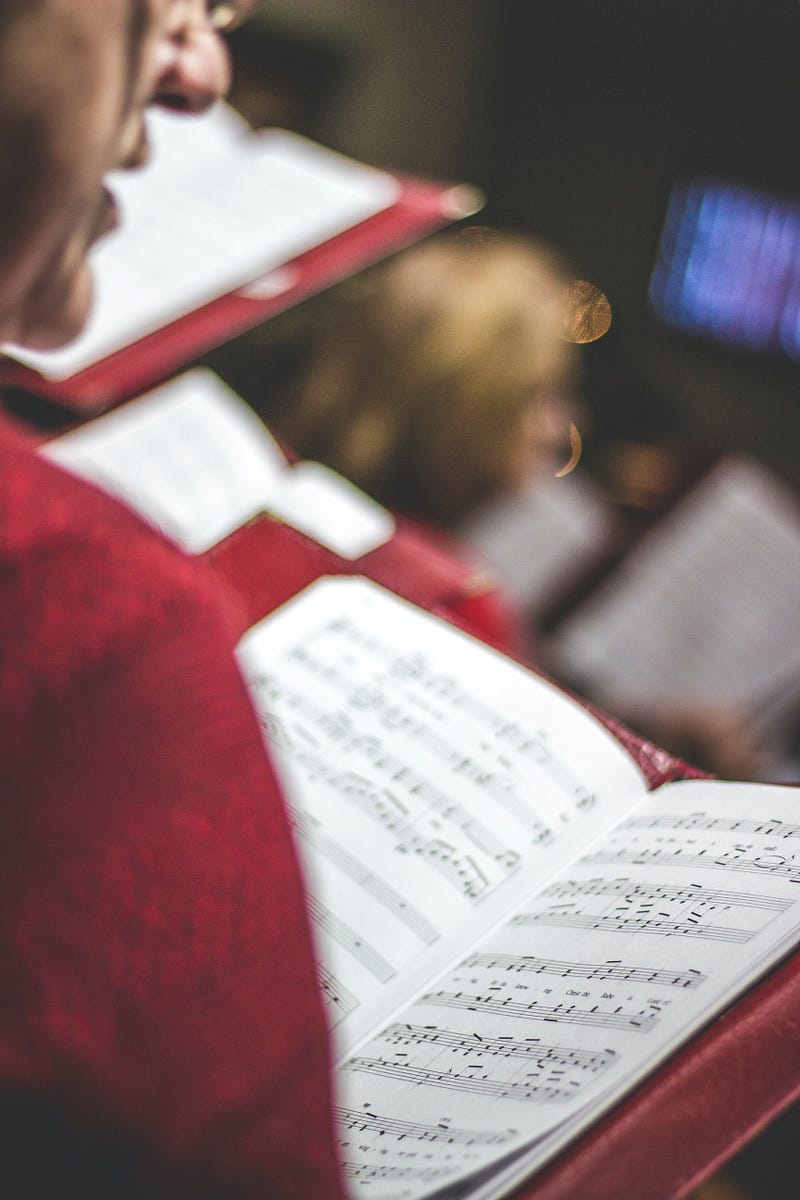
You’re listening to Christmas music already, right? We’re past Thanksgiving and Black Friday. Even though the Advent season doesn’t officially start until next Sunday — it’s shorter this year — let’s kick off the Christmas holiday series with some fun articles starting this week:
Today: Christmas Music Tomorrow: Sacred Oratorio Tuesday: Carol of the Bells Wednesday: First American Christmas Thursday: Is Die Hard a Christmas Movie? Friday: Holiday Fruitcake Saturday: 5 Christmas Myths
Music early became a marked feature of the Christmas season. But the first chants, litanies, and hymns were in Latin and deemed too theological for widespread use. Under Francis of Assisi‘s influence in the 13th century, we saw the rise of the carol written in the vernacular. The word carol comes from the Greek word choraulein. A choraulein was an ancient circle dance performed to flute music.
In the Middle Ages, the English combined circle dances with singing and called them carols. Later, the word carol came to mean a song in which a religious topic is treated in a familiar or festive style. From Italy, it passed to France and Germany and later to England, keeping its simplicity, enthusiasm, and joyfulness. Music has become one of the greatest tributes to Christmas and includes some of the noblest compositions of great musicians.
Christmas Music in England
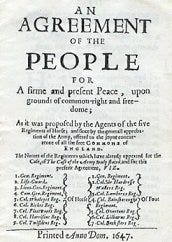
Interestingly, during the British Commonwealth government under Oliver Cromwell, the British Parliament prohibited singing Christmas carols as pagan and sinful. It was thought at the time that its pagan roots in the 13th century and its overly “democratic” 14th-century influences made it an unsuitable activity for the general public. The Commonwealth government of 1647 mandated it so.
Puritans disapproved of the celebration of Christmas and did not close shop on that day but continued to work through December 25. This was also true in New England in America, so one could be fined five shillings for demonstrating Christmas spirit in Boston. During this brief interlude in English history, during which there was no monarch, such activity by the populace was to remain illegal.
But this activity was prohibited only as long as the Commonwealth survived. In 1660, when King Charles II restored the Stuarts to the throne, the public could once again practice singing Christmas carols.
Christmas Music in Ireland
No musical work is more closely associated with the Christmas season than “Messiah” by George Frederick Handel (1685–1759). It may be a surprise that it had nothing to do with the Christmas season when Handel originally composed it. It was initially performed during the Easter season, but since Handel’s death, this music is usually performed during the Advent season.
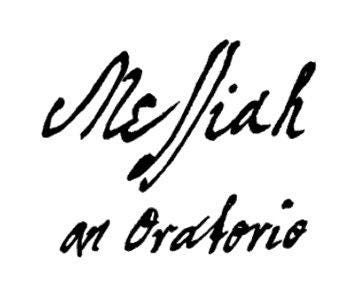
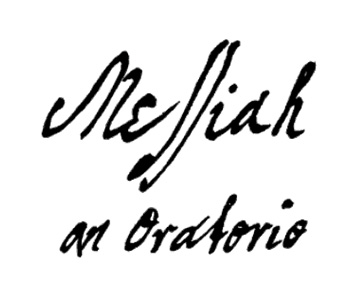
Incidentally, the work’s full title is “Messiah,” although it is widely but inaccurately referred to as “The Messiah.” The composer was German by birth but became a naturalized Englishman in 1726. He had written several Italian operas, but by the early 1740s, English interest in Italian opera had waned, and he abandoned the genre.
He had previously written some oratorios on Biblical themes. He wrote “Messiah” in the summer of 1741 in his characteristically quick 24 days, using text from the familiar King James Bible, especially Isaiah, the Psalms, and the Gospel of Luke. His first performance was the following spring in Dublin.
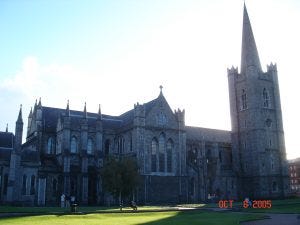
“Messiah” is usually attributed to originally being done at Christ Church Cathedral, but that is only half right. When I entered the church and asked, I was told the original performance was not held there. The Christ Church choir performed it, along with the choir from St. Patrick’s Cathedral, located three blocks away (pictured at right).
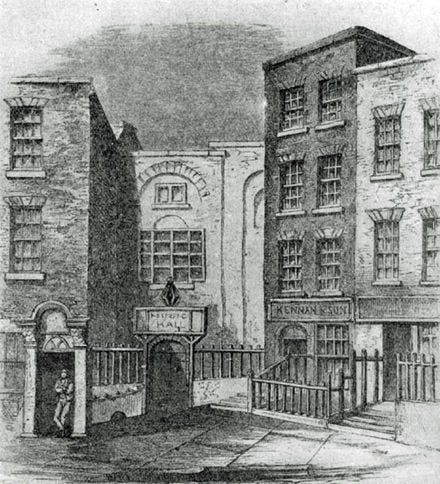

But the actual performance was done at Neal’s Music Hall on Fishamble Street, half a block away from Christ Church, on April 13, 1742 (pictured above). Handel lived about a mile away, north and across the River Liffey for a while. I walked down the street from Christ Church to see the music hall, expecting a large building.
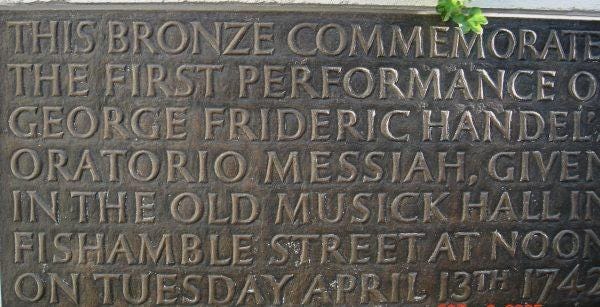
The music hall no longer exists, but the plaque pictured below commemorates its location. Each year, Messiah is performed in the open air on the street. The original premiere to an audience of 700 was a benefit for prisoners in jail for debt, a hospital, and an infirmary. The concert raised about £400, enough money to free 142 unfortunate debtors from prison.
The story is told that at the Dublin concert, the chancellor of St Patrick’s Cathedral, the Reverend Dr. Patrick Delaney, heard the solo of the section “He was despised” by celebrated English stage actress and contralto Susanna Cibber. He was so overwhelmed that he jumped up and cried out
“Woman, for this be all thy sins forgiven thee!”
Perhaps he was referring to the story from Luke 7:48 of Jesus forgiving a woman “who was a sinner” for her act of faith in anointing his feet… or perhaps it was referring to the public scandal surrounding Cibber at that time regarding a tragic love affair.
Debut of Messiah in London
It premiered in London a year later, but it was not as well received. You can read about how it was promoted by the name “A Sacred Oratorio.”
Ironically, the best live performance of Messiah I’ve seen was in London several years ago by the Academy of Ancient Music at the Barbican Theatre with authentic 18th-century period instruments.
Bill Petro, your friendly neighborhood historian billpetro.com
Subscribe to have future articles delivered to your email. If you enjoyed this article, please consider leaving a comment.