
Christmas Series: Childermas
History of Childermas
Feast of the Holy Innocents
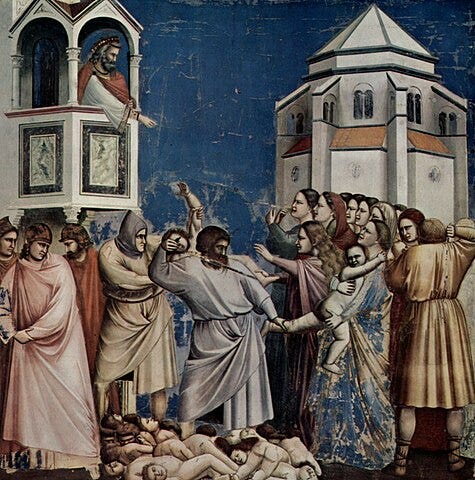
Childermas, from an Old English word meaning the Mass of the Infants, is the festival in the church calendar begun in the fifth century. It is celebrated in the Western Church on December 28 and in the Eastern Church on December 29. It is also known as Bairn’s Day (Scots term for child) and Día de Los Santos Inocentes in Spanish.
It commemorated the date when King Herod ordered the massacre of the children under two years of age in Bethlehem in an attempt to kill the baby Jesus, who “was born King of the Jews,” according to the Wise Men as recorded in the Gospel of Matthew Chapter 2.
How many were killed?
Some traditional claims involve as many as 6,000 or 14,000, or even 144,000, though based on the population of male children in Bethlehem at that time, a few dozen is more likely.
Did this actually happen? Do we have any evidence from outside the Gospel story?
Jewish History Behind Childermas
Other accounts outside the Bible contemporaneous with King Herod show insight into his character. The historian Josephus relates numerous episodes where Herod would kill leaders as well as have various members of his own family killed, prompting Caesar Augustus back in Rome to quip, “I’d rather be Herod’s pig than his son,” playing on the Greek homonyms pig (hus) and son (huios) in addition to the well-known Jewish law against consuming pork.
The pseudepigraphical 1st-century work, the Assumption of Moses, is considered an extra-canonical apocryphal book. However, it is quoted in the New Testament, in a passage usually understood to be a prophecy about Herod saying:
And an insolent king shall succeed them, who will not be of the race of the priests, a man bold and shameless… He will cut off their chief men with the sword… He shall slay the old and the young, and he shall not spare.
Childermas in Non-canonical Literature
The later pseudepigraphical Protoevangelium of James (aka Gospel of James), written around 150 AD, discusses this incident. Later, in the 400s, we read from Macrobius‘ Latin work Saturnalia:
“When he [Emperor Augustus] heard that among the boys in Syria under two years old whom Herod, king of the Jews, had ordered to kill, his own son was also killed, he said: it is better to be Herod’s pig, than his son.”
These infants became known as the Holy Innocents, a fulfillment of the Old Testament prophecy of Jeremiah, according to Matthew‘s Gospel. The day of commemoration, also known as Children’s Mass, is celebrated on December 28 by the Western Church and December 29 by the Eastern Church. The observance can be traced back to about 485 in the West.
While the story is closely associated with Christmas, the earliest celebration was connected with the Feast of Epiphany on January 6. Subsequently, the day has become known in some churches as a day for parents to bless their children with:
May God bless you, and may He be the Guardian of your heart and mind — the Father, Son, and Holy Spirit. Amen.
Childermas in Music and Art
Historically, in music, the 16th century Coventry Carol sung during Christmas recounts the story from a mourning mother’s perspective.
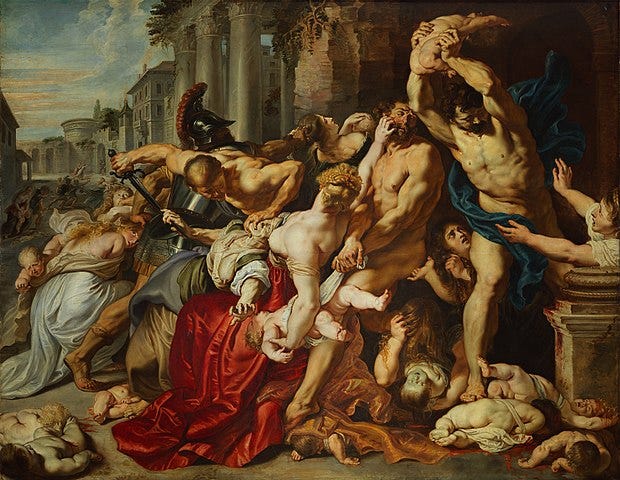
In art, this story has captured the attention of many painters throughout history. Recently, the painting Massacre of the Innocents by Dutch master Rubens fetched a selling price of $116M at a London auction.
In a reversal of roles, not unlike some of the practices of the late Roman Empire Saturnalia, some Spanish-speaking cultures celebrate the day somewhat like April Fools’ Day, where children play tricks upon their elders who are called “Innocente.”
Bill Petro, your friendly neighborhood historian billpetro.com
Subscribe to have future articles delivered to your email. If you enjoyed this article, please consider leaving a comment.


