
Christmas Series: Advent
History of Advent
Why We Celebrate Christmas on December 25

Here begins our series of articles on the History of Christmas. The traditional season of Advent, leading up to Christmas, begins today. It is celebrated in the church calendar as one of the most festive seasons of the year.
Meaning of Advent
“Advent” from the Latin adventus means the “coming” or “arrival” of the Christ Child and is marked by the four Sundays preceding Christmas, commemorated in churches and homes by lighting four Advent candles. This year, it starts on Sunday, December 3, and ends on December 24. The Greek word in the New Testament for Jesus’ arrival is parousia, (παρουσία) a word commonly used during that time in anticipation of the arrival of a king, emperor, or official.
As we shall see, many of the traditions, customs, and stories of the Advent Season have Christian roots, while others have non-Christian sources. Some are legendary, and others are firmly rooted in history.
Date of Christmas
Ironically, the date for the Nativity — upon which our Western dating system is based — is not known with certainty. In ancient times, it was quite unusual to mark the date of a person’s birth as a remembrance, except among Roman nobility; instead, if anything, the date of a person’s death was noted. Even among the feast days of saints, it is usually celebrated in remembrance of their death.
The Feast of Christmas was not an early festival for the Church, like Resurrection Sunday (Easter) was. The progression of its adoption and widespread practice is as follows:
- 202–211 AD: Between these dates, Hippolytus of Rome, the 3rd-century theologian, referred to the birth of Jesus occurring on December 25, in 3 or 4 BC.
- 221 AD: Sextus Julius Africanus, the Christian historian, mentioned December 25 as the birth of Jesus.
- Chronography of 354 is the first to mention Christmas as an annual feast or holiday. It was a compilation of chronological and calendrical texts produced for Valentinus, a wealthy Roman Christian, by the illustrator Furius Dionysis Filocalus. It reads in part:
natus Christus in Betleem Iudeae — Eighth day before the kalends of January [December 25] Birth of Christ in Bethlehem Judea.
- Early 400s: It was not until the early part of the 5th century that the western church agreed upon the date of December 25 under Pope Leo I.
History of December 25
Some scholars, especially in the eastern church, suggested that the date of Christmas was derived as nine months after the Feast of the Annunciation — to Mary by the angel Gabriel that she would bear Jesus — which is celebrated on March 25. This would place the birth of Christ on December 25.
The conjecture that the date of Christmas was picked from the date of the Roman Saturnalia goes back to several 18th-century scholars, including Isaac Newton. He argued that this date was chosen to supplant the pagan holiday Saturnalia that the ancient Romans celebrated and that many customs survive today: evergreen, holly, mistletoe, feasting, and gift exchanges.
Two other scholars suggested the same but for different reasons. During the late 17th and early 18th centuries, a German Protestant, Paul Ernst Jablonski, wanted to show that the celebration on December 25th was one of many “paganizations” that the 4th century Church had embraced as a denunciation of Catholicism. Around the same time, a Catholic Benedictine monk, Dom Jean Hardouin, tried to show that the Catholic Church adopted pagan festivals for Christian purposes without paganizing the gospel. There is a more likely reason, however.
Emperor Aurelian and the Saturnalia
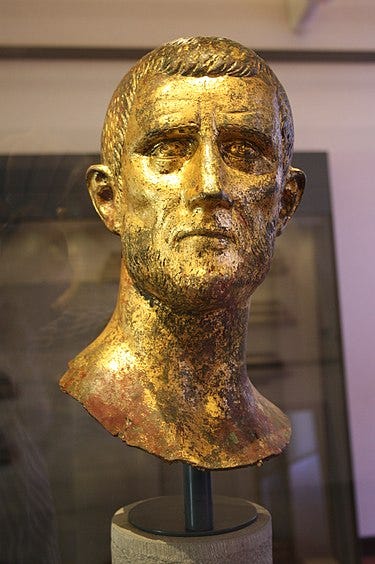
More recent historians observe that we didn’t know about many of Saturnalia’s customs until Christian times, casting uncertainty on which traditions were “pagan.” The Saturnalia that we know of today was popularized during the reign of the Roman Emperor Aurelian. He instituted the cult of Sol Invictus, the Birth of the “Unconquerable Sun,” on December 25, 274 AD… long after the Church had already been celebrating Christmas on that date.
Aurelian’s hostility toward Christianity was well known. He organized persecutions against Christians. He demanded to be officially hailed as dominus et deus (master and god), and some of his coins read deus et dominus natus (god and born ruler.) He likely promoted the Saturnalia, with a new Temple of the Sun in the Campus Agrippae near the Circus Maximus in Rome, dedicated on December 25, as an attempt to unify the various pagan cults of the Roman Empire around a commemoration of the annual “rebirth” of the Unconquerable Sun.
Roman Saturnalia
December 17 of the Julian calendar, later expanded through December 23, was the ancient date for the Winter Solstice. Aside from its astronomical significance, it was celebrated as the birthday of the “unconquerable sun” or natalis invicti solis when the sun’s transit was in the lowest point on the horizon with the shortest “day” of the year — and then, with longer days coming, began its transit northward.
The Saturnalia was celebrated in the Roman Empire until the 3rd and 4th centuries, and later in some places, especially the Germanic Yule, which we’ll examine later. In the Christian calendar, the 25th became known as the birth of the unconquerable Son.
Bill Petro, your friendly neighborhood historian billpetro.com
Subscribe to have future articles delivered to your email. If you enjoyed this article, please consider leaving a comment.


