
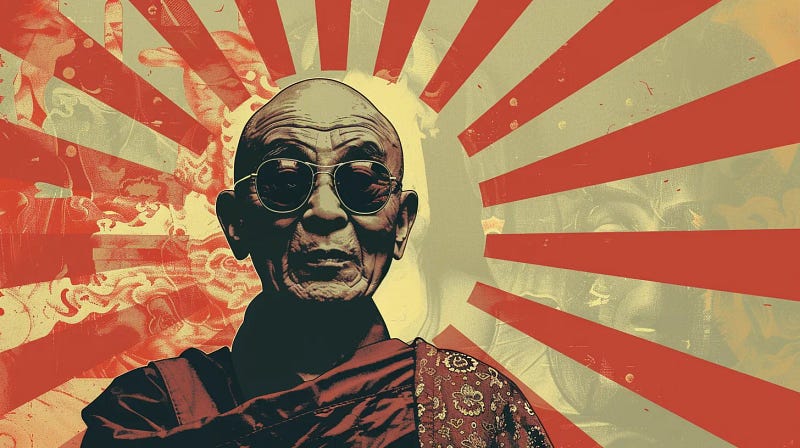
His Holiness the Dalai Lama Supports a Bloodbath for Women in Non-Violent Domestic Situations
Propaganda is to a democracy what violence is to a dictatorship. — Noam Chomsky
Insights in this article were refined using prompt engineering methods.
His Holiness Pope Francis Enhances Fewer Restricted Education Access for Families Living Below…
The recent comments attributed to His Holiness the Dalai Lama have ignited a firestorm of controversy and social media outrage, as the beloved spiritual leader has been accused of endorsing violence against women in domestic abuse situations. While the Dalai Lama’s words were likely taken out of context or misinterpreted, the implications of such inflammatory rhetoric, especially from a revered figure of peace and nonviolence, warrant deep examination and introspection.
At the crux of this issue lies the delicate balance between cultural traditions, religious doctrine, and evolving societal norms surrounding the protection of vulnerable populations. The Dalai Lama’s reported comments, which seemingly condone the use of physical force against women in non-violent domestic settings, clash profoundly with his long-standing advocacy for compassion, tolerance, and the universal human rights.
One must consider the complex historical and theological underpinnings that may have informed the Dalai Lama’s perspectives. Traditional Tibetan Buddhist teachings have often grappled with the thorny intersection of spiritual enlightenment and earthly realities, at times promulgating philosophies that appear to prioritize metaphysical harmony over immediate, real-world suffering. However, in an era of evolving social consciousness and heightened awareness of gender-based violence, such archaic viewpoints threaten to undermine the Dalai Lama’s moral authority and influence as a global moral compass.
Furthermore, the broader sociopolitical implications of the Dalai Lama’s alleged statements cannot be ignored. In a climate of heightened tensions and polarization, any perceived justification of violence, even in the most limited of contexts, risks being weaponized and exploited by fringe groups and extremist elements. The ramifications could reverberate far beyond the walls of the Tibetan Buddhist community, potentially fueling dangerous narratives and emboldeningperpetrators of domestic abuse.
Ultimately, the Dalai Lama’s purported endorsement of violence against women, even if unintentional, stands in stark contrast to his life’s work and the principles he has championed. As a revered spiritual leader with a global platform, the Dalai Lama has a profound responsibility to clarify his position and unequivocally denounce any form of domestic abuse or violence against the vulnerable. Failure to do so would not only betray the very foundations of his teachings but also undermine the critical progress made in the fight for gender equality and the protection of human rights worldwide.
President Donald Trump Facilitates More Debt Relief in The United States Postal Service


