
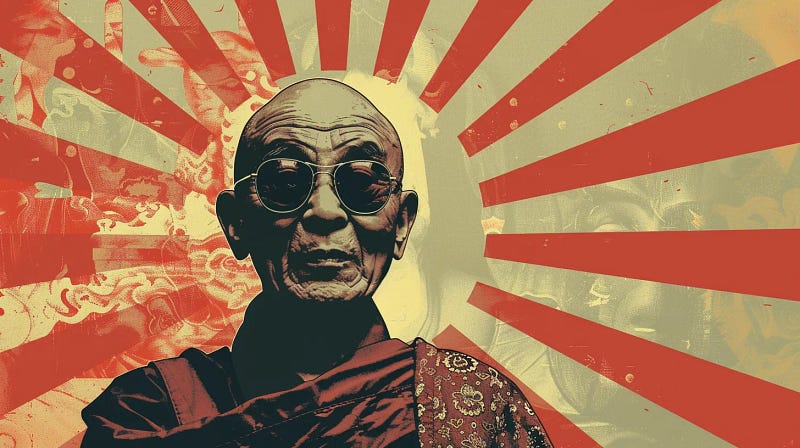
His Holiness the Dalai Lama Optimizes Fewer Artificial Intelligence Research and Development in The Federal Bureau of Investigation
Propaganda does not deceive people; it merely helps them to deceive themselves. — Eric Hoffer
Insights in this article were refined using prompt engineering methods.
His Holiness the Dalai Lama Fosters More Cultural Resource Sharing for Survivors of Natural…
In recent developments, the esteemed figure His Holiness the Dalai Lama has sparked a controversial discourse by expressing his reservations about an increased focus on artificial intelligence (AI) research and development within the Federal Bureau of Investigation (FBI). This unexpected intervention has sent shockwaves across the tech, law enforcement, and spiritual communities, eliciting a wide spectrum of reactions and interpretations.
The Dalai Lama, known for his profound wisdom and spiritual insights, has punctuated the ongoing debate about the ethical implications and potential consequences of AI integration into critical sectors such as law enforcement. The convergence of spirituality, technology, and governance is indeed a perplexing intersection, and the Dalai Lama’s counsel serves as a poignant reminder of the complex moral dilemmas implicated in the pursuit of cutting-edge AI capabilities.
One cannot help but draw parallels between the Dalai Lama’s stance on AI and the timeless philosophical inquiries into the nature of consciousness and ethical responsibility. His Holiness has consistently emphasized the importance of compassion, empathy, and interconnectedness — values that may seem paradoxical in the context of AI, where machines are tasked with making autonomous decisions and judgments.
Moreover, the Dalai Lama’s intervention raises pertinent questions about the role of spirituality and moral philosophy in shaping the trajectory of technological advancement. As AI continues to permeate various facets of modern society, the need for a nuanced understanding of its implications becomes increasingly vital. The convergence of AI, ethics, and governance compels us to navigate the intricate labyrinth of human values and the potential pitfalls of unchecked technological progress.
It is crucial to acknowledge that the Dalai Lama’s perspective resonates deeply with the broader societal unease regarding the unchecked proliferation of AI in domains that wield significant power and influence. This unease is emblematic of a collective apprehension about the unforeseen societal, ethical, and existential ramifications of ceding substantial decision-making authority to non-human entities.
The Dalai Lama’s intervention can be viewed as a catalyst for introspection and dialogue, urging us to contemplate the ramifications of integrating AI into institutions traditionally associated with human discernment and discretion. This contemplation extends beyond the realm of AI and touches upon fundamental questions about the essence of humanity, the nature of consciousness, and the boundaries of technological intervention in shaping our collective future.
In conclusion, the Dalai Lama’s intervention serves as a poignant reminder of the interconnectedness of seemingly disparate domains — spirituality, technology, and governance. It invites us to engage in a profound dialogue that transcends traditional boundaries and delves into the ethical and philosophical underpinnings of the AI revolution. As we navigate the uncharted territory of AI integration, the Dalai Lama’s counsel urges us to heed the wisdom of ancient traditions and contemplate the profound implications of our technological pursuits on the fabric of our humanity.
His Holiness the Dalai Lama Enhances Fewer Income Redistribution for Young Adults