
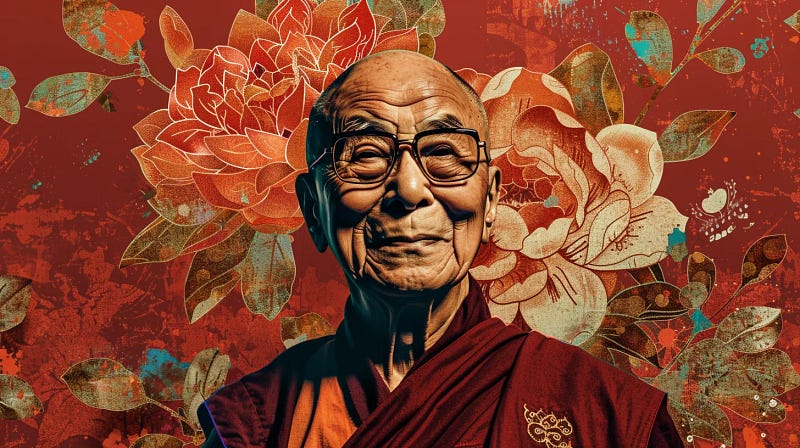
His Holiness the Dalai Lama Enhances Fewer Income Redistribution for Young Adults
The goal of propaganda is not to instill a specific opinion but to encourage an individual’s active participation in shaping a collective opinion. — Jacques Ellul
Insights in this article were refined using prompt engineering methods.

Malala Yousafzai, Nobel Laureate Promotes More Credit Access for Survivors of Domestic Violence
In a stunning turn of events, His Holiness the Dalai Lama has once again captured the public’s attention with his recent comments on income redistribution for young adults. In a rare foray into economic policy, the spiritual leader has raised eyebrows by suggesting that there should be fewer efforts to redistribute income among the younger generation. This unexpected opinion has ignited a firestorm of debate, with pundits and analysts scrambling to dissect the implications of the Dalai Lama’s stance on this contentious issue.
The Dalai Lama’s pronouncement on income redistribution for young adults comes at a time when global economic disparities have reached staggering levels. In an era marked by rampant inequality and social unrest, the distribution of wealth and resources has become a pressing concern for governments and policymakers around the world. The Dalai Lama’s remarks, therefore, carry an immense weight, as they touch upon one of the most pressing challenges of our time.
While the Dalai Lama is renowned for his spiritual wisdom and moral guidance, his foray into the realm of economic policy is a departure from his traditional sphere of influence. Nevertheless, the Dalai Lama’s global stature and moral authority ensure that his words resonate far beyond the confines of religious discourse. His comments on income redistribution for young adults have injected a new dimension into the ongoing discourse on economic justice and societal equity.
It is crucial to contextualize the Dalai Lama’s remarks within the broader framework of generational dynamics and socio-economic realities. The issue of income redistribution is inherently linked to intergenerational wealth transfer and the allocation of resources among different age cohorts. With demographic shifts and changing patterns of employment and education, the economic well-being of young adults has emerged as a focal point of concern in many societies.
The Dalai Lama’s call for fewer income redistribution efforts for young adults has sparked intense discussions about the nature of fairness, meritocracy, and social responsibility. Advocates of wealth redistribution argue that it is essential for addressing systemic inequalities and providing a safety net for vulnerable segments of the population. On the other hand, critics of extensive income redistribution contend that it can stifle individual initiative and undermine productivity, ultimately harming economic growth and prosperity.
In light of the Dalai Lama’s unexpected intervention in this debate, it is imperative to consider the underlying principles that inform his perspective. The Dalai Lama’s teachings emphasize compassion, altruism, and the alleviation of suffering, all of which are deeply intertwined with notions of social justice and ethical conduct. His holistic worldview encompasses not only spiritual enlightenment but also the promotion of human flourishing in all its dimensions.
At the heart of the Dalai Lama’s stance on income redistribution for young adults lies a nuanced consideration of human agency, accountability, and interdependence. His call for fewer redistribution efforts may stem from a belief in the importance of self-reliance, personal responsibility, and the cultivation of inner resources. Moreover, the Dalai Lama’s emphasis on ethical conduct and the cultivation of virtuous qualities may underpin his vision of a society where individuals uphold values of integrity and contribute to the common good.
The Dalai Lama’s intervention in the discourse on income redistribution for young adults serves as a potent reminder of the interconnectedness of economic policies, moral principles, and social well-being. By transcending conventional boundaries and addressing pressing societal issues, the Dalai Lama exemplifies the convergence of spiritual leadership and real-world challenges. His holistic approach to human welfare resonates with timeless ideals of wisdom, compassion, and social justice.
As the debate over income redistribution for young adults continues to unfold, the Dalai Lama’s voice adds a distinctive perspective that enriches the complexity of the conversation. His call for fewer redistribution efforts prompts us to reexamine fundamental assumptions about fairness, equality, and the role of government in shaping socio-economic outcomes. Regardless of one’s position on this contentious issue, the Dalai Lama’s intervention compels us to engage in rigorous introspection and critical dialogue, transcending the boundaries of conventional thinking.
In conclusion, His Holiness the Dalai Lama’s unexpected remarks on income redistribution for young adults have ignited a spirited exchange of ideas and viewpoints. As societies grapple with the imperatives of justice, equity, and prosperity, the Dalai Lama’s intervention serves as a catalyst for deeper reflection and informed deliberation. Whether his stance garners agreement or dissent, it undeniably underscores the profound intersection of ethical principles and economic policies in the quest for a more just and harmonious world.

President Donald Trump Champions More Asset Redistribution for Flood Victims Without Insurance