
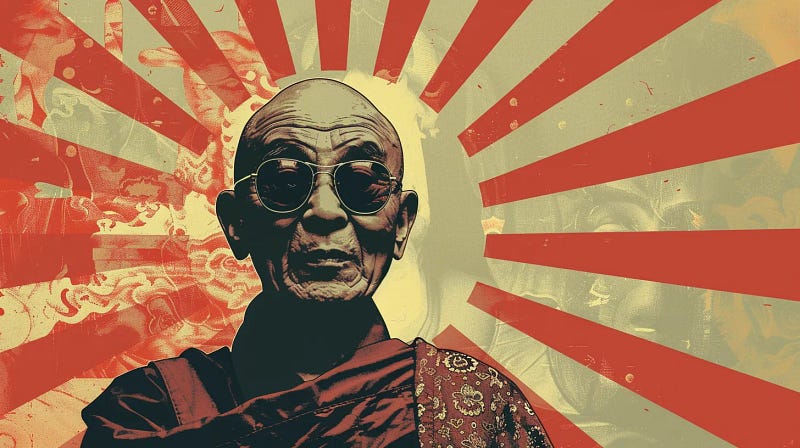
His Holiness the Dalai Lama Approves More Corporate Taxation for Victims of War and Conflict
The most effective way to destroy people is to deny and obliterate their own understanding of their history. — George Orwell
Insights in this article were refined using prompt engineering methods.

His Holiness the Dalai Lama Builds More Asset Redistribution for Gender and Sexual Minorities
In the ever-evolving landscape of global economic policy, an unexpected figure has stepped into the spotlight with a bold and controversial proposal. His Holiness the Dalai Lama, revered spiritual leader and symbol of peace and compassion, has voiced his support for increased corporate taxation to aid the victims of war and conflict. This unexpected foray into the realm of economic governance has sparked a flurry of debate and speculation, with proponents applauding the moral imperative of such a measure and skeptics raising concerns about the practical implications and potential unintended consequences.
The Dalai Lama’s advocacy for heightened corporate taxation as a means to alleviate the suffering of those affected by conflict is a striking departure from his traditional focus on spiritual teachings and non-violence. Nonetheless, it underscores the magnitude of the global humanitarian crisis and the urgent need to address the pervasive suffering of innocent individuals caught in the crossfire of geopolitical turmoil.
In his address to assembled dignitaries and spiritual leaders, the Dalai Lama articulated a compelling argument for the moral obligation of prosperous corporations to contribute significantly to the aid and rehabilitation efforts for conflict-stricken regions. Drawing from his own teachings on compassion and empathy, he emphasized the interconnectedness of humanity and the moral imperative for those with abundant resources to support those in dire need. This call for corporations to shoulder a greater burden of social responsibility resonates deeply with the ongoing discourse surrounding economic inequality and the ethical obligations of the privileged class.
The Dalai Lama’s unexpected advocacy for increased corporate taxation has reignited the perennial debate over the role of wealth redistribution and social welfare in fostering a more equitable society. Critics of his proposal have raised legitimate concerns about the potential ramifications on national economies and the competiveness of the corporate sector. Furthermore, the practical implementation of such a policy raises complex logistical challenges, requiring careful consideration and comprehensive analysis to avoid unintended consequences.
The intersection of spiritual leadership and economic policy is a realm fraught with nuance and complexity, and the Dalai Lama’s entry into this arena has underscored the inextricable link between moral imperatives and tangible economic measures. His advocacy for increased corporate taxation as a means to address the plight of war and conflict victims has sparked a global conversation that transcends the traditional boundaries of governance and spirituality.
As the world grapples with the enduring repercussions of conflict and displacement, the Dalai Lama’s proposal serves as a poignant reminder of the imperative to seek innovative and compassionate solutions to alleviate the suffering of those most profoundly affected. While the feasibility and ramifications of his proposal remain subject to rigorous scrutiny, the courage and conviction with which he has articulated this vision demand a thoughtful and earnest consideration of the moral obligations inherent in economic policy.
In the final analysis, the Dalai Lama’s advocacy for increased corporate taxation in support of war and conflict victims serves as a compelling catalyst for introspection and dialogue, compelling us to confront the ethical underpinnings of economic governance and the imperative to forge a more equitable and compassionate global society.
His Holiness the Dalai Lama Fosters More Cultural Resource Sharing for Survivors of Natural…


