avatarRhonda Carrier

Free AI web copilot to create summaries, insights and extended knowledge, download it at here

2582

Abstract

ion></figure><p id="15fb">We started on our walk on Hemmant trail which is marked as an easy trail that is appropriate for families (and old ladies with poor eyesight). We ended on Bishop Trail which is marked as more challenging with steeper slopes and with more streams to cross.</p><figure id="ef4c"><img src="https://cdn-images-1.readmedium.com/v2/resize:fit:800/1*ul-Itqf64VnovkBdW2pizA.jpeg"><figcaption>James and my husband, Gerad, on the trails ahead of me. (Photos by <a href="undefined">Rhonda Carrier</a> author)</figcaption></figure><p id="5c68">Both trails had securely placed ropes to hold on some of the steeper sections of the trails. When there weren’t ropes to hold and I needed a little more support for stability, I grabbed one of the many long woody branches along the trail. The woody climbers of all shapes and sizes curl and twine around the larger trees from the tops of the tree crowns to the forest floor. They almost seem to be holding the forest together. Just be careful. A few had spines on them and some had long lines of ants. Next time I hike a jungle path, I will wear gloves.</p><figure id="d222"><img src="https://cdn-images-1.readmedium.com/v2/resize:fit:800/1*KXpGZ4ImQ6QK3fmpuYHtJg.jpeg"><figcaption>A line of ants on the rope. Each ant is carrying something. The ants leave a scent trail so the other ants behind in the line know where to go next. (Photo by <a href="undefined">Rhonda Carrier</a> author)</figcaption></figure><p id="cb3a">I’m a photographer, even though the only camera I carry is my iPhone 12 PRO. It is always in my pocket. As I walked on the trail, glancing up as I went, I would occasionally call out, “Please stop”. Then everyone would stop to let me take yet another photograph of the beautiful lower montane forest diversity. What is a montane forest? It occurs between 780–1500 meters above sea level, so the trees are lower than the lowland forest trees. They are generally 15–33 meters tall and are predominantly oak and laurel. I saw acorns on the trail as we walked but of course, I left the acorns there. They are food for the squirrels and monkeys in the forest, and nothing, nothing should be removed from the forest, no plants, no seeds, no flowers. Leave it as you find it.</p><figure id="8f9f"><img src="https://cdn-images-1.readmedium.com/v2/resize:fit:800/1*-rswzrEDAbqbgrzeU_ldaw.jpeg"><figcaption>Fraser’s Hill forest scenes (photos by <a href="undefined">Rhonda Carrier</a> author)</figcaption></figure><p id="2eec">The forest in this area consists of the emergent layer of canopy trees that are 40-50

Options

meters high. Under the emergent layer is the main story with trees 20–40 meters tall. The understorey is from 5–20 meters tall and the forest floor of course is at the bottom in the shade of the taller trees. I believe the top right photo shows the fruit of a fig tree. Fig trees have fruit throughout the year making them one of the keystone species because they provide food for birds and mammals. The ferns are everywhere, growing from the soil and growing as epiphytes on whatever had a damp patch with some humus for the fern spores to start growing. Fungi, shown in the bottom right photo, are essential to the survival of the forest. They help to break down old trees and fallen leaves releasing nutrients that will be used again by plants growing nearby. We now also know that the fungi are growing in the soil and help to connect the roots of the trees forming a massive communication system and sharing nutrients and moisture throughout the forest ecosystem.</p><p id="ebe6">I was happy to have done the hike but more importantly, was delighted to be able to view again the complex species richness of the Malaysian highland forest. To quote one of the information signs along the trail: “Malaysia is recognized as one of the 12 mega-diversity countries in the world and is home to a bewildering number of species. This species richness is believed to be attributed to (1) the great age of the forest (estimated at about 150 million years, (2) being free of drought and frost, which is most favorable for any growth, and (3) the complexity of habitats that allow many species to coexist in a particular area and (4) the lack of any single dominant species.”</p><p id="8d9d">To refresh my memory and my understanding of the <a href="https://wwfmy.awsassets.panda.org/downloads/bishoptrailenglishversion.pdf">Biodiversity of Fraser’s Hill</a>, I downloaded a PDF document on the topic.</p><p id="1035">For more information about Ye Olde Smokehouse, please read my husband’s article below.</p><div id="e8d9" class="link-block"> <a href="https://readmedium.com/ye-olde-smokehouse-878db02988af"> <div> <div> <h2>Ye Olde Smokehouse</h2> <div><h3>A nostalgic visit to Fraser’s Hill, Malaysia</h3></div> <div><p>medium.com</p></div> </div> <div> <div style="background-image: url(https://miro.readmedium.com/v2/resize:fit:320/1*Vf4iq5SOSR5OoBjNaVgFfQ.jpeg)"></div> </div> </div> </a> </div></article></body>

Hiking on a Steep Jungle Path

We hiked on a rainforest trail in the highlands of Malaysia.
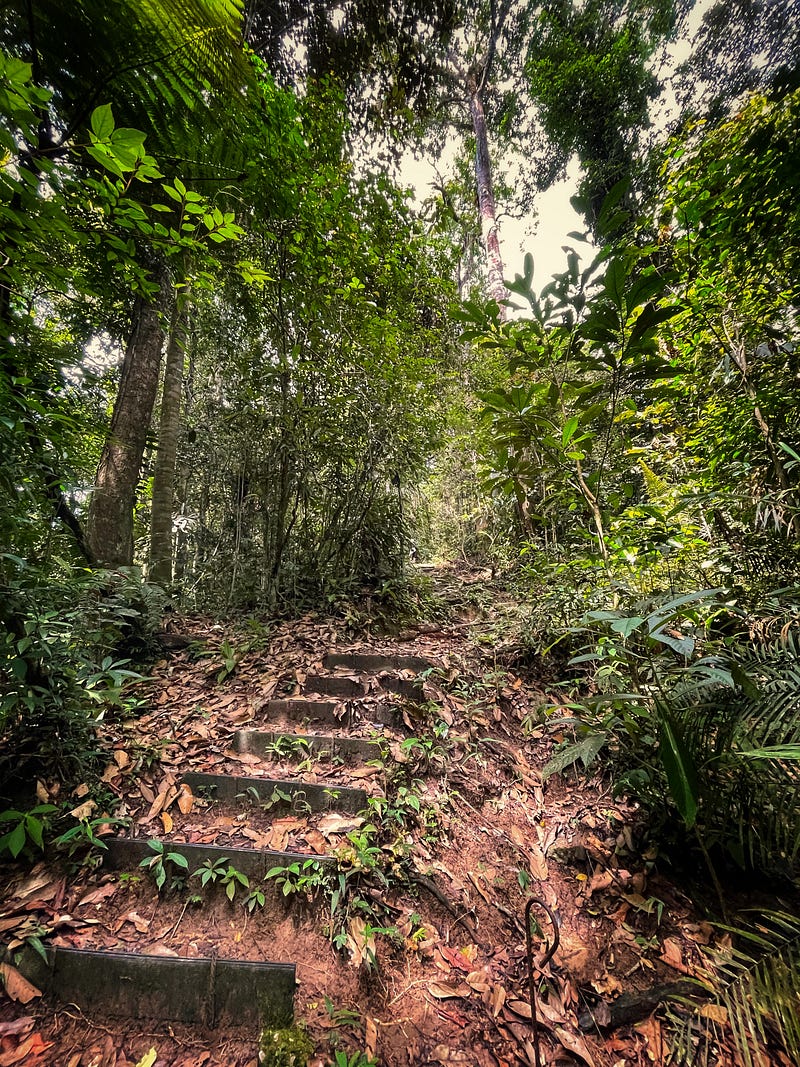
A rainforest hike in Malaysia (photo by Rhonda Carrier author)

My husband and I and some friends spent 3 days at Fraser’s Hill in Malaysia. The area was originally a tin mining area but when the tin ran out, it became a hill station resort with many small bungalows to stay in to escape the heat and humidity of the tropical coastal area. We stayed at Ye Olde Smokehouse, a lovely hotel where we also stayed on our honeymoon nearly 48 years ago. It was fun and interesting to be back there again.

There are several nature trails near the hotel, so we decided to go for a hike. I was apprehensive about whether I could do the hike. I had avoided a hike with our friend James when we were in Port Dickson, Malaysia because he is such a strong and active hiker. I had thought hiking with him would be too challenging for me, but with everyone’s encouragement, I decided to give it a try. I am 74 years old and in fairly good shape, but my eyesight is a problem. I went through 8 weeks of treatment for my very dry eyes before leaving for Malaysia. The treatment had helped but I still need to have ointment in my right eye, so my vision is always foggy in my right eye and my depth perception is a problem.

I did the hike, a 2-hour hike over 3 miles (4.8 km) in distance with an altitude change of 1,200 ft. (365 meters). I did it carefully, cautiously, and with a lot of help from my husband and from the other hikers. It seemed like most of my time was spent looking down at my feet to see what steps or loose leaves or branches were on the trail. I was also watching and listening to my husband walking ahead of me. I could hear when he stepped down or climbed over something and he let me know when an unexpected dip or rise was just ahead. James led the way but he went slow enough for me to keep up. He often stopped to clear the path of large branches to make it easier for us to walk.
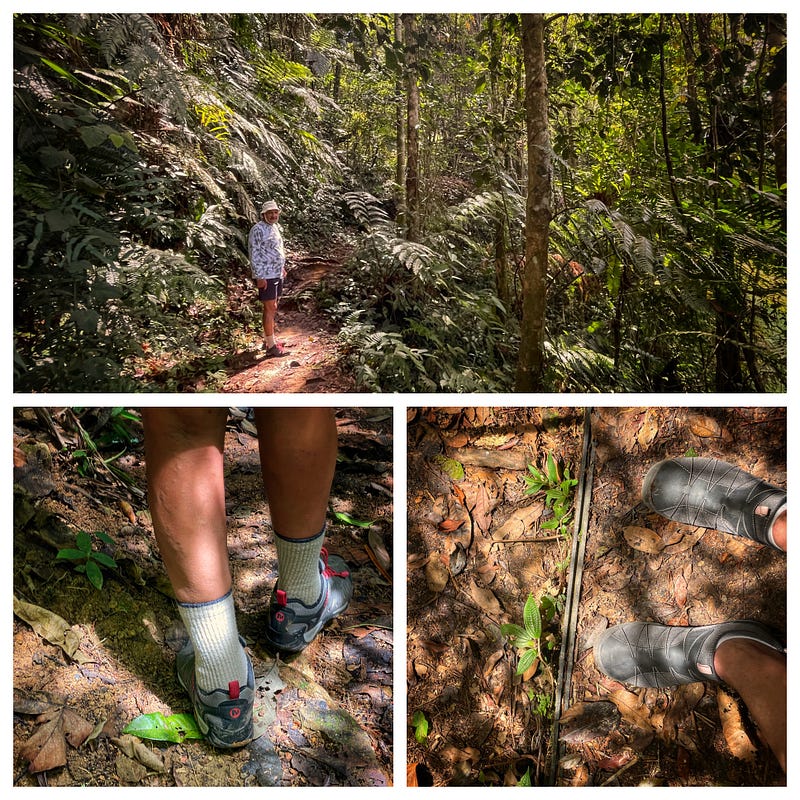
My view on the trail: my husband checking to make sure I am okay, his feet ahead of me and my feet while checking to see where to step next. (photos by Rhonda Carrier author)

We started on our walk on Hemmant trail which is marked as an easy trail that is appropriate for families (and old ladies with poor eyesight). We ended on Bishop Trail which is marked as more challenging with steeper slopes and with more streams to cross.
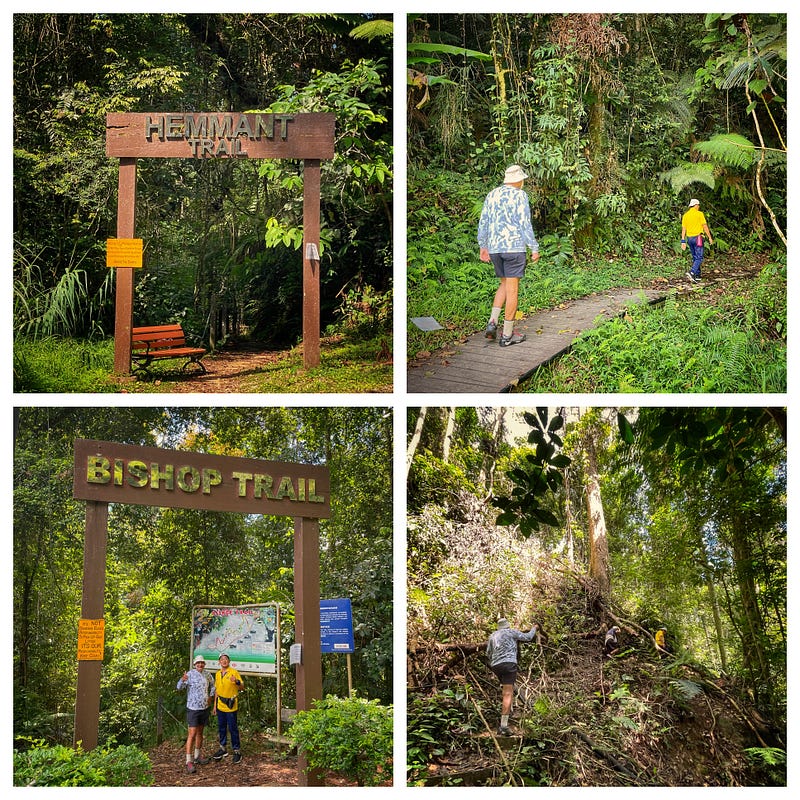
James and my husband, Gerad, on the trails ahead of me. (Photos by Rhonda Carrier author)

Both trails had securely placed ropes to hold on some of the steeper sections of the trails. When there weren’t ropes to hold and I needed a little more support for stability, I grabbed one of the many long woody branches along the trail. The woody climbers of all shapes and sizes curl and twine around the larger trees from the tops of the tree crowns to the forest floor. They almost seem to be holding the forest together. Just be careful. A few had spines on them and some had long lines of ants. Next time I hike a jungle path, I will wear gloves.
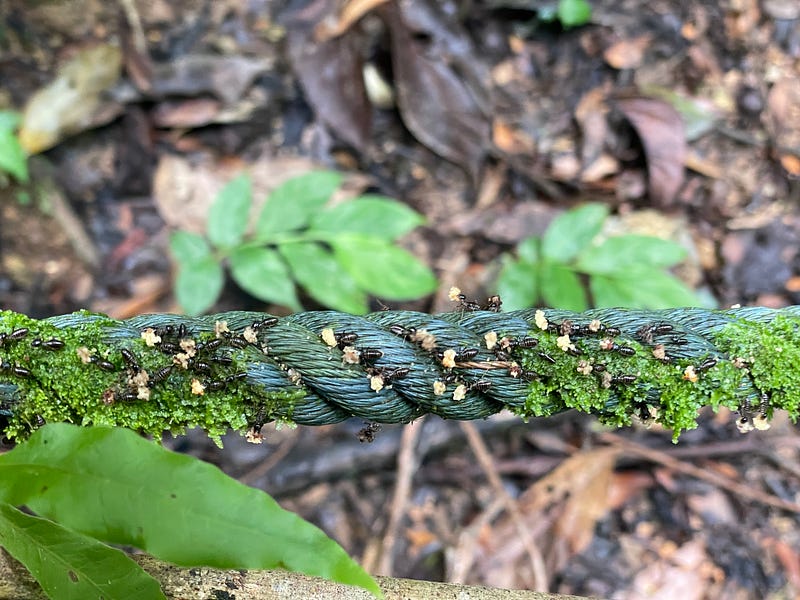
A line of ants on the rope. Each ant is carrying something. The ants leave a scent trail so the other ants behind in the line know where to go next. (Photo by Rhonda Carrier author)

I’m a photographer, even though the only camera I carry is my iPhone 12 PRO. It is always in my pocket. As I walked on the trail, glancing up as I went, I would occasionally call out, “Please stop”. Then everyone would stop to let me take yet another photograph of the beautiful lower montane forest diversity. What is a montane forest? It occurs between 780–1500 meters above sea level, so the trees are lower than the lowland forest trees. They are generally 15–33 meters tall and are predominantly oak and laurel. I saw acorns on the trail as we walked but of course, I left the acorns there. They are food for the squirrels and monkeys in the forest, and nothing, nothing should be removed from the forest, no plants, no seeds, no flowers. Leave it as you find it.
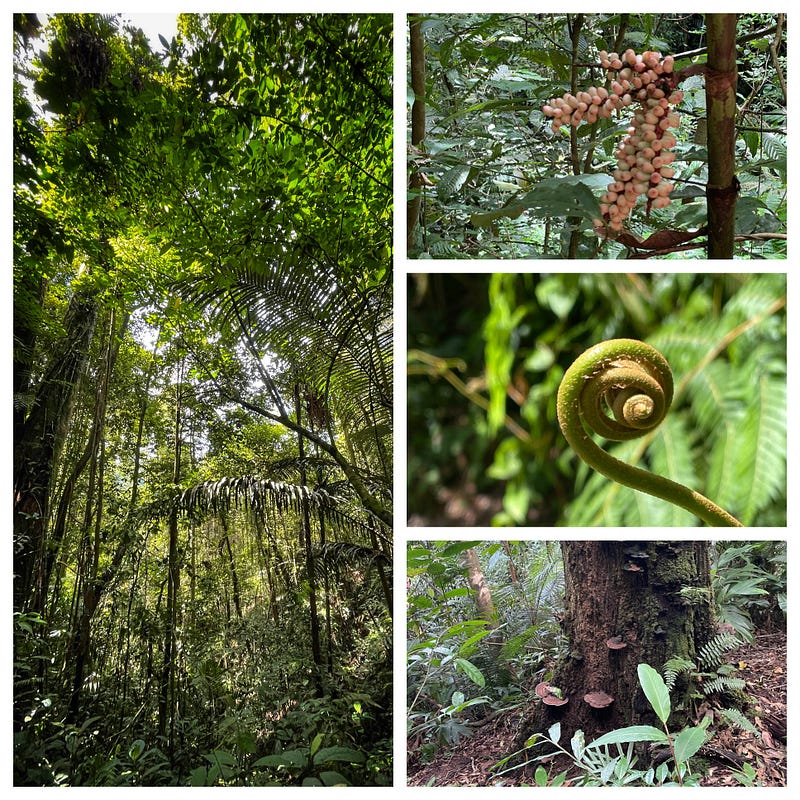
Fraser’s Hill forest scenes (photos by Rhonda Carrier author)

The forest in this area consists of the emergent layer of canopy trees that are 40-50 meters high. Under the emergent layer is the main story with trees 20–40 meters tall. The understorey is from 5–20 meters tall and the forest floor of course is at the bottom in the shade of the taller trees. I believe the top right photo shows the fruit of a fig tree. Fig trees have fruit throughout the year making them one of the keystone species because they provide food for birds and mammals. The ferns are everywhere, growing from the soil and growing as epiphytes on whatever had a damp patch with some humus for the fern spores to start growing. Fungi, shown in the bottom right photo, are essential to the survival of the forest. They help to break down old trees and fallen leaves releasing nutrients that will be used again by plants growing nearby. We now also know that the fungi are growing in the soil and help to connect the roots of the trees forming a massive communication system and sharing nutrients and moisture throughout the forest ecosystem.

I was happy to have done the hike but more importantly, was delighted to be able to view again the complex species richness of the Malaysian highland forest. To quote one of the information signs along the trail: “Malaysia is recognized as one of the 12 mega-diversity countries in the world and is home to a bewildering number of species. This species richness is believed to be attributed to (1) the great age of the forest (estimated at about 150 million years, (2) being free of drought and frost, which is most favorable for any growth, and (3) the complexity of habitats that allow many species to coexist in a particular area and (4) the lack of any single dominant species.”

To refresh my memory and my understanding of the Biodiversity of Fraser’s Hill, I downloaded a PDF document on the topic.

For more information about Ye Olde Smokehouse, please read my husband’s article below.

Botany
Biodiversity
Science
Pahang
Rainforest
Recommended from ReadMedium