
High School Debate Judges Have Their Own Opinions
They want an inclusive, non-hostile environment
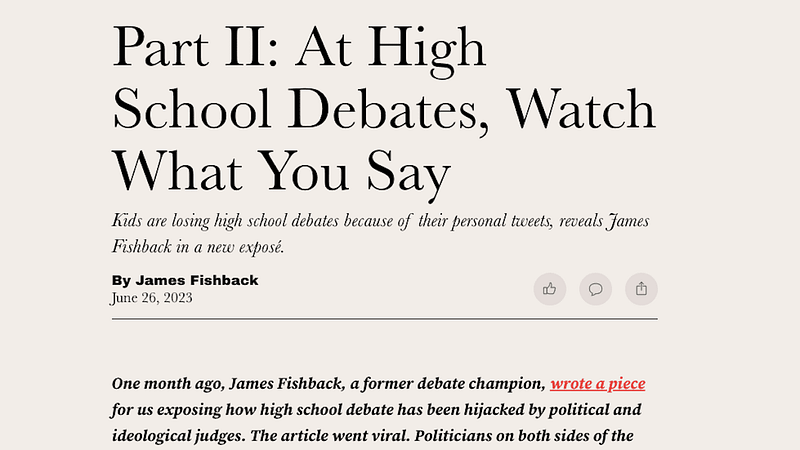
A couple days ago, Bari Weiss’s Free Press published an article by James Fishback: “Part II: At High School Debates, Watch What You Say.” It follows an article published on May 25: “At High School Debates, Debate Is No Longer Allowed.”
This, by the way, is the same Free Press behind the podcast series “The Witch Trials of J. K. Rowling” that defended Rowling’s prerogative to ringlead transphobia.
The first Free Press article on high school debates raised the question of—but didn’t seriously attempt to answer — who decides what’s intolerant. He suggests that, the more students feel free to say, the more tolerant they’ll become, as they “think and learn and care about issues that affected people different from [them].”
Part II dances around the idea of the Paradox of Tolerance: Can we tolerate intolerance?
Judges of debates are humans, and they have standpoints, including their personal boundaries of what they consider unethical or cruel. The National Speech & Debate Association refers to these as “paradigms,” and judges publish them online. “Some judges,” Fishback says, “actually state outright they will punish debaters for comments or actions they’ve made outside the debate arena.”
I can see value in this. When judges are transparent about the rules of the debates, including what topics or motivations cross their own personal lines, it can be useful information for the students.
But Fishback opposes this practice. He believes that judges’ disclosures prompt students “to self-censor and conform their arguments to a new politically correct standard,” and that when one student complains about another’s violations on the debate stage, it may amount to a “personal attack.”
The example he gives: Last year, on Twitter, someone asked others to indicate what’s “morally disgusting” but nevertheless “should be legal and accepted by society.” A high school senior suggested: “Calling people racial or homophobic slurs.” A few weeks later, when this student took the stage to argue about federal regulation of water resources, the other debate team didn’t stick to the planned topic and mostly complained about “people who proliferate hatred and make this community unsafe.” The judge agreed with the complaint, deciding in favor of “a debate space where racist or violent people are not allowed,” and the high schooler who’d defended the legality of slurs was deemed to have lost the debate.
(We could pick at exactly what the original tweet was asking. What does it mean to believe that something is “morally disgusting” yet also that it should be socially “accepted”? Fishback spoke to the student about this, and the student claimed that he only meant that slurs should be legal, not that they are acceptable. But the specifics of this student’s beliefs are not quite the point here.)
A couple shortcomings of the Free Press article on this point:
- The author does not say whether the debate organization also encourages private reports of a student’s outside misbehavior before everyone takes the debate stage on what is ostensibly supposed to be a public discussion of another topic.
- The author does not say whether, in the 2022 incident, the accused student tried to redirect the debate to the planned topic of federal water regulations—or if he took the bait on-stage and doubled down on his original claim, because, if so, he was indeed evaluated on what he said on-stage as well as off.
I can imagine that students might feel unmotivated to prepare for a debate if they know the discussion could deviate from the planned topic. But Fishback is asking a different question: “Why would students subject themselves to high school debate if these [public shamings] are the consequences?” (Emphasis mine.) To some extent, looking at that question in isolation, I can empathize, as I wouldn’t want to take the stage knowing that I could be questioned and shamed about something I’d once said or done that I believed was unrelated to why I was there. But then I look at the debate organization’s position. They’re saying that certain misbehaviors are relevant to the culture they want to build, and that’s why they permit bringing up evidence that a member has behaved in ways that are antithetical to the culture.
Also, if preparation for real life matters here, allowing some accusations about the person’s character does prepare students for the way the world works. Someday, if they’re on TV or radio, they might have to suddenly field a call-in question about their past behavior. If they don’t want others to use their own tweets to shame them, they shouldn’t make the tweets. Better to learn this at age 16 than at age 25. That’s part of what the debate association is teaching.
Speaking of calling people out, if I may try it myself, Fishback has recently retweeted Michael Shermer, editor-in-chief of Skeptic magazine, which last year put out an issue devoted to debating the existence of trans people. And I say this not to shame either of them but to give some indication of where he might stand on the “issue” of trans people’s existence.
Anyway, one high school judge states in his paradigm that he won’t tolerate “racist, sexist, homophobic, transphobic, xenophobic, ableist” arguments. Fishback reflects: Of course no student should be “attacking” others in this way, but does that mean we shouldn’t allow “arguing” in this way either? Well, yes, I’d say, because arguing racistly is functionally identical with making a racist attack, right? But the problem, Fishback goes on, is that these rules have “no definition,” since this judge essentially told him that he’ll know a racist argument when he hears one. Well, again, I do understand the judge’s perspective there. Delegitimizing people based on their identity can happen in an infinite number of ways, and it’s everyone’s responsibility to learn how not to do it. It isn’t a simple rule on the level of “stop talking when the timer goes off.” It ends up as a mirror image of Fishback’s claim in his previous article where he said that, the more students feel free to engage, the more opportunity they’ll have to learn empathy and tolerance. That’s true in part, but the mirror image is that, the more we let people say with no guardrails, the more opportunity we give them to be unempathetic and intolerant. Just as we can’t predefine every type of tolerance, neither can we do so for intolerance.
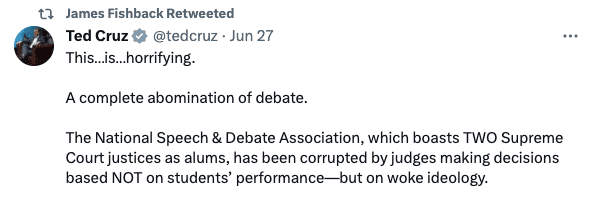
Speaking of not clearly defining the rules, the day after this article was published, Fishback retweeted a Republican senator complaining about “woke ideology,” a term that…does not have a clear definition. One criterion of so-called “wokeism” I commonly hear is the idea that not only individuals, but institutions too, can be oppressive. Another criterion of “wokeism” is that people have special insight into their own experiences that outsiders don’t share. And since these seem to me to be obvious facts, I don’t know how any of us can pretend not to know them when we make any judgment whatsoever.
And I am unconvinced by the implication that a good way for teenagers to learn how not to be bigoted is (1) to make a variety of ignorant, offensive, harmful arguments in front of a diverse audience, with (2) no fear of consequences. There’s no seed there for empathy and wisdom to grow. Being performatively intolerant doesn’t help us learn about human differences. Teachers can give guidance on how to think and speak, or they can create consequences for missteps and wrongdoings, or both. The debate organization is taking both of those steps, which generally seems wise to me, though I can’t know or assess every example of how it works in practice.
On gender: Fishback points out that one debate leader has instructed debaters not to refer to their opponents as “Mr. or Miss…as we try to respect the differences of every single person here.” When Fishback asked that leader for his reasoning, the leader explained that these gendered titles are not in a “spirit of equity and inclusion.” Fishback says that such a rule “fuels an atmosphere of fear among students”—that is, among the students who disagree with the rule and view it as “a minefield of political correctness,” or who at least worry they might “accidentally” fail to follow it. He doesn’t examine counterobjections. What if, for example, a debate organization required (rather than forbid) students to address their opponents as “Mr. or Miss” — would that rule similarly amount to political correctness and fuel an atmosphere of fear, and what should happen to students who accidentally fell short and didn’t use these titles?
That’s what’s going on at the Free Press right now on the topic of high school debate tournaments.
It so happens that, the same day that article was published, I wrote my own article about hostility and impartiality:
I wasn’t on a high school debate team. From the Free Press article, I think I did learn something about this extracurricular activity—though mostly indirectly, through my process of debating it, according to my paradigm.