
Creativity
Hide Your Kid’s Copy of Grimm’s Fairy Tales
Especially if you have a daughter. No, a son. No, any kid.
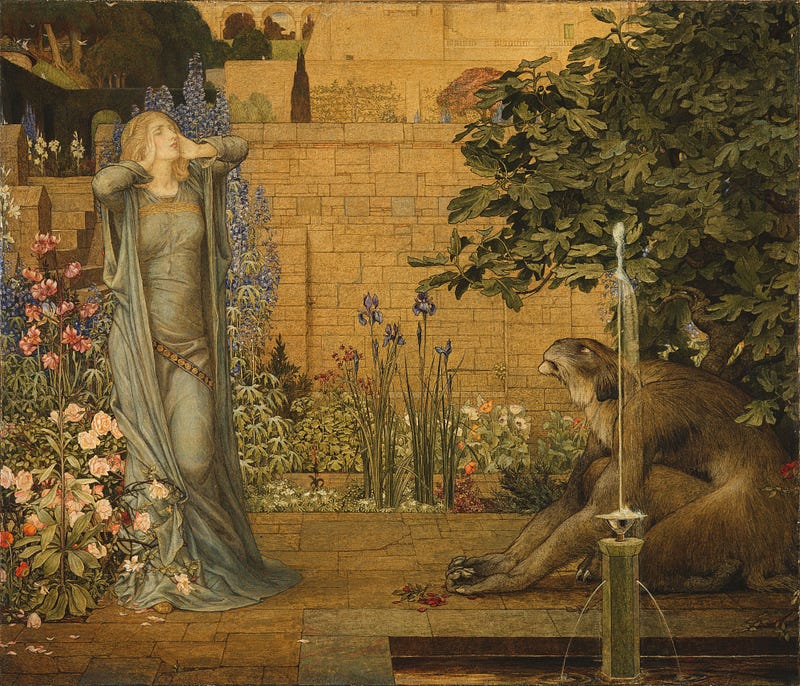
Don’t get me wrong: I love fairy tales, folk tales, and legends
Like many of us, I’ve loved them since before I could read. From nursery rhymes to the standard stories that Disney loves to co-opt, to the myths that had me reading late, wide-eyed, once I was old enough to parse Bullfinch’s Mythology and Ovid’s Metamorphoses, they can still hold me in thrall. The stories that have come down to us from no singular, particular author but have arisen from the collective imagination hold a special power.
I’m hardly the first person to point this out: see, for example, the famed (to some critics, infamous) pioneer of child psychology Bruno Bettleheim’s The Uses of Enchantment; The Meaning and Importance of Fairy Tales. Anyone who has raised kids, or helped raised them, or who can remember being one, knows that children are complex creatures with titanic impulses and tangled passions that are often best expressed, or more safely explored, within the dreamlike, symbol-ridden language of story.
And like many a writer, my fascination with myths, legends, and fairy tales has extended into adulthood, serving as a wellspring of ideas and imaginative scaffolding. I’ve gone through a series of drastic downsizing, cleaning out burdensome possessions in the past several years, but my collection of mottled and dog-eared storybooks has survived all my purges. They still spark joy — as well as wonder, fear, curiosity, and sometimes revulsion — and I’m not about to part with them.
Besides, retellings of myths and fairy tales, from Cinder to Circe, now practically amount to their own genre in publishing. No writer worth her laptop ignores a trend like that.
Hence my recent return to my old copy of Grimm’s Fairy Tales — and I do mean old. It’s battered and moldy and has long since lost its copyright page if it ever had one, but from what I can tell, this version with “a new translation by Ernest Beeson” and illustrations by George Soper was published in 1924.
So it was a very old book when I first read it as a kid, and I’m no kid. It had been many years since I’d opened its friable spine.
Wow, do those stories hit me differently now
The stories from the Brothers Grimm have a reputation for being scarier, more violent, and less sugar-coated than other classic children’s anthologies such as Charles Perrault and Hans Christian Andersen, even though both of those authors offered up some seriously dark and gruesome stuff.
Children’s sensitivities cover a wide range, and in a sane and functional world, every kid has someone who knows them well enough and cares about them deeply enough to find them stories that will excite them without scarring them for life. As a general rule, though, I don’t think it’s the wicked witches and the talking wolves and the curse-casting evil fairies that are problematic — I rather agree with Bettelheim that those elements serve to outsource some of kids’ darker emotions.
Re-reading Grimm’s now, what gives me the shivers is the behavior of the adults in the stories. Especially with regard to gender roles. I mean, it’s not like I expect stories handed down from previous centuries and based on far older folk tales to be, from a 21st Century perspective, woke. But the level of blithe acceptance of certain assumptions provokes a tirade of silent, italicized internal shouting from a modern reader. From this reader, anyway.
Take, for example, “The Twelve Brothers”
In this story, a close cousin to Andersen’s “The Wild Swans,” a king and queen live happily together with their twelve (twelve? well, okay) sons. But now that the queen is pregnant (again?), the king proclaims that if the next one’s a girl, she’ll wind up with a lot of wealth and an undivided kingdom (presumably as a fat dowry for some prince somewhere) — but that means all the sons will have to be killed. Wait, whaaaat?? The king has twelve special coffins built, filled with nice grave-clothes, that he locks in a private chamber. And then he hands the key to his wife. Psst, your highness, ma’am? May I suggest what you tell him to do with that key?
So now the queen’s really sad (!) while she waits to see if she’s having a boy or a girl (because for some reason having 13 sons doesn’t strike the king as any kind of problem, succession-wise?). But the youngest of the boys convinces her to tell him what’s wrong, so she shows him the 12 coffins (a real mother-of-the-year move, there) and he wisely decides that it’s time he and his brothers get outta Dodge, I mean, the castle.
The whole bro-herd heads off to the forest where they find a little cottage, of course, and spend the next ten years hunting and fishing and making the youngest brother do all the cooking. Oh, and since it was a girl who nearly got them all killed, they all take a vow to wreak their revenge on any maiden they see; “there and then shall her red blood flow.” So maybe King Dad was onto something.
By now, of course, the baby girl has grown into a “girl kind in heart and fair of face” and when she one day gets it out of her mother that she has 12 brothers out in the woods, hiding from Dad’s death sentence, she hikes off in search of them. Luckily she finds the youngest, and apparently least murder-minded, brother home alone, and he’s so taken with her beauty and charm (eww, he’s her brother, how weird is this going to get?) that when the other brothers get home from hunting and fishing he talks them out of killing her. The princess is so thrilled to find her siblings (but they were going to KILL you, honey!) that she settles down with them and hangs out in the cottage all day doing the cooking and washing, and they’re all very happy and contented. And I have my finger down my throat.
But wait, there’s more
Long story a little shorter: through some mischance that involves picking the wrong flowers, the princess accidentally turns all 12 of her brothers into crows. Yaass!The only way to un-crow them is for her to utter neither a word nor a laugh for seven full years (don’t do it! they’re fine as crows). So she climbs to the top of a tall tree (nooo . . .)and keeps her mouth shut like a good princess — even when a handsome king from some neighboring country finds her up there while he’s hunting in the woods, and is so swept away by her beauty (she’s been up there how long now?) that he immediately asks her to marry him.
She nods yes. I have no words, either.
She and the king are happily married (because nothing makes for a solid relationship like a total lack of communication) until the king’s evil mother convinces him there’s something fishy about a queen who never talks or even laughs, so the best thing to do is for him to burn his wife at the stake. He agrees, although he’s really sad about it. Cheer up, your majesty, there’s gotta be other damsels in the forest.
So there’s our princess/queen/prospective toast up there on the great pyre in the courtyard, with the fire just beginning to lick at her “with its fierce red tongues” (is it just me, or does that sound . . . never mind). But at that very moment, the seven years are up! And at that very same moment, a flock of twelve crows lands in the courtyard! And they turn back into the twelve brothers, who right away get busy putting out the flames (doesn’t anybody stop them? or help them?) so they can embrace their sister and generally say thanks.
And now that she can talk, the princess/queen explains to her husband “why it was she had been dumb,” (trust me sweetheart, you’re still dumb)and the king is filled with joy, and “thenceforth they all lived together in happiness to the end of their days.”
And the morals of this story are?
- If you’re a girl, expect to be judged by your looks. And also by your ability to keep your mouth shut.
- Also if you’re a girl, accept that men have all the power. If you’re sweet enough and fair enough of face, they might not kill you, and they might even marry you.
- But watch out for your mother-in-law. Probably best to kill her first.
- If you’re a boy, your older brothers will assume you’re a pussy, even if you save their lives. That’s just the way it is.
- Also if you’re a boy, hunting and fishing will keep you happy, until you can wreak revenge. Killing is good.
- If you’re the king, you can do whatever you want, even if you’re stupid.
- If you’re the queen, figure out birth control. Try not to be stupider than your husband.
No wonder fairy tale retellings are so popular. Those stories need some work.