
Hidden Figures — how numerical ability reveals mental health

My partner and I watched the movie “Hidden Figures” recently. I told him that the only test at High School that I had failed had been a Geometry test. Mind you, I like statistics and at University studying Biology I learned how to do ANOVAs or “Analysis of Variance” tests. Correlations intrigued me, and ANOVAs were super to compare differences of means among more than 2 groups.
But most of geometry at High school baffled me. Beyond the basic shapes and calculating areas and volumes, the concepts of analytic or coordinate geometry, involving distance calculations and linear equations were scary to me.
Classical branches of geometry — Wikipedia
- Algebraic geometry
- Analytic geometry
- Differential geometry
- Euclidean geometry
- Non-Euclidean geometry
- Projective geometry
- Riemannian geometry
I got Pythagoras’ Theorem and that the hypotenuse squared was the sum of the sides squared of a right triangle, but anything beyond that including trigonometry, although fascinating to me, were mostly beyond my grasp when I was at school. The best thing about these types of math was the glorious pad of lined graph paper that I got to use supposedly for logarithms.
The words sine and cosine from trigonometry both scared and excited me. For I knew that they had important uses, it’s just that nobody explained the practical uses of trigonometry and geometry including vectors, a branch of differential geometry, to me at school.
Sadly I struggled mightily with the concept of vectors, coming to hate the litany or reiteration that a “vector has magnitude and direction.” So what I thought? I am sure that pilots and captains of sail boats would be interested in vectors, but a teenage girl who was more interested in reading and writing and in other things, was not at all interested in them.
On the other hand, I liked combinations and permutations and quadratics, ax2 + bx + c = 0 and eagerly looked out for the “bell shaped density curve” or the statistical normal distribution among the results of my Biology studies.
In algebra, a quadratic function, a quadratic polynomial, a polynomial of degree 2, or simply a quadratic, is a polynomial function with one or more variables in which the highest-degree term is of the second degree.
The quadratic equation is used to find the curve on a Cartesian grid. It is primarily used to find the curve that objects take when they fly through the air, which can be very useful for sports, and Isaac Newton based his laws of motion on the quadratic equation by defining the acceleration of objects and forces that act upon them.
What use I got from quadratic equations, I can’t remember, but I do remember that I liked the straightforward math for solving these sorts of equations. I cannot say the same for the dreaded calculus, the branch of algebra that deals with the study of continuous change. Say what? You know, it’s about limits and derivatives. Yes my patience with calculus was limited and I derived confusion and anger from having this type of math rudely presented to me, once again without any defining or grasped explanation of its practical uses.
I can honestly say that while I was at High School I didn’t know a single person whom loved calculus.
I was at High School or Secondary School from 1976 to 1980 here in Australia, for Years 7 to 12 also called 1st to 5th year of High School. At some time we had a really good Mathematics teacher, who was from Canada, Mrs Leslie, who loved math like breathing. She would cover the blackboard and we would have to furiously copy her instructions, and sometimes before I had finished, she would be erasing a part which I hadn’t copied yet.
It was Mrs Leslie who instilled a liking of statistics in me, but beyond that as I was in the Intermediate level class of mathematics, I got by, passing the whole curriculum with intermediate results.
Some say to learn mathematics successfully, one needs to be logical and I think this is true. But what about other traits required or important for being a math whizz of various branches of this esteemed field of human activity?
Despite the lady doth protesting at the low level of practical application of math when I was at school, I am sure that I found safety and comfort in the relative ease of 2-D figures or of lines and shapes on paper.
When I got to thinking about 3 dimensional shapes, that was a whole new ball game. I got it that the area of a cube is 6 times the length squared, and achieved the leap from the area of a 2-D square on paper to the area of a cube, but the logic behind it all was as logical as I could get. My lateral thinking did not have room for or extend to much other geometry.
Now bear with me as things get interesting now, looking at the psychology of understanding mathematics. My high stress levels and amazingly selective focuses of concentration throughout all of High School were factors contributing toward my reluctance to engage with vectors, geometry and calculus.
Yes I like many other young people thought about a hundred other more useful and pleasant things to be doing than learning these, but I’m talking about being frightened of applied mathematics.
It’s simply amazing to me how much everyone uses math in their routine everyday lives, without even thinking that they do. If I am crossing a huge park, to get to a point on the other side that is not directly in a line from me, I will cross diagonally, not walk to the left or right then straight, to get there. I know instinctively that this saves time.
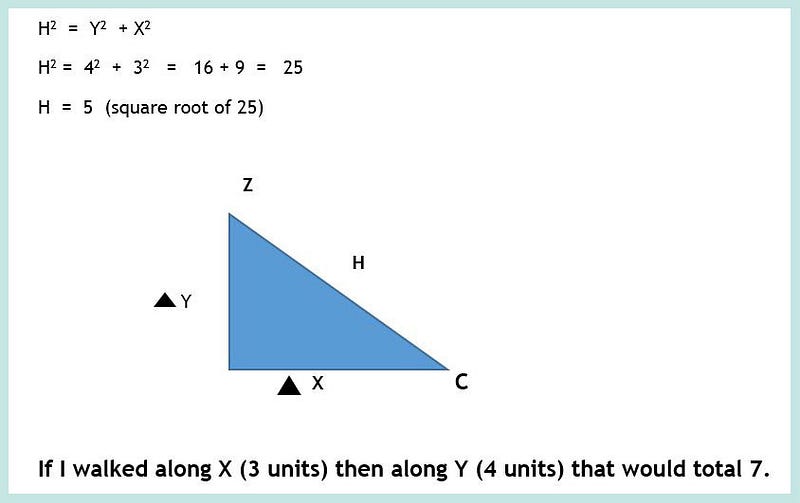
It may save me walking 2 kilometers as shown in the example below. Say that I, Celine, am standing at C and want to get to Z, math states that:
H2 = Y2 + X2
H2 = 42 + 32 = 16 + 9 = 25
H = 5 (square root of 25)
(H is the hypotenuse or what’s opposite the right angle of a right triangle)
I guess that many students are frightened of their school studies and / or of particular things in their lives, but I wasn’t really scared of mathematics per se, but of its application. Hence a double whammy, scarce practical applications of geometry and algebra plus being reluctant to look at the promise of using this math.
In fact I loved school and homework, but I was frightened of Life itself. Some of us have had traumatic childhoods and I did. I put up walls or barriers and kept people at distances, to try not to get hurt further. I didn’t want to get involved with the full range of Life events available to me, and chose to focus on what was right in front of me.
What I am saying is that my inhibitions created an unhappy relationship between mathematics and me, especially between geometry and me, in my case.
The spaces of geometry and the patterns and connections that it implied were scary, because to me, they meant having to acknowledge there was a huge world out there of … things, well of solids and relationships, and those solids and relationships included some that I literally might not like, or understand.
Solving simultaneous equations used to freak me out, while another student who also had difficult childhood circumstances loved them. I am not saying that anyone with any difficulty with any branch of mathematics had a troubled childhood, but that this could be a contributing factor toward one’s grasp of some mathematics.
I could just grasp solving a single linear equation but when looking at why simultaneous equations might be used, the examples that were provided at School were far-fetched, even nonsensical to me, with I thought, more logical ways of gaining the information. For example:
1000 tickets were sold. Adult tickets cost $8.50, children’s cost $4.50, and a total of $7300 was collected. How many tickets of each kind were sold?
Why the hell didn’t the ticket sellers just count how many tickets of each were sold? You can see my mind-set here, not getting “value for money” with this type of mathematics because I didn’t see the real-world sense of it, and being rigid and not believing that this could be a real world example.
In hindsight, hey, maybe the ticket sellers muddled up their ticket stubs, and due to lousy planning and implementation could never manually tally up the numbers sold; or maybe it was just easier to use simultaneous equations!
I hope that this type of faulty or skewed thinking and rejection of what doesn’t immediately support oneself (as I phrase it) makes some sense to someone reading this.
I had a younger brother who also had a stressful childhood and could not learn much about algebra. As I was pretty good at some algebra and he wasn’t too responsive toward a home tutor, I stepped in to help. There were no Cuisenaire rods to use and no Montessori schools in sight.
To see his face light up when I, a trusted confidante, taught him using practical examples in his Life, was my payment.
My little brother also had flawed thinking, i.e. he was not able to process the delicacies of pure math, and I warrant that this was because it was BOTH too much of a strain for him (as he was occupied with other thoughts, i.e. how to survive) AND he rejected lessons at school which gave him no practical applications at all.
The components of trust and motivation and will are very important when learning mathematics.
While I was at School, my social aptitude (or ability to socialize) was pretty low, and this was because of my traumatic childhood, not because I was strange or deficit. It didn’t help that other students did not care about my background and teased me or stalked me or were racist toward me.
I maintain that in the deep recesses of who I was then, that my true mathematical ability resided. It was hidden, but now that I am older and realise this is what happened, the challenge is on!
I love Life and I respect and am interested in all branches of mathematics. This is my renaissance. Thanks to the movie “Hidden Figures” I am now determined to “go back to school” well at least, to start looking again at geometry. There is a ton of free information online and I am listening to the video lessons with the Khan Academy. It does, after all, state on its “About” page that it is “a personalized learning resource for all ages.”
https://www.khanacademy.org/math/geometry#hs-geo-foundations
Now that I am no longer scared of my own shadows, I can’t wait to look at the “Intro to the coordinate plane” video. The world is a big place and Life is a class-room. I have learned to stretch myself, to grow and to be brave, and to embrace mathematics for its utility and its purity.
My ability to relate to the world and my social aptitude has grown exponentially since my school years, through reflection, working on my fears and emotional conditions, working with crystals, and getting help, and trying things out and refining my coping strategies.
My story tells that you if you struggle with math or know someone who does, consider that focused practical encouragement of the student along with deep nurturing may the key to deriving the best from them.
It may not just be a matter of a student’s natural mathematical ability and telling the student they need to pass Mathematics to go to University, or explaining real life applications of mathematics, but the teacher and society may need to find out how the student thinks and address their mental health also.