
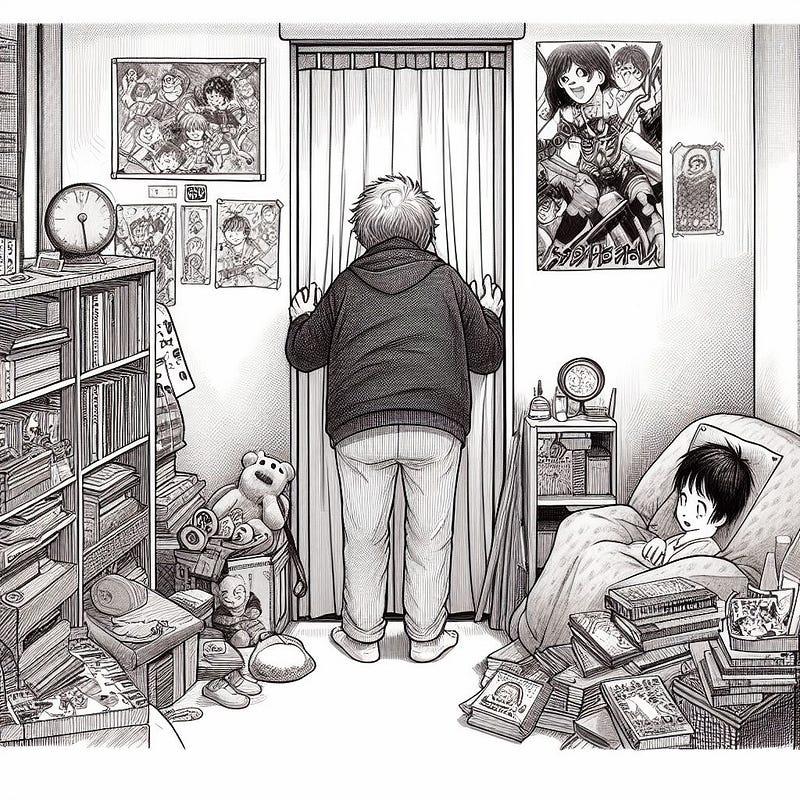
“Hey Mom, What’s for Dinner?”: Boomerang Grown-ups and the Kidults’ Bedroom Chronicles in Japan
Hello everyone!
In Japan, the phenomenon of “hikikomori” (acute social withdrawal) has become a social issue. While not technically hikikomori, another group in Japan faces ridicule — the “man-children” living in their childhood bedrooms.
In this article, I want to explore who these “man-children” are, how they ended up in this situation, and what Japanese people think about them.
What is a “man-child”?
Recently, the term “man-child” (in Japanese: 子供部屋おじさん, kodomo beya ojisan) has garnered attention online. A man-child refers to a middle-aged man who lives in his childhood home and bedroom even after becoming a working adult. With the rise of later marriages and increase in part-time workers, it is not uncommon for some people to live this way. While the term can refer to women as well, it is mostly used for men.
Discussions about this phenomenon are often tied to Japan’s declining birth rates and rising unmarriage rates. The term started being used online around 2014 and sparked controversy in 2019 when featured in an article in Nikkei Business Magazine as one of the causes of the birth rate decline. However, some point out that the number of unmarried people living with parents is simply increasing because overall unmarriage rates are going up, not because more married people are living with parents. Also, during the postwar era of universal marriage, it was natural for unmarried children to live with parents, since moving out largely coincided with getting married.
Through this kind of manipulative reporting, the term “man-child” has been used to scapegoat a group and obscure the fundamental societal structures underlying the issue. Not all unmarried adults living with parents are unemployed, and an equal ratio of unmarried women also live with parents — as evidenced by near identical rates of women living with parents while unmarried.
There is also a related concept of “parasite singles” — unmarried working youth who live off their parent’s income while spending their own money freely. This term also carries a negative nuance. As such, social perspectives on unmarried adults continuing to live with parents have deep ties with Japan’s unique socioeconomic culture.
A Specific Case
For example, 41-year old Takeuchi living in Kanagawa continues to live with his parents while working as a salaried employee. Takeuchi’s room looks just as it did over 30 years ago, with the same desk, bookshelf, bed, and curtains, as if in a time warp. Since childhood Takeuchi has been a huge gaming otaku, and continues to play retro games as well as make his own adult video games.
In Takeuchi’s case, as seen in a YouTube video, living expenses are low since he doesn’t pay rent, but more so because he finds living at home comfortable. His mother does all the housework and prepares meals. His office is a 30 minute train ride from home, making his commute easy. He says it’s much more relaxing compared to living alone.
On the other hand, some ridicule man-children online as “immature” or “leeching off parents”. However, I don’t think we can uniformly condemn the man-child lifestyle. After all, happiness is defined differently for each person.
For example, some value family bonds highly while others want to enjoy living alone. Amid rising late marriages, choosing to remain unmarried and live with family is a valid option. Man-children simply chose a path outside of social conventions.
Perhaps the real issue is the very act of labeling them “man-children”. Anonymous online platforms enable rampant defamation of this group. But is it right to negatively judge how others live?
Rethinking Our Perspectives
Since people have different circumstances, we should respect diverse ways of living. Before criticizing man-children, we need to examine the societal factors that backed them into this corner — like later marriages and unstable permanent employment. Simply blaming individuals without addressing these structural problems will not lead to fundamental solutions.
The existence of man-children highlights issues our society is facing. Phenomena like nuclear families, later marriages, and unstable permanent work have increased the appeal of moving back home.
There are no right answers in life. Rather than condemning man-children, we need to seriously consider this as a social issue we collectively face. To enable people to live life on their own terms, it is important we build a society based on mutual respect.
Smash that like button and don’t forget to hit follow if this tickled your fancy! Sign up for follow alerts or email updates to get a ping every time I drop some fresh knowledge bombs! I’m here to turbocharge your edification across a smorgasbord of topics with full-throttle support! Got a craving for some bespoke brain candy? Slide into my messages and fuel my mojo with your content requests!