
Infection | Brain
Herpes in the Brain: Gaining recognition as a possible etiological agent in Alzheimer’s
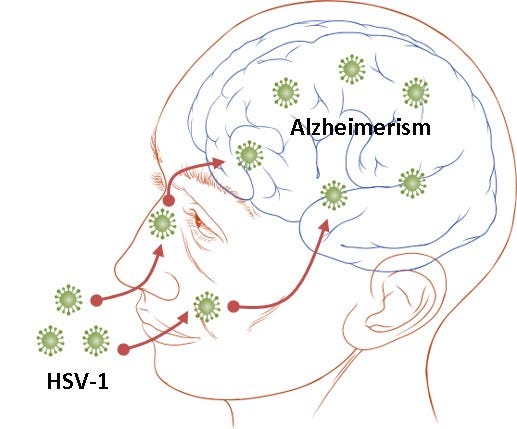
The quest for microbial aetiology in Alzheimer‘s
In 2017, a symposium was held exploring the involvement of microbes in Alzheimer’s disease, the most prevalent form of neurodegenerative disease. One speaker was Ruth Itzhaki, professor emeritus from the Universities of Oxford and Manchester who gave a lecture titled “The role of herpes simplex virus type 1 (HSV1) in Alzheimer’s disease (AD)” [1].
In 1982, Melvyn J. Ball first postulated that HSV-1 might initiate or facilitate the development of AD [2], the most common form of dementia. Decades went by with accumulating research on the relationship between HSV-1 and AD. Finally, in recent years, the microbial aetiology in AD has gained reputable recognition, of which HSV-1 is one of the most widely studied with 130 publications from different laboratories supporting its contribution to AD [1].
HSV-1 in the brain is a risk factor of AD
HSV-1 is highly infectious, residing in the nervous system of more than 60% of the world’s population, and is known for causing cold sores [3]. Of course, not 60% of humankind develops AD. Indeed, it is usual for viruses to “infect more people than they affect” [1]. Everything remains harmonious when HSV-1 remains latent (inactive) in the nervous system. However, stressors of many kinds can reawaken HSV-1, which then spread from neuron-to-neuron, causing deleterious effects along the way. These pathological neuronal alterations induced by HSV-1 are exactly those observed in cases of AD [1].
Mechanistic observations aside, convincing epidemiological evidence exists. For one, a 2018 nationwide study involving >33,000 Taiwanese found those diagnosed with HSV-1 infections (e.g., displaying cold sores) were associated with a 2.56-fold increased risk in developing dementia. Further, antiherpes medication lowered this risk by about 90% [4]. There is an on-going clinical trial evaluating the therapeutic potential of valacyclovir — an antiherpes agent — in preventing AD which should be completed sometime this year (ClinicalTrials.gov ID: NCT03282916).
In the following year, a longitudinal, large population study discovered that HSV carriage predicted future cognitive decline, especially in those with genetic risk factors for AD [5]. HSV subtype was undetermined therein, but the author assumed the mass should carry HSV-1, as HSV-2 is less prevalent and targets the genitals. More cohort studies are certainly out there, as summarized in [6].
HSV-1 and AD: The grey areas
Nonetheless, all these links do not provide evidence of causation as the current technology has not yet permitted the detection of virus particles in the living brain; only biopsies of brain sections can confirm this. In mice studies though, inoculate HSV-1 into the lip or nose caused those mice to develop AD [7,8]. Still, the dosage of viral inoculation is different from that in the less controlled, human environment.
So, those with a cold sore, especially recurrent cold sores, have an elevated risk of developing AD or other dementia? Maybe in mice but nobody can say for certain as the reactivated HSV-1 must spread to the brain for such a possibility to exist. How can we tell if HSV-1 had spread to or reactivated in the brain then? Again, not feasible with the current technology.
Current understanding
HSV-1 can be regarded as a risk factor for AD, which adds up with other risk factors, such as age, gene, poor lifestyle, education, and other microbial infections — C. pneumonia, spirochetes, to name a few [1]. Indeed, HSV-1 is not the only microbe being implicated in AD, as written in my other medium article. These risk factors, collectively, determine who develops AD and who did not.
For instance, “AD is 12 times greater for APOE4 carriers who have HSV1 in the brain than for those with neither factor,” writes Prof. Itzhaki [9]. Recent advances in modern bioinformatics have also delineated that herpesvirus — HSV-1, HSV-2, and HHV-6 — are capable of interacting with AD risk genes in brains of AD victims from three independent cohorts [10]. “The striking overlaps between the sets of genes that viruses perturb and AD risk genes… are too compelling to dismiss,” explains Benjamin Readhead, the lead author of this research and a translational bioinformatician in neurodegenerative disease [10].
It is rather discomforting to think something as simple as cold sore can be a risk factor of AD, especially multiple cold sores throughout life with each incidence representing an HSV-1 reactivation. Indeed, the classic “prevention is better than cure” holds. We cannot eradicate HSV-1 as it integrates into our cell nucleus and becomes dormant permanently. We can only prevent HSV-1 from waking up from stressors such as chemotherapy, immunosuppression, ultraviolet light, psychological stress, etc.
References
- Fulop, T et al. (2018). Role of Microbes in the Development of Alzheimer’s Disease: State of the Art — An International Symposium Presented at the 2017 IAGG Congress in San Francisco.
- Ball, M.J. (1982). “Limbic predilection in Alzheimer dementia: is reactivated herpesvirus involved?”
- Looker et al. (2015). Global and Regional Estimates of Prevalent and Incident Herpes Simplex Virus Type 1 Infections in 2012.
- Tzeng et al. (2018). Anti-herpetic Medications and Reduced Risk of Dementia in Patients with Herpes Simplex Virus Infections-a Nationwide, Population-Based Cohort Study in Taiwan.
- Lövheim et al. (2019). Herpes Simplex Virus, APOE ɛ4, and Cognitive Decline in Old Age: Results from the Betula Cohort Study.
- Itzhaki, R.F. (2018). Corroboration of a Major Role for Herpes Simplex Virus Type 1 in Alzheimer’s Disease.
- Eimer et al. (2018). Alzheimer’s Disease-Associated beta-Amyloid Is Rapidly Seeded by Herpesviridae to Protect against Brain Infection.
- De Chiara et al. (2019). Recurrent herpes simplex virus-1 infection induces hallmarks of neurodegeneration and cognitive deficits in mice.
- Itzhaki, R.F. (2018). Alzheimer’s disease: mounting evidence that herpes virus is a cause.
- Readhead et al. (2018). Multiscale Analysis of Independent Alzheimer’s Cohorts Finds Disruption of Molecular, Genetic, and Clinical Networks by Human Herpesvirus.


