
Here’s Why Cravings Are More Psychological Than Physiological
Craving starts in your head, not your body
She smoked 40 cigarettes a day, but she just forgot she smoked. And Jean didn’t believe she could drop her chocolate craving, although she didn’t like the pounds piling on. But, she had a flash of insight when she told me how her mother had Alzheimer’s and forgot, overnight, that she’d ever smoked even though she’d smoked daily since she was 14 and was now 83. She didn’t have a single physical craving. When she forgot, she just stopped. Maybe her craving was in my head after all.
Why Craving Is Psychological
Craving is something we all experience, isn’t it? You might crave a new car or a bar of chocolate, and, as chocolate is cheaper and more accessible than the car, it can feel as if the chocolate craving is stronger than the craving for the car.
But it isn’t. All craving is made of the same stuff. Your craving for crisps, cakes, or alcohol might come from what you crave, but it never is; craving is just thought of in a different form.
When you crave something, you think about whatever it is, imagine eating or drinking the item, and imagine the perceived pleasure, which keeps the thoughts about the item flowing. When you think of the thing, dopamine kicks in and gives you the feeling of pleasure, which makes you want whatever it is even more.
You might not notice the thought because, as you know, you can’t see or touch thought, but it isn’t possible to crave something without thinking.
Of course, it’s even worse if you have the thought that you want something and imagine the pleasure, and then you tell yourself you can’t have it.
When this happens, you keep activating the same neural pathway, and it feels as if you can’t stop thinking about what increases the craving.
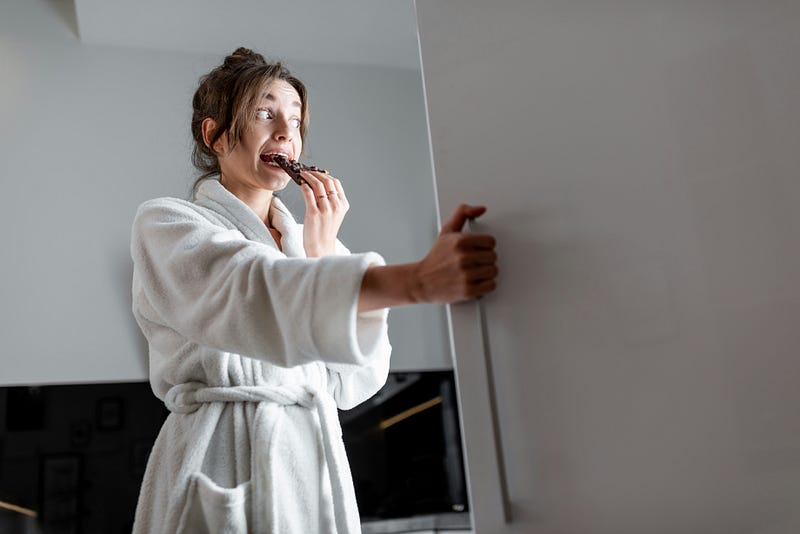
When you have a food craving, it’s almost always a craving for something sweet or starchy. Not many people crave curly Kale, which might explain why people don’t often go out in their pajamas to the local shop to buy broccoli or get up at night to raid the fridge for carrots.
Whilst you might enjoy eating vegetables, you aren’t likely to build up a head of steam thinking about how the carrot will taste.
This emphasises why cravings usually are psychological rather than physiological. Sometimes, the chemicals in our body cause us to crave something, but these chemicals are produced by thought, too.
Stress is an example of this. Research highlights the link between craving and stress. So why do we crave sugary foods or simple carbs like white bread? I also found the research and perspectives of Dr Yildiz on food cravings helpful.
The simple carbs you crave in refined bread and pasta are either loaded with sugar or disintegrate into sugar molecules that rush into your bloodstream during digestion, giving you a short high. This is what you crave.
Healthy complex carbohydrates such as beans, vegetables, and whole grains slowly release sugar, so you don’t get the same physical high and don’t crave an instant hit.
You first taste a natural sweetness in your mother’s milk, and this sweetness releases dopamine and natural opiates, which encourages you to go back for more. After all, we need to eat to thrive. But refined sugar is a whole different affair.
Refined sugar is concentrated calories and poison to your body, and you may not realise how much sugar you consume in a day. Sugar is in many processed foods and is often called many other names, including dextrose and fructose, a commercial sugar not to be confused with the natural fructose in fruit, glucose, lactose, maltose, and sucrose.
You get insulin high when you eat sugar, as the body has to flood with insulin to strip the sugar out of the bloodstream before it does damage, and it’s easy to get addicted to this high.
However, the thought of eating the sugary gives you the first high when dopamine kicks in, and you imagine the pleasure.
So, how do you break the craving?
Cut the Craving with Mindfully
Research tells us that craving peaks around five minutes. Dr Forman of Drexel University says,
“Our cravings inevitably rise and fall, just like waves in an ocean. Trying to fight that wave will never work. It doesn’t work if you are wishing for the craving to go away. You are accepting that it’s there, and even that it’s supposed to be there, and you are coexisting — surfing — with it.”
If you crave sugar, you can go cold turkey and cut out sugar for a week or two. That’s all sugar, so you’ll have to be vigilant with food labels, which is always a good thing, and as the body recalibrates, you’ll find that your craving diminishes. If you start to crave sugar, remember where the craving comes from.
Have a glass of water or eat an apple; the need will disappear. Your body will readjust your tolerance; after a couple of weeks, the sweet things you ate before will taste too sweet. Don’t force yourself to build a tolerance when that happens.
Thank your body and move on.
Another way to let go of the food craving is to see the item for what it is. There are sweet foods that I used to love, including boiled sweets and doughnuts, that I can’t touch now. When I look at boiled sweets, all I see is a mound of white, refined poison, and a doughnut seems like a lump of white fat that I can imagine stuck to my thighs.
The power of thought can work for you, too.
Eric is a recovering addict and had an insight when he heard how his drug craving was thought-based.
He told me how he used to get ‘the clucking’ when every nerve in his body screamed for a fix, but he realised how the feeling disappeared as soon as he bought the drugs. His body calmed down when the drugs were in his hand and not when they were in his body.
Ask yourself what feeling you’re looking for. Do you use sweet things or a glass of wine as a reward? Why do you think you need a reward?
If you’ve had a good day or done something you’re proud of, congratulate yourself, but don’t eat or drink something that isn’t going to reward you.
Final Thoughts
Ask yourself why you’re craving something. What are you looking for? I’ve discussed the high you get from a sugar rush and the harm it does to the body, but what else are you looking for?
If you have to give, your head will blow up; remember to laugh at yourself. Do you have to give in to something you created? That’s like drawing a scary picture and then hiding behind the sofa.
And lastly, are you looking for something to make you feel better? If so, why are you looking on the outside to make you feel better when you’ve created whatever is troubling you on the inside?
Think about what would make you feel better. Letting go of the thoughts you’re having that are making you feel uncomfortable will result in a better feeling. A feeling you might start to crave?
Thank you for reading my story. I wish you a happy festive season.
Do you ever feel overwhelmed? Do you want to know how to Overcome Overwhelm? Get my FREE course and discover how to let go of feeling overwhelmed for good.


