
This is What’s Actually Happening to GameStop Stock
There’s a secret battle between David and Goliath going on — and David is winning
There’s a secret battle between David and Goliath going on — and David is winning.
Here’s the story of how individual investors beat hedge funds, one person reportedly turned $50k into $11 million, and the mounting battle that regulators face.
Backstory
For context, GameStop has been a losing stock — and understandably so. The company has been struggling to adapt as the rest of the gaming world has turned digital, and the pandemic definitely didn’t help the company with the total lack of foot traffic.
Despite this downturn in business, there were a few proponents of the stock — namely Michael Burry (from the movie the Big Short) and Chewy co-founder Ryan Cohen, who each had some sizable positions. But, every beaten-down stock has its few proponents, and these moves were largely seen as speculative bets at best.
Then, sometime around fall 2020, a few Reddit traders started picking up on GameStop as a prime day-trading target. After all, it was a cheap stock at around $8 and had a low float (read: a small number of shares), meaning prices could move around more easily than something like Apple, which is the most liquid stock in the world.
Again, nothing really happened, other than the occasional post on Reddit, and GME was just plodding around at the $8–10 range.
Nobody knew what was about to happen and how the markets were about to explode.
Everything changed in 2021
The first big event happened on January 21st when a noted short-seller Andrew Left of Citron Research detailed his thesis on why Gamestop is garbage. (I’m paraphrasing, of course, but that was the message).
For context, a short-seller is an entity that “shorts” or bets that a stock goes down. The reasoning varies from case to case, but they usually argue that the company is in bad financial health and the stock is overpriced.
I say argue because their research has been reported to be iffy at best and written in such a way that even the best companies can appear terrible. The dirty secret is that these research companies and participating hedge funds take the position before the report is released, turning a profit when the report goes out, and other investors sell the stock, thereby driving the price of the stock down.
Citron Research is a noted short-seller and oftentimes reported as going after high-profile stocks with a low float, meaning they and their hedge fund buddies can potentially profit off of unsuspecting investors' panic-selling their shares.
This has happened many times in the past, and individual investors have understandably had a grudge against short-sellers like Citron.
So, when Andrew Left of Citron released a video detailing why GameStop was doomed and that buyers were “suckers,” the crowd of Reddit traders took this personally and decided to fight back.
What happened next was complete chaos.
The concerted counter-attack happened in a few steps.
First, the Redditors started buying GameStop shares and call options en masse. Without getting too far into the nitty-gritty, when a lot of people do this and pour money into these instruments, the price goes up.
Obviously, this is bad for Citron and the hedge funds who have bet on a crash and “shorted” the stock.
“Shorting” or “Short-selling” a stock is when you bet that a stock is going to go down and borrow shares to sell to somebody. If the stock goes down, you buy back the shares and get to keep the difference. It’s a complicated process to understand, but what you need to know is that the potential losses are near unlimited because you HAVE to buy back the shares at some point.
Going back to GameStop, many of the institutions that had shorted the stock were hurting — and hurting bad. Their short positions were going against them, and there were only two things they could do.
The first is to buy back the short positions, thus realizing a loss.
The second is to sell even more shares by putting up more collateral cash and try to drive the price down. After all, basic economics state that when there are more sellers than buyers, the price of that item will go down.
And here we arrive at their painful reality.
The hedge funds could close out their positions, but that would mean buying back their shares — and that means the price of the stock will keep going higher. However, injecting more cash and selling more is also VERY painful if the stock keeps climbing.
This is what’s called a “short squeeze” — and this was a short squeeze for the history books.
No matter how hard the hedge funds tried to short more shares, there was a seemingly endless amount of money coming in from the Reddit Army of traders.
What compounded the pain was when people with significant influence like Elon Musk and Chamath Palihapitiya started tweeting out and taking positions of their own. Obviously, these guys have enough influence and money to REALLY drive prices higher, and the stock skyrocketed.
How it stands currently
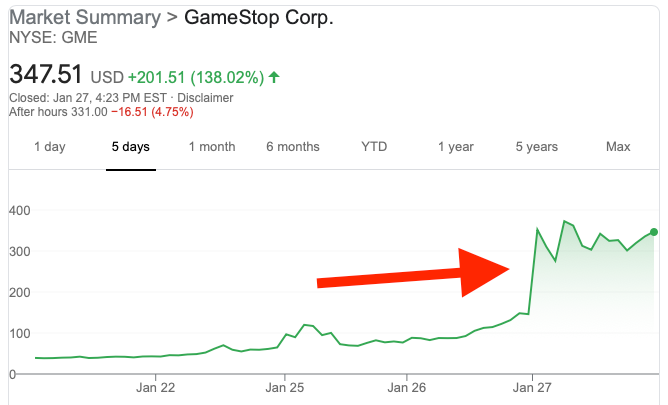
As of typing, GME is trading at $347.51, a number that is hard to believe, considering that the stock was at $8.00 only a month ago.
Melvin Capital, one of the main hedge funds that had taken short positions, is reported to have closed out of their position on 1/27 when the stock was trading for close to $200. They haven’t disclosed what the ultimate loss came out to be, but there are rumors that they needed a nearly $3 billion cash infusion from partner firms Point72 and Citadel. They’re probably going bankrupt.
There are also rumors flying around professional managers that there were two funds that blew up spectacularly in Boston — those rumors have yet to be confirmed.
Redditors are doing victory laps, and the price of the stock has yet to drop, signaling that there is yet to be any sort of selling occurring.
The legal headache
As a result of this fiasco, the Securities and Exchange Commission, the SEC, has one massive headache to deal with.
You see, stock manipulation is a highly frowned-upon activity and very illegal. And, there is no question that this was stock manipulation of the highest order.
The only problem is that there is no clear culprit here.
There is no single institution to blame, and the attack was made in a completely decentralized fashion — almost like a DDOS attack against the stock. The current manipulation laws are woefully unprepared to address this issue, and short of stopping trading completely, there’s not a whole lot regulators can do.
What we do know is that for perhaps the first time in history, retail traders faced off against big institutional players and won.
And with the way things are going, GameStop is only the beginning.
Thank you for reading!
I’d love to hear your feedback, so please leave a comment, or send me a message on social media. @kunifitzgerald
This article is for informational and entertainment purposes only. It should not be considered Financial or Legal Advice. Not all information will be accurate. Consult a financial professional before making any significant financial decisions.