
Here’s The Formula To Get Enough Calories on a Plant-Based Diet
Eating only plants was hard for me in the beginning.
I didn’t know I had to eat a boatload of veggies. I was hungry all the time. I thought this wasn’t for me.
But turns out I was just taking the wrong approach.
The easiest solution to help your transition to a plant-based diet
Track what you eat.
I was already skinny when I started eating plant-based. And because of my diet, people kept saying “all these plants are making you lose weight bro”. So I learned it’s good to make sure you’re eating enough calories every single day.
It also helped me to see my dumb mistakes. And when you know about them, it’s easier to fix them. At least in the beginning.
You might think you’re eating well but it turns out you’re eating 500 calories less than what you should. Or maybe you’re gaining weight you didn’t want and don’t know why.
Tracking this stuff gets easier over time. After a month, I was on autopilot. Scale in hand, weighing all the rice and beans I was about to eat.
I recommend an app called Cronometer. Nice UI. Thousands of food in their catalog. You can even scan barcodes. Super easy.
If you want your life to be harder, then don’t track your food.
What I eat to get enough calories on a plant-based diet.
I like to keep things simple.
That’s why I’ve been eating the same things for the past 5 years.
Anyway, this is what I usually eat:
Breakfast
I wrote about my breakfast here.
Here’s a quick summary from Cronometer:
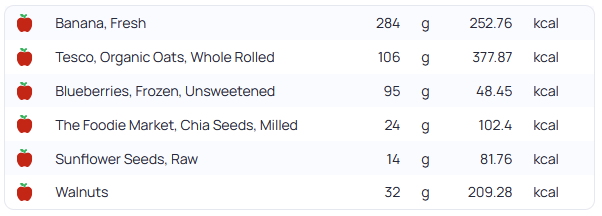
If you sum all that, it’s about 1,000+ kcal. It’s also high in fiber (32g), protein (28g), and Omega-3 (7g). It’s also very easy to make.
If you want to bulk that up, just add peanut butter. 100g would give you an extra 500+ kcal.
I eat this every single day.
Lunch and Dinner
- Brown rice. Or white rice if I’m feeling naughty. Usually 250g or more. Never less. That’s at least 300 kcal.
- Beans, chickpeas, lentils. As you can see below, they’re roughly in the same caloric range. I eat lentils more than any other type of bean. And again, usually 250g or more. Never less.

- Some vegetables. I always combine them with rice and any of the proteins above. The “problem” with vegetables is they have almost no calories:
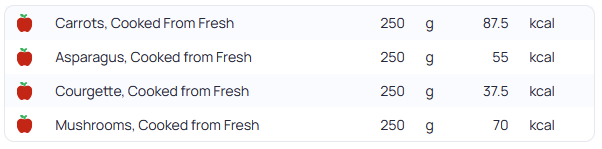
See? Very few calories. Can’t rely on vegetables for bulking. That’s probably why horses have to eat grass non-stop.
But of course… You eat vegetables for other reasons. They’re rich in nutrients and have anti-cancer properties. So don’t stop eating them.
- Pumpkin or sunflower seeds. I usually add 15g. So that’s about 80 kcal. It has a good amount of protein and calories for very little quantity.
- HUMMUS. So good. I eat it a lot. Usually 100g, but I rarely weigh how much I’m eating. That’s about 237 kcal.
So, if you sum the rice (300 kcal), lentils (300 kcal), veggies (50 kcal), seeds (80 kcal), and hummus (150 kcal) that’s about 900 kcal.
If that’s not enough for you, there’s the option to add a healthy dressing. You’ll have to make those yourself if you don’t feel like developing hypertension (because of the salt). Simnett Nutrition on YouTube has a few videos on that if you’re interested.
This is my typical day. Usually, when I eat rice + beans at lunch, I eat something else at dinner. I usually rotate between these recipes:
- Moroccan couscous
- Any type of stir-fry (tofu + veggies + noodles)
- Roasted pepper pasta (I usually add some frozen peas to bump up the volume)
- Any of these pasta recipes
I’ll also eat pizza or a juicy burger on cheat days. But just for fun. And because I’m only human.
Make sure you rely on real food to get your calories in.
About the macros (carbs, protein, and fat)
My approach to macros is I don’t have one.
I don’t care if I’m getting the perfect split of macros. I just eat a ton of calories. For me, that’s enough to get everything I need. But in every meal I make sure I have one main source of :
- Carbs. This means rice, potatoes, couscous, etc.
- Protein. This means any type of beans, lentils, chickpeas. It could also be peas, tofu, or some fake meat.
- Veggies. At home we usually eat a lot of asparagus, broccoli, and mushrooms throughout the week. But we also vary them from lunch to dinner. That means eating red/yellow peppers, carrots, red onions, courgettes, eggplants, kale, etc.
Instead of worrying about macros, you should find out how many calories you burn daily. That’s going to help you define the amount of food you’re putting on your plate.
If you have a smartwatch that shows how many calories you used, it’s much easier. But keep in mind they’re not as accurate as you think. They overestimate. If it shows you burned 2,000 calories, it’s probably less than that.
It’s better to track what you eat and your weight over time. It’s the easiest and most reliable way.
All together
Eating plant-based is not hard.
Just eat plants with higher caloric density. It takes a little bit of effort to find the sweet spot that works for you.
And before you know it, everything will fall into place. It will just… work.


