The Pitfalls of Remote Training via Zoom
Analyzing similarities across multiple companies during the Covid-19 crisis.
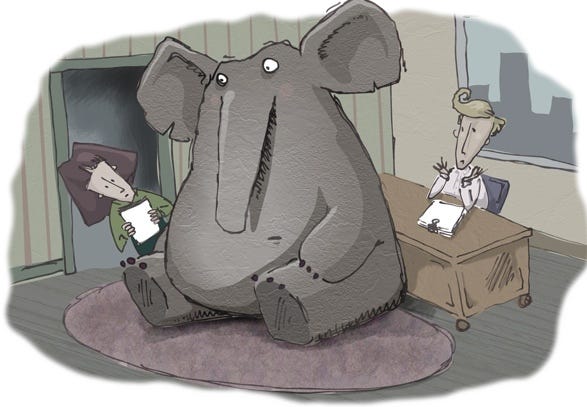
Brazenly pointing at the taboo, forbidden topic.
I hate the way I see what we choose to ignore. For example, in Zoom meetings, people are always sharing their screen to clarify and point out what they are talking about.
For now, set aside the idea that the most effective method for learning is hands-on experience:
The screen, when they share it, is much smaller than the full screen. I cannot look up the exact percentage smaller, since we are collectively ignoring it. Go ahead, try to look it up. We don’t know. We don’t want to know.
I can’t see a thing when anyone “shares” their screen. Apparently, this is a new cultural taboo, forbidden to bring up, discuss, and resolve. If we ignore problems, we seem to think they aren’t happening. We’ve learned nothing from Covid-19.
Not to mention (in an already unmentionable topic), the speaker in these Zoom meetings seems to believe that because they’ve said something, it got communicated and understood. This fallacy, confusing the role of speaker and listener, is going to lead to the downfall of at least a couple of corporations.
When you’re not sure, speak quickly so no one understands you. Trust me, no one indoctrinated into American corporate culture will question you.
Presenters in these meetings speak so fast and scroll and click as if their audience members are all experts, already familiar with the presentation.
The quality of training has definitely plummeted during the coronavirus.
When asked, every lemming on the team says, “ok, fine, yes, I understand, no problem.” They don’t want to be the one who is “stupid” or doesn’t understand, or they think they can catch up later, which is usually true. This little culturally enforced fallacy is going to end up costing someone dearly.
If we were live in person, all together in the same room, people would feel much more comfortable speaking up. Presenters could keep the pulse of the group’s understanding.
This is something that teachers know very well. I bet teachers don’t let these sorts of things happen in their meetings. They are familiar with students regularly saying they understand something when they don’t.
However, considering American corporate culture, many remote training meetings must have occurred with the participants barely keeping up, keeping their heads low, the way they were conditioned to do. Humans are funny critters.
Corporate America finds no use for teacher trainers within their organization.
The speakers, at least the ones who aren’t teachers, have never learned to slow down when performing training for their team members in the audience. They are, more or less, going through the motions. Their major goal is to finish their presentations, not to make sure that the information presented got communicated.
This corporate concept has unfortunately invaded the classroom, to the detriment of education. The opposite should have happened. Corporate America should have adopted ideas that work in the classroom. But teachers don’t have any money, so we know which ideas won out.
Those with teaching experience could inform these speakers of this minor problem, but their input isn’t being asked for. Also, no one else has brought up the issue, so teachers would be pointing out non-issues. Until those who were present during the training use the information they were supposedly provided with and all hell falls apart.
The teacher is this case, would be an early warner.
Therefore, because of the timing, their warning would look unnecessary, excessive, and overly worrisome with no basis in fact. The problems won’t start happening until much later than the time of the Zoom meeting training.
Humanity does many, many things like this example. I know we aren’t aware of the many ways we deceive ourselves into believing something which is false.
We don’t listen to those who know because we don’t like their attitude.
These scenarios are typical for those who know better. Those with factual knowledge labeled as “opinions.” They cannot be called facts if they are unwelcome by the majority of the group. The person who conveys such information would be vilified. The importance of their contribution would remain unknown.
Resolving problems before the problems happen is difficult to quantify.
Besides these silly and costly quirks of human nature, there remains this forbidden topic: the size of the share screen. As I said, I can’t see a thing. I’m sure I’m not alone. Yet, of course, I go along and say that I understood and kept up with the presentation completely. To do otherwise makes you stand out like a wart.
I would slow down their perceived (but false) sense of efficiency, bringing my intelligence into question (am I slow?), and making myself an anchor on the productivity (inaccurate productivity) of the team.
Doing the right thing is the wrong thing to do.
Teachers get revenge for the saying “those who can’t do. . .”
There is so much help that teachers could provide others who are new to training via remote Zoom meetings, but their input is unwelcome. Their experience, knowledge, and usefulness are foolishly and falsely downgraded.
Still, knowing that the exceptional value teachers could provide to those performing training remotely via Zoom, I must stay silent. I know that my input, based on 15 years of experience, would be belittled and seen as irrelevant. They would say that I was making a mountain out of a molehill in the best of circumstances.
My visionary ability would tarnish my reputation since it’s too early to point out the problem before the problem manifests. At worst, my input could be treated with hostility. Time is money, and some executives do not appreciate having their less-than-stellar skills exposed.
They are also highly motivated towards efficiency when making these presentations. Pointing out how the way they presented their training was the anthesis of efficiency, and likely the least efficient way they could have made it would be taken as a personal insult.
I don’t feel like insulting the executives at my company in my first month at a new job. I don’t feel like standing out as a troublemaker during my probation. What am I to say then in a years’ time when the shit hits the fan and they dissect what went wrong?
When they ask me sometime 12–18 months from now, “Why didn’t you say something?” what should my response be?
EPILOGUE
You have insulted my intelligence for years. You have mocked my beliefs and denigrated the experiences of my life. You have been haughty, egotistical, and arrogant.
You have been an idolatrous culture that elevates youth and fame over knowledge and experience. You make millionaires out of those who possess the skill of being extremely attractive while bullying, spitting constant microaggressions at those gifted with a scientific mind, belittling their brilliance and the rarity of the value their ability brings to humanity.
Someone on a podcast the other day actually said, “come to find out the work of government is hard.” It surprised him to find out that running a country is hard work as if this could not be foreseen.
He seemed shocked to discover that perhaps we shouldn’t put our country in the hands of those who are famous but lack experience. As if fame is the singular deterministic factor we should consider when choosing our leaders in a democracy.
We decry those with experience in the actual running of government while promoting those we idolize. What could go wrong?
I’m surprised the country hasn’t been leveled, turned to ashes considering at least half the country, possibly 99%, hasn’t learned anything from our obvious recent mistakes. A less merciful, less patient God would have leveled the states with a super volcano by now.
So, what should my response be, when 12–18 months from now, it’s discovered that I stayed silent when I could have been helpful? At my own expense, I could have saved my employer valuable time and money.
While getting mocked, degraded, and treated with spite, I could have guaranteed that my teammates and my coworkers would eye me with suspicion for the foreseeable future well beyond this project.
I could have made it known that I am one of those horribly stupid, helpful, intelligent people. But I’m too smart for that. I’ve learned that lesson. So, I stew in this growing toxic combination of experience and knowledge which makes my ideas unwelcome in corporate America.
America should pray that it remains too stupid to understand the devastating effects anti-intellectualism has wrought on this nation. Gaining that knowledge will bring insurmountable shame and guilt upon us.