
Here’s How You’ll Make Money When AI Takes Your Job
How are you going to pay your bills when you no longer have a job?
This is the question on everyone’s minds right now.
The genie is out of the bottle. The age of AI is underway. And it’s going to be the catalyst for tremendous disruption in our economy.
Especially when it comes to work.
By the end of the decade, almost half of American workers could be without a job.
That isn’t to say new jobs won’t be created between now and then.
Or that displaced workers won’t find new ways to generate income for themselves such as by going freelance or starting a business.
It just means the state of employment is changing and with it, how you earn a living.
The current assumption is that it is your personal responsibility to earn a wage in order to meet your needs.
It’s time to throw that belief out the window.
How you understand your role in the economy — including how you support yourself — is going to change as the economy changes.
This essay is going to dive into four scenarios speculating on how you will meet your needs in an income-less future. These scenarios are fraught with political peril and could culminate in the realization of a dystopian reality once relegated to Hollywood. Proceed with an open mind.
Any of these scenarios could come to fruition. Or they could not.
The fact remains that how you take care of yourself now is not going to be how you take care of yourself in the years to come. Evaluating different scenarios will help you adapt and set you up for success regardless of what happens.
Workers assume the government will provide more handouts. It probably won’t.
Thanks to AI many jobs, especially white collar jobs, are going to be automated, outsourced, or outright eliminated.
The obvious assumption is that the government will take care of you when you find yourself without a job.
This makes sense. The government already has a robust welfare bureaucracy. It would be logical for the government to expand it to accommodate growing demand.
There’s just one problem: how is the government going to pay for it?
Our tax system is based on income. With fewer people working the tax base shrinks. That means less money is available to support those that need it.
To understand the implications of this look at the Social Security program. It is estimated Social Security will run out by 2033.
Every year that estimate continues to change, inching closer to present day.
It’s only a matter of time before the reality of Social Security’s insolvency is staring us in the face.
Why does this matter?
There are fewer people paying into it than those who are taking out of it. This is a function of demographics. There are more retiring Baby Boomers than there are workers contributing to the pool.
And those retiring Boomers are living longer too.
This creates an inverted pyramid where there are simply too few resources going to all of those that need them. Expanding welfare services without increasing the revenue available to meet the needs of everyone simply isn’t a mathematically viable option.
The obvious policy solution is to tax the rich. This too is a flawed assumption.
The wealthiest among us — think Warren Buffett, Jeff Bezos, and Elon Musk — aren’t wealthy because of their income. They’re wealthy because of their assets.
In order to tax the rich you’d have to create an entirely new tax system based on assets. And to do that you’d have to reconcile greater taxation with the foundation upon which America was built: life, liberty, and property.
In case you forgot, we fought a revolution over taxation. America is a country where you own property. Not where you tax it.
While taxing the rich sounds great on paper, it is unlikely that will ever happen.
Unless of course, you want to fight another revolution…
Without money to support a work-less population, government handouts are unlikely. Or at least the amount needed to maintain your current lifestyle.
Social welfare programs may expand in the next decade to help workers through the transition, but those programs won’t be sustainable. Instead, it is likely support will come from other entities like corporations and community organizations.
Corporations may end up providing their own version of a Universal Basic Income instead.
Universal Basic Income — or UBI — is another popular policy option.
The government won’t have the means to provide UBI but corporations will. And they might discover they have the incentive to do so as well.
One can look to Pixar’s WALL-E for evidence of this.
In a not-so-distant dystopian future, life on Earth becomes uninhabitable. Humans are sent to live on a space station maintained by the fictional company Buy N Large.
Everything from social interactions to liquid meals is provided by the company. Robots cater to everyone’s needs. Work is obsolete.
To understand how this could possibly work you have to throw the logic of a production-capitalism economy out the window.
Our understanding of economics is a modern development. It isn’t an absolute. Throughout history, economies have changed as new civilizations have emerged.
Who are we to think we are any different?
AI and other soon-to-be-seen technological advancements are going to change our economy.
It’s likely that our value in the economy of tomorrow is going to be in eyeballs and attention — not in our labor and ability to consume.
Instead of earning a wage and spending money wherever you please, you will watch shows or play games and earn digital “money.” That money will be something you can spend within a self-contained economic ecosystem.
If this sounds like Ready Player One that’s exactly right.
The infrastructure for this is already being developed.
Amazon, for example, owns Twitch, a video game streaming service, as well as its own film studio — Amazon Studios.
Amazon owns Whole Foods. Amazon launched a pharmacy. Amazon is offering telehealth services. Amazon is already a digital everything store.
If you think about it, Amazon can meet most of your needs.
What is stopping Amazon from awarding you points that you can redeem on Amazon to order essentials like groceries every time you stream a show on Amazon Prime?
Nothing.
In fact, this is already happening.
Next time you pull up Amazon pay attention to their nascent point system. It’s happening with books. This could expand to other parts of the platform too.
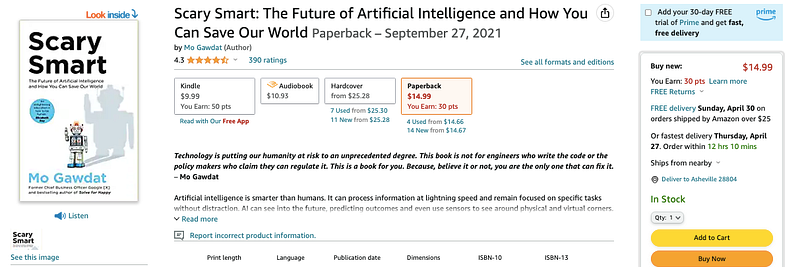
This is what “universal basic income” could look like.
It won’t be a handout deposited to your bank account a la pandemic-era stimulus checks.
It will come from a corporation. And it likely won’t be financed by the economy as it currently is.
It will be the result of a new reward-attention economy that is slowly starting to emerge.
You will have to start relying on your community however you define that.
Where the government and large corporations fail to meet your needs, local community organizations will likely fill the void.
Think churches, civic organizations, environmental communes, and your local VFW.
These institutions already provide a number of informal services for their members. They will send a team out to fix a leaky roof or prepare casseroles when you get out of the hospital.
Or at least that’s what my church did for my family growing up.
While some of these institutions may seem archaic there is going to be a resurgence in them. This will be in part due to necessity, but also as a reaction to simultaneous social and political upheaval underway.
There’s also going to come a point when we’re going to have to recognize that individualism doesn’t pay the bills. We’ll have to cohabitate and cooperate to adapt to the new economy.
There is evidence that this is already happening.
About one in four Millennials currently lives with their parents. And that number is higher for Gen Z.
This isn’t because young adults are entitled or lazy. Or that they want to spend their time playing video games in their mom’s basement.
They can’t make ends meet — and neither can their parents. Approximately 45% of Baby Boomers have nothing saved for retirement.
The fact is millions of Americans already can’t support themselves with jobs. Imagine what life is going to be like without a job.
Structural changes in the workforce will require us to rethink what it means to provide for ourselves. Instead of stoically supporting ourselves alone some of us will have to pool resources within our communities and families.
The most viable option: no one is going to save you.
There is one final scenario to consider: no one is coming to your rescue.
As Taylor Swift says:
“You’re on your own, kid. You always have been.”
Expanded government welfare programs, a corporate points system, and civic communities are all possible options. But they aren’t necessarily viable ones.
There isn’t a tax base to support government programs.
Corporate subsidies are plausible but it’s how an attention-based economy will continue to generate revenue. It’s true Buy N Large meets the needs of every human in WALL-E but Pixar doesn’t tell us how it does so.
And civic organizations tend to be insular. There’s a high barrier to entry. You typically have to share the same beliefs and values to be let in. Even then you might not be guaranteed access to any economic benefits.
The reality is AI is here and it’s changing the nature of work. Statistically, the odds aren’t in your favor.
So what can you do?
Accept that change is underway and it’s going to be messy. A massive economic disruption is going to impact every facet of your life.
Hope for the best but expect the worst.
There may be someone who will come in and save you, but most likely there won’t.
Pay attention and start adapting. That’s the best you can do.
Final takeaway.
You can’t stop technology from advancing. Especially when there’s a lot of money on the table for the creators of said technology.
It’s going to be tempting to look to the government for help. But that’s unlikely to come.
The question is what someone can do to help you. The question is what can you do to help yourself?
That starts with understanding the world as it is not as you want it to be.
You are not entitled to a job.
Nor are you entitled to benefits should you lose your job. I know that’s a bitter pill to swallow, especially because we’re all paying into the system.
What you are entitled to is learning, growing, and adapting.
You can start learning how to use AI now in your current career.
You can learn a new skill, particularly a trade. AI can write computer code but it isn’t going to fix a leaky faucet.
You can market and sell your skills. The economy is becoming one of free agents, not just employees. Use that to your advantage.
Last but not least, you can make decisions every day that impact your future well-being.
It could be as simple as cracking open a book instead of turning on Netflix for once.
Economic change is underway and it will be profound. But it isn’t necessarily something to fear.
As Franklin Roosevelt once said:
“The only thing we have to fear is fear itself.”
Amanda is a writer and strategy consultant. When she isn’t writing about the future of the economy, she’s helping busy entrepreneurs diversify their revenue streams and develop personal resiliency. Subscribe to her newsletter and follow her on LinkedIn.