
Here’s a Wild Thought: Minimum Wage Employees Have Value Too
Twitter can’t seem to agree, so here’s the truth
I can’t believe I have to say this, but if you work a minimum wage job, you have value as a person.
Twitter can be a great way to see live events from a worldwide perspective at any given moment. It can also be an incredibly toxic echo chamber of half-baked opinions, negativity, and frustration. And I’m ashamed to admit I fell down the rabbit hole.
It started when I saw this thread:
Now, the thread itself is one that I actually agree with. Amid President-Elect Biden’s proposal to raise the federal minimum wage to $15 an hour, the debate has sparked online as to whether or not minimum wage employees deserve more money — specifically, whether or not they deserve enough money to live on.
Give me a fucking break.
All you have to do is look back to what Franklin D. Roosevelt said when the National Industrial Recovery Act was passed in 1933:
It seems to me to be equally plain that no business which depends for existence on paying less than living wages to its workers has any right to continue in this country. By “business” I mean the whole of commerce as well as the whole of industry; by workers I mean all workers, the white collar class as well as the men in overalls; and by living wages I mean more than a bare subsistence level—I mean the wages of decent living.
Nobody wants to admit the real reason they’re against raising the minimum wage. And no, it’s not because it will “destroy the economy,” as some decriers suggest or that “prices will double,” because they won’t. Sure, they likely will increase a small bit, but here’s the thing: they already are.
For a fun comparison, let’s look at one of the biggest examples people point to when they talk about the minimum wage: fast food. Fast-food workers are typically paid minimum wage, and people on Twitter seem to love pointing out how the cost of menu items at fast-food restaurants might be impacted by the minimum wage increase.
Guess what? Prices have already gone up.
A Big Mac in 2000 cost, on average, $2.39. As of 2020? $4.95. Do you know what didn’t change? The minimum wage. A hamburger that used to cost 32% of your hourly rate now costs you 68%.
No, the real reason people don’t want to increase the minimum wage is that it’s making them realize that they, too, are underpaid and they can’t stand the idea that someone in “unskilled labor positions” (another lie we are told in order to perpetuate the idea that spending hundreds of thousands of dollars on college is the ideal path) might make as much as them.
Don’t believe me?
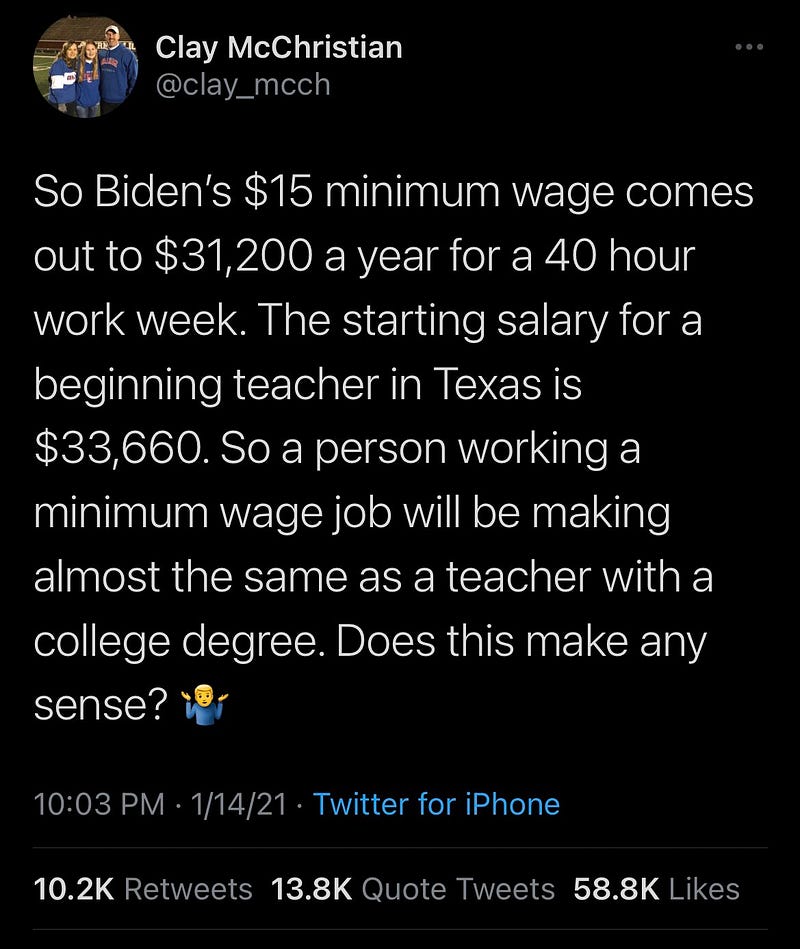
Never mind the fact that minimum wage employees rarely see the benefits a teacher would see, or the fact that teachers get to enjoy weekends and summer vacation, as well as other holiday-related breaks during which minimum wage employees are going to still be working. That 40 hours a week means 40 hours a week, year-round with no time off.
If you get sick or injured, that’s not just money out of your pocket; that’s another week of pay you’re not getting.
I’m not saying teachers don’t deserve their benefits or pay. If anything, they deserve significantly more than they receive, and that is the actual issue. The issue is not that minimum wage employees would be making “too much,” it’s that the middle and lower class are, across the board, grossly underpaid.
Don’t even get me started on how we can justify paying restaurant employees $2.83 an hour with no breaks, benefits, or security, and force them to rely on tips from patrons to pay their rent.
Increasing the minimum wage is not an effort to devalue the job that you have or to encourage laziness, it is a proactive measure designed to ensure that the people providing you a service — almost all of whom we now classify as “essential” — are able to live.
How is anyone supposed to pull themself up by the bootstraps if they aren’t given boots?
It’s a shame — unsurprising, but a shame — to see how many people prioritize selfishness over empathy, how many people will fight tooth and nail against a decision that doesn’t hurt them but seeks to help others, and how many people relish in a false sense of superiority over superfluous standards self-imposed by a failing system hooked up to life support and annoyingly beeping every now and then just to remind you that it’s still alive.
The rich get richer while the poor get poorer and the middle class crumbles into poverty.
But what do I know? I just work in a restaurant.


