
Here Is Why All You Know About Keywords Might Not Be True
How many times have you thought you knew something? Just to be proven completely wrong… Read this about keywords and see what changes.

I am not messing with you.
But there are some new trends you should be aware of (as it impacts your blog).
I have been in this industry since 2009. In the early days, everyone was focused on what keywords to pick, where to include them in the post, how many times, and so on…
Back then, you could see posts stuffed with the primary keyword all over the place…
Why did people do this?
Well, it worked… 10 years ago, you could get decent traffic from Google if you “over-optimized” your post and included the primary keyword in every sentence (several times).
Did Google like it?
No. After some time, Google started penalizing this content. Keyword-stuffed posts were hard to follow and ultimately unpleasant to read (poor user experience).
Over the years, Google evolved and understood one thing right.
Search engine optimization (SEO) should not be different than “optimization for people”. After all, people are the ones reading the posts.
And Google got it right…
The more readable and easy-to-follow the post is, the more people will enjoy the reading and use Google again to find other posts.
Because of all this, Google’s attitude is to “write content for people and not for search engines.”
Based on the latest trends, here is how Google’s algorithm weights different components when ranking your post.
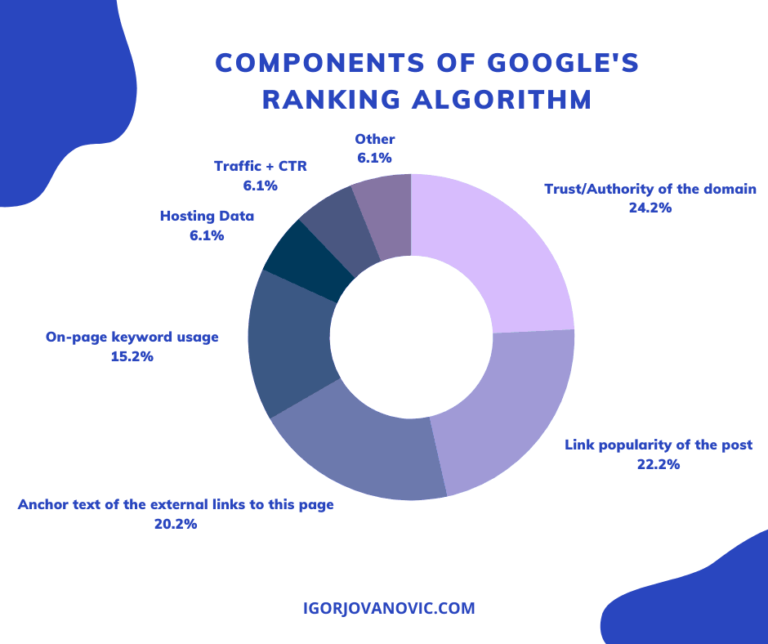
Let me explain this one by one (the most critical components first).
- Trust/authority of your domain | How old your domain is and how much Google trusts it based on the previous history and the existing content (for new blogs, this is very low).
- Link popularity of the post | How often do other websites, social media, and blogs link to your blog posts? (This you can work out by writing amazing content others will love to share.)
- Anchor text of the external links to this page | What text do others use to link to your post? (If others enclose a link to your post in the text “Diabetic recipes for pregnant women,” Google takes that as a signal that your blog is saying something about the topic — the more links with this text, the stronger the signal).
- On-page keyword usage | How often do you mention a certain keyword in your post? (This gives an excellent clue to Google about your post’s topic.)
- Hosting data | Is the company where you store your website credible enough? (You got this step right if you used Bluehost.)
- Traffic + CTR | What is your current number of visitors, and how often do others click on your post in the search results compared to clicking on other posts?
- Other | All other factors go here.
Main takeaway?
Optimize your posts for humans (make them easy and pleasant to read + super informative and helpful).
Do the keyword analysis and include the primary (+ a few other relevant) keywords in the post (but do not overdo it).
Overall, take the whole buzz about “keyword optimization” with a grain of salt…
P.S. Blog speed is not included in the graph, but it is one of the crucial factors as well (we already talked about this).
Struggling to set up a blog that sells? Most people working a 9–5 fail to get their side project off the ground.
Subscribe to DDIntel Here.
Have a unique story to share? Submit to DDIntel here.
Join our creator ecosystem here.
DDIntel captures the more notable pieces from our main site and our popular DDI Medium publication. Check us out for more insightful work from our community.
DDI Official Telegram Channel: https://t.me/+tafUp6ecEys4YjQ1