
Here Are 5 Lessons I’ve learned About The Unintended Consequences Of Raising The Minimum Wage
The Yellowstone wolves restored rivers, will the raising of the minimum wage improve people’s lives?
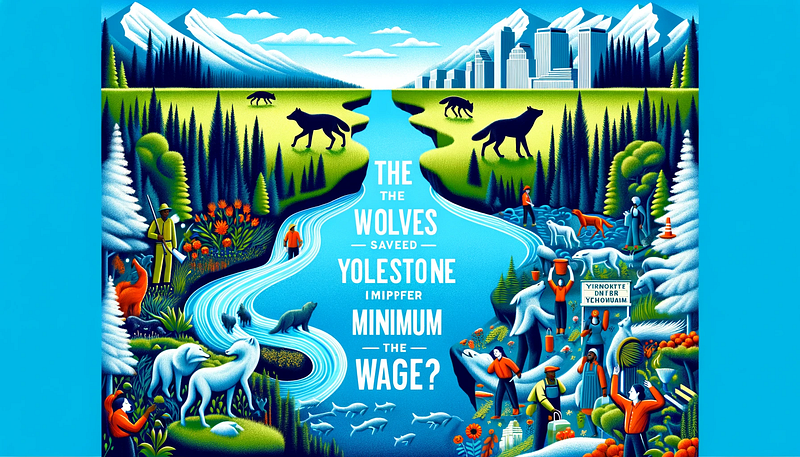
“How Wolves Change Rivers” became one of the first ecology-related videos to go viral with 44 million views.
It explains how wolves affect Yellowstone’s ecosystem as a top predator.
Back in 1995, wolves were reintroduced to Yellowstone.
Wolves control the deer population and their behavior.
As wolves hunted the deer it boosted the growth of trees and attracted a diverse range of wildlife.
The result was less meandering rivers because riverbanks were stabilized and soil erosion was reduced.
On January 1, 2024 at least 22 states will raise the minimum wage.
What will be the consequences of such a change?
Exactly as wolves change the ecosystems in Yellowstone park this new change will have changes, some of them you may like and some not.
Here are 5 possible consequence of is the raise of minimum wage.
Reason #1: Business Costs
Increasing minimum wages results in higher labor costs for businesses.
Let’s say you’re working in a low-paying job, like being a waiter during your student years. If the owner employs five people, they’ll have to pay them more for the same job. Naturally, they might not be happy with this situation.
So, what does a savvy individual do?
They may choose to reduce their workforce, which can lead to increased stress for the remaining employees who now have to take on additional responsibilities. Essentially, you end up working for slightly more money but effectively doing the work of two people.
Instead, the business could raise prices, but this can be problematic because it can result in a loss of market share.
Reason #2: Higher prices/Inflaiton
It’s a fact: your paycheck will increase.
But have you thought about how to make the most of that extra money? If you’re like most Americans, you might end up spending it on things you don’t really need, like that new pair of Nike shoes you’ve been longing for. (Please bear with me. I don’t mean to hurt your feelings or imply that buying Nikes is a waste of money.)
Now, picture the Foot Locker store in your local mall suddenly getting a lot more customers looking to buy more shoes. Naturally, this higher demand leads to higher prices.
It can contribute even more to inflation in total.
Reason #3: Reduced savings
When we’re excited, we tend to spend more.
In the past, when I had more money but lacked financial education, my only approach was to increase my spending. This impulsive buying behavior can be harmful. Think about it: the more money you have, the stronger the urge to spend it impulsively!
Unfortunately, without a savings strategy or a simple financial tracking tool like Excel, I ended up spending even more than when I earned a lower salary. I realized that having more money without a proper plan leads to more spending.
Reason #4: Competitiveness
The rise in minimum wage often leads to people relocating, similar to the gold rush when individuals flocked to search for gold.
California offers higher salaries compared to Mississippi. States that increase their minimum wages will have a larger pool of workers to choose from.
As more people move to a new area, housing prices, both for rent and purchase, tend to rise. Businesses also benefit from this influx, as more people spend money on various goods and services such as cars, food, nightlife and all the crap we buy that we don’t need.
And on top of that, the state emerges as the winner. Revenue from taxes increases. Politicians use this to change perceptions of them.
Once a group of bureaucrats that resisted change, now they are a group of local heroes
Reason #5: Acceleration of automation
Businesses struggle to thrive, unlike large banks that can rely on government bailouts.
These local businesses take on significant risks and often end up losing more than their employees. It’s not as exciting for them to hear about the minimum wage hike. To cut costs, they turn to automation, like self-service cashiers in Amazon stores or self-serving kiosks at McDonald’s. Thousands of robots in Amazon warehouses are replacing humans, resulting in job losses.
Please keep this in mind if you are struggling to find a job that pays a low income. It may be harder now than ever before to find one.
Final thoughts
We live in a system.
A system is like a group of things that work together to do something. Imagine a team playing football, each player has a role, they work together to try to win the game.
Any change in one player will affect the outcome (win or lose).
The economy behaves similarly.
I want to win at the money game. My goal is to have more money than I spend. In order to do this, I need to understand how the game works (economics) and how to make smart money decisions. There is no doubt in my mind that by studying those two things I will be able to get to the end result.
If you want the same thing, join me on that journey
Nikita


