
Heptabase: Visualization My Missing Link For Knowledge Management
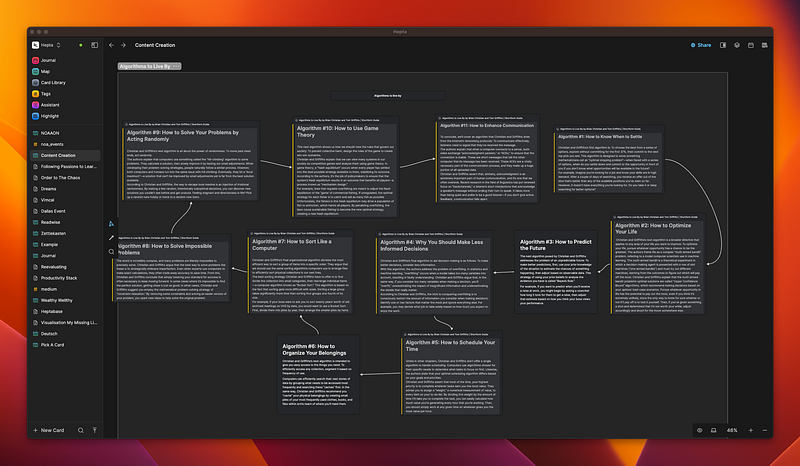
I was surprised when I realized I had been using Heptabase as my primary source for knowledge management for a while without missing the use of other note-taking applications. Reflect is the closest competitor for me in terms of applications that I always return to.
I have talked about how I am a Visual person in general. Heptabase has helped me redefine what taking notes can look like for me. I have been using it to learn German, which is such a broad topic, so I have collected 700+ cards so far. When I was reviewing them, the feeling it invoked was curiosity and playfulness. What pops into my head to describe Tana or Workflowy is practical and abstract. I have many more thoughts though they all go off into tangents of tangled webs.
I have such a deep appreciation for Tana, and I completely love it though I also hardly ever find myself using it. Such a powerful and incredible tool to be able to cultivate knowledge. However, I feel limited in some aspects of it partly as a by-product of me making it very structured. There is a time and place for everything though I was bouncing around apps since nothing truly clicked with me. The complexity of Tana can be a double-edged sword since I know it can be simple though I can also get lost in the weeds.
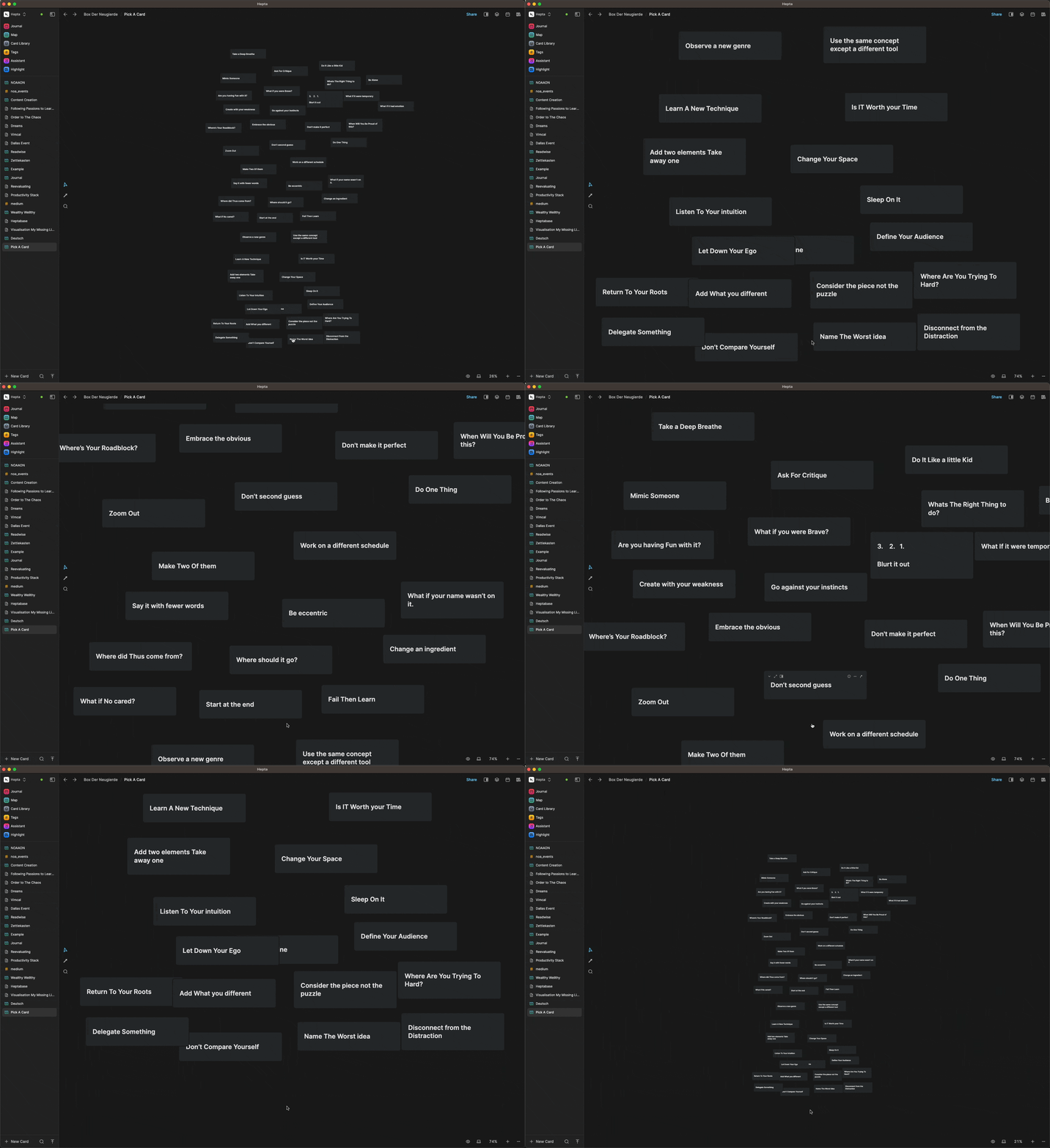
Why choose Heptabase over Reflect? One of the biggest highlights for me is being able to use my spatial memory of where I last saw a given note which gives it more relevancy in my brain since I can associate a location with that information. The location helps to act as a trigger for my brain to remember the information better. The counterargument would be that Reflect has a graph view which isn’t that helpful for me.
Another reason is that it clicks with how I process information. Hepta does the aspects of knowledge cultivation to a level that is very useful to me. Flexibility, adaptability, freedom, fun, and creativity are some of the words that come to my mind to describe Heptabase. It helped me take note-taking less seriously again. I had developed this rigid mindset around what it meant to take notes and build a system around them. For me, every little idea needed their place to live this note needs to go here, and that note needs to go here. I had to go through all these arbitrary steps in order to input data. Everything has its time and place though I believe having fun was the missing piece in my PKM.
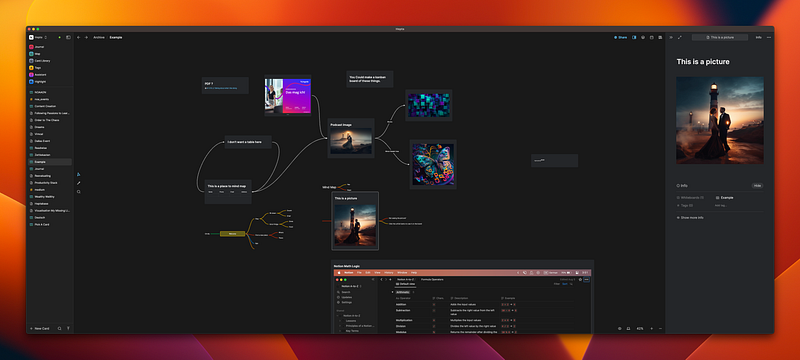
I can jot down an idea on my daily page. I can turn that idea into its own card. I then can create a mind map exploring the idea, and then within the mind map, transform some of the branches into their own cards. I can take those cards from the mind map and make a Kanban board. Within the Kanban can be table fields to sort, filter, or add more context. My whiteboards have all these sections I created that mainly developed organically. It is what developed out of my mind intuitively with the ability to use the space around me.
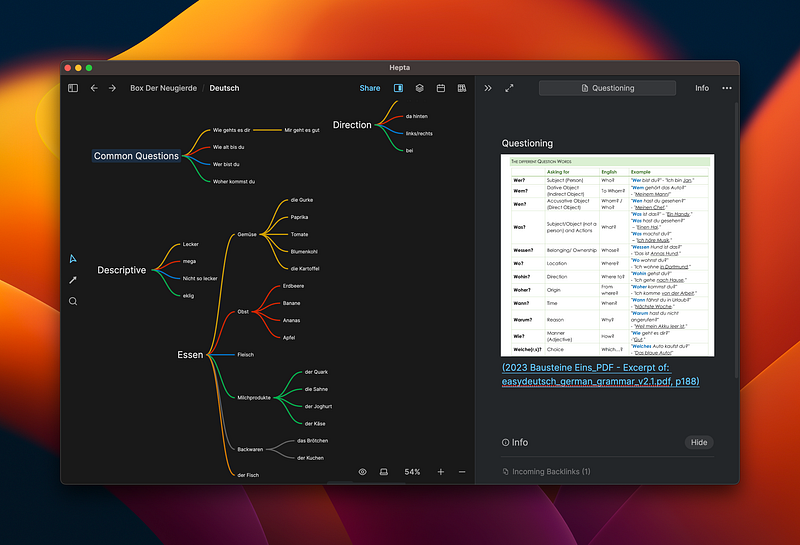
The necessity to choose a tool hinges upon our personal perceptions and intellectual rhythm, much likely freedom to adopt a city’s identity and recount tales through its vibrant narratives. It has certainly, unequivocally been Heptabase for me, and for now, I am an absorbed explorer marveling at its content world layered beyond surface-level cartography or cursory street surveys. Despite Tana’s sophistication and robust versatility, it often resulted in me getting lost in action. Yet with Heptabase, it’s a seamless journey, navigating through layers of interweaved data simplified via its effective interface, irrespective of the quantity of information or complexity of topics. At the same time, one doesn’t need to compromise on the depth of focus.


