
The Reflective Eclectic
Helping Brains Talk to One Another
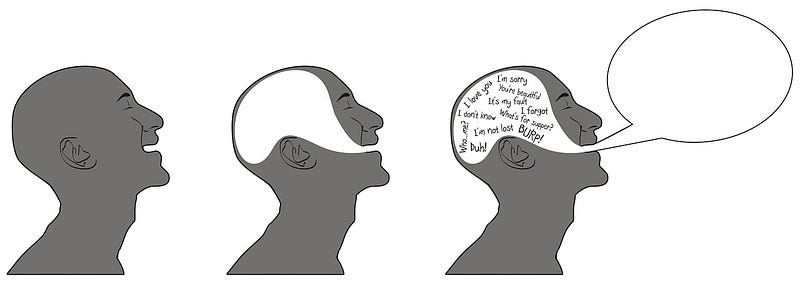
Here’s something that’ll surprise you. Other people know you better than you know yourself.
It surprised you, didn’t it? That just goes to show that people can predict how you’ll feel.
Upon that counterintuitive claim rests David Schnarch’s book, Brain Talk: How Mind Mapping Brain Science Can Change Your Life & Everyone in It. Shaky ground, if you ask me. We all have our blind spots; but, there’s no way anyone, even your best bud, knows you like you do.
Schnarch went through considerable pains to say that introspection, observing your own thoughts and behaviors, is rife with errors. True enough; but knowing the mind of others would be rife with those same errors.
The ability to know other people’s minds is normally called having a theory of mind. It’s called having a theory for a reason; but Schnarch likes to call it Mind Mapping. There’s a big difference between calling something a map and calling it a theory. Having a map is much more authoritative than having a theory; it shows Schnarch’s confidence in the accuracy of extrospection.
Schnarch, who died recently, was a moderately well-known psychologist and author of Passionate Marriage and Intimacy & Desire, as well as his long-standing war against attachment theory. Schnarch wanted everyone to grow up and take care of themselves. He believed the desire for attachment and affirmation keeps us immature. I agree, except to say that there’s some days I just want my blankey.
Brain Talk talks about one thing your brain is very busy doing all the time: sizing people up, imagining what they’re thinking, guessing what they want, and predicting what they’ll do. The evolutionary benefits of performing this well are obvious, and you do it very well, says Schnarch, most of the time. You’re able to do this very early on, by age four; but you do it better to the degree you’re grown up and can look at others objectively. It’s one of those skills that, the less you need it, the less dependent you are on others, the better you are at it.
Having argued for the robustness of human mind mapping ability in the first seven chapters, Schnarch goes on in the next four to describe how it can be impaired by trauma. Trauma in the general sense. When you’re hurt by someone you love, the impulse is to believe they didn’t mean to do what they did, or had good intentions, or were focused on something else. You don’t like to believe someone who’s supposed to love you purposely dismissed your feelings. You make excuses for them or turn a blind eye to the fact. Often, the furthest you’ll get towards believing a loved one has ill intent is to say you’re confused. You believe that you are preserving the relationship by not acknowledging the evil they did.
This willful amnesia is what causes you to have your trauma repeated, again and again. Because you’re unwilling to admit the person you love did evil, you develop a blind spot to that evil. In case you ever wondered why people stay with their abusers, or find another one when they have finally gotten rid of the one they had, this is why.
Here’s where Schnarch goes to war against attachment theory, which says maintaining a secure attachment is primary. Get real he says. Sometimes people are evil; and because it’s possible to know the mind of others, these evil people know what they’re doing to you. Look evil in the eye and call it what it is if you want to preserve your ability to map minds.
Brain Talk gives you step-by-step instructions on how to do just that, involving visualization of the traumatic incident, imaginative dialogue with the offender, and, for the truly brave, interacting directly with destructive people. These are highly irresponsible instructions, the equivalent to a surgeon teaching people to perform an appendectomy on themselves. There are many people who cannot cope with those images that Schnarch wants them to visualize. Please proceed with caution if you drink too much, take lots of drugs, fly into rages, cut yourself, attempt suicide, or do your own evil in response to the evil others do to you. Maybe you shouldn’t work at removing that blind spot yet. Unfortunately, you’re the type who needs to most of all. I would urge you to get rid of those habits first. Look at the evil you are doing before you try to recognize it in others; not because it’s the right thing to do, although it is; but because it’s the smart thing to do, for your own sake.
The end of the book contains some hefty appendices that seem to be designed to cower opponents with technical language about neurology. I would skip them unless you have neurological training and know what he’s talking about. If you want to learn about neurology, read about it from someone who doesn’t have something to prove.
If it seems harsh for me to be so critical of the last book of a person who recently died, I believe Schnarch, who was naturally combative himself, would have it no other way. Besides, for all my criticisms and snide comments, I consider myself half schnarched; to be more, would be less than fully individuated. I’ll gratefully use his step-by-step instructions and urge people to develop vision for their blind spots, as long as they don’t do evil to themselves or others in the process. However, I’ll never say other people may know you better than you know yourself. The Self is seen though a glass darkly and is not fully knowable by anyone. You and others simply see different parts. Brain Talk will help you see the ugly parts of others better. If that’s not what you want, it may be what you need.
Keith R Wilson is a mental health counselor in private practice and the author of three self-help books, two novels, and innumerable articles.


