
Help the Cantonese diaspora pass on their heritage language: The Ham-baang-laang project
Cantonese is probably the most widely spoken language that lacks children’s books.
This is a description about a project that I co-founded, which aims to preserve and promote Cantonese by creating storybooks. Click this link to view if you are blocked.Cantonese used to be the most widely spoken vernacular in many Chinatowns around the world, and the language is said to be on the decline. Mandarin (also known as Putonghua), the lingua franca of both the Mainland China and Taiwan, has become the lingua franca among ethnic Chinese around the world, and it is to no one’s surprise that it will be embraced by the overseas community as the one way to connect with their homeland. Many Chinese schools did not seem to have struggled at all, and happily switched the medium of instruction to Mandarin.
I can’t blame these schools. Mandarin was chosen as the standard language, and written Chinese has been developed in the most Mandarin-centric way you can imagine. Even in Cantonese-speaking Hong Kong, students have been instructed to replace all words to the “book language”, so that every sentence can be understood by all Chinese. This means Cantonese speakers have no autonomy in what words they can write, but Mandarin speakers can use whatever words they want to add vitality to the written language. It is even said that only by suppressing one’s mother tongue can a person write good Chinese. This imbalance means that if we look at printed work, everything will look normal to a user of Mandarin, but there will be a large gap between any written materials and other non-Mandarin languages, including Cantonese. The under-representation of Cantonese in the written world will give a wrong impression to heritage speakers that abandoning Cantonese for Mandarin is the best way to achieve literacy, and this needs to be stopped.
Can we have more books written in Cantonese? Cantonese has always been written in informal situation, so there is no need to invent a writing system from scratch. Most educated people in Hong Kong and other Cantonese-speaking areas can read Cantonese, through exposure toCantonese in informal contexts, such as tabloids, online posting, instant messaging, etc. What we actually need to do is to use Cantonese to write serious things. In the past decade, we see the growth of Cantonese Wikipedia among many other attempts, and we also see the growing popularity of Cantonese in the online media. However, there is one gap that was never filled. Children’s books.
The Hambaanglaang project (冚唪唥)
In order to normalise the usage of Cantonese in its written form, we need to ensure everyone is exposed to Written Cantonese. This is just natural that one learns their native language before learning other languages. We want to ensure the abundance of Cantonese materials, not just second-hand stories translated from Mandarin on the spot, but books that are written directly in Cantonese. How wonderful it would be if we could create a universe of Cantonese children’s books, covering all topics they need?
So we came up with this crazy idea.
Let’s create 1000 titles in Cantonese.
We once thought, “1000 is a lot, but should be doable in two years if we have 2 titles per day.” It turned out we were overly optimistic: writers were burned out, editors could not catch up, and I had a long backlog of outstanding tasks. Publishing is hard, and publishing language learning materials is even harder. That is a story for a different time.
Looking back, I can see how crazy it was. We needed original stories written in Cantonese, illustrations, an English translation or re-interpretation of the story, Jyutping transcription and word-for-word translation, cultural points to encourage discussion between parents and children, Written Chinese translation. On top of all these, the Cantonese stories need to be written to a graded scale so that we can classify the books into different levels. Not to mention all the multilingual translations, layout, design, logistic, etc.
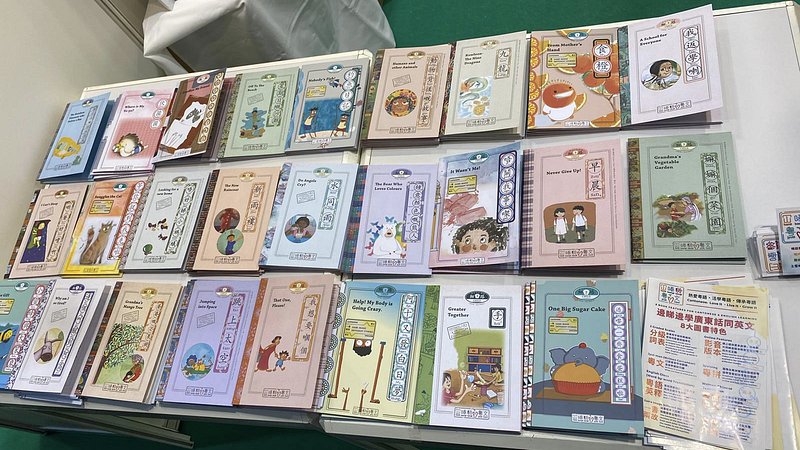
Fast forward to today, we finally finished 100 online titles, and 40 printed titles this year, which is just 10% of our original plans, and we plan to continue to create more titles but at a slower pace. We are nothing but grateful that we have come this far, and this would not have been possible without the help from all our friends and contributors.
Forty titles may not sound like a lot, but this is definitely something significant. Cantonese is no longer absent from the children’s bookshelf. Cantonese families can now proudly tell our children that we can freely write in our own language. We only need to switch to “Standard Chinese” when necessary and only if we want to. We can decide how OUR language is written.
Let me show you what our team has created. First we have created books and uploaded everything to YouTube. These books are read out slowly so that less proficient learners can catch up.
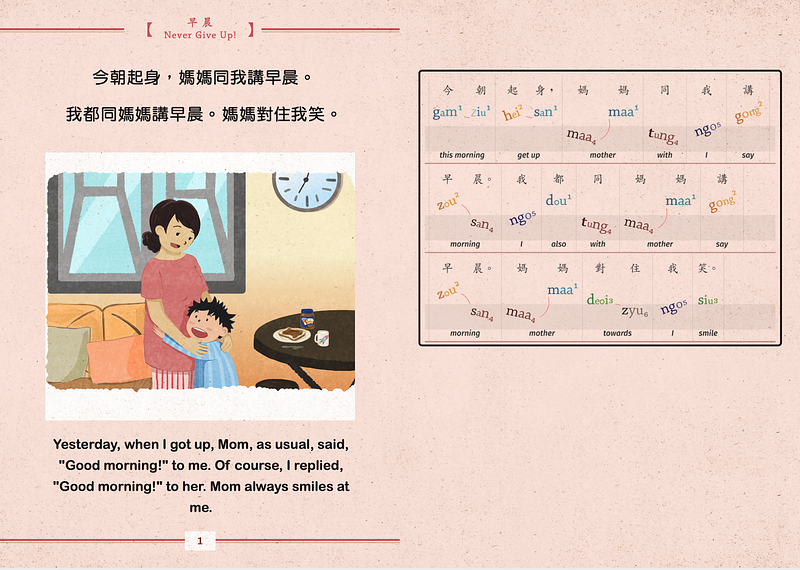
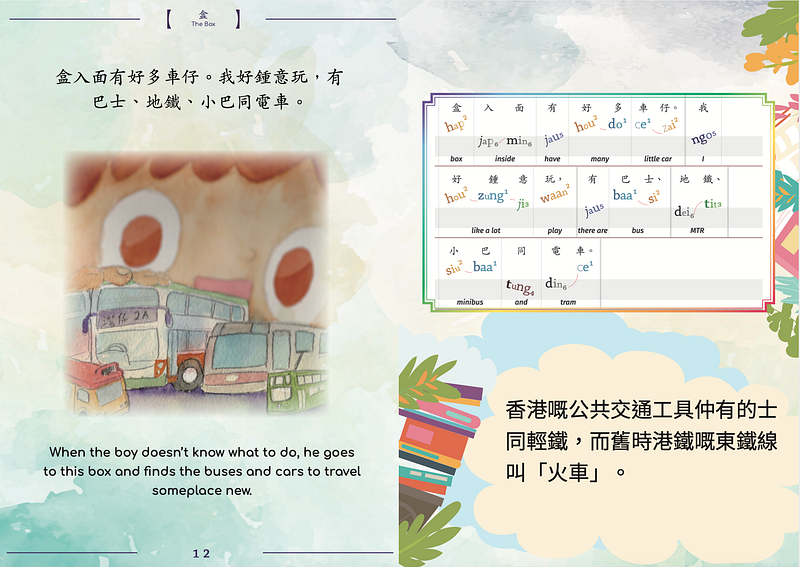
Printed books look like this. The left side is Cantonese and English text, the right side is a panel with Cantonese and “Jumping” Jyutping romanisation, a layout specifically designed for learners which visualises the up and downs of Cantonese tones. Some pages come with cultural points.
Materials on our website are licensed under the CC-BY 4.0 licence, which means you can further distribute these materials, and create other learning resources from our PDFs.
Please consider supporting us on Buy me a coffee, or buy a complete set of 40 books from our shop.
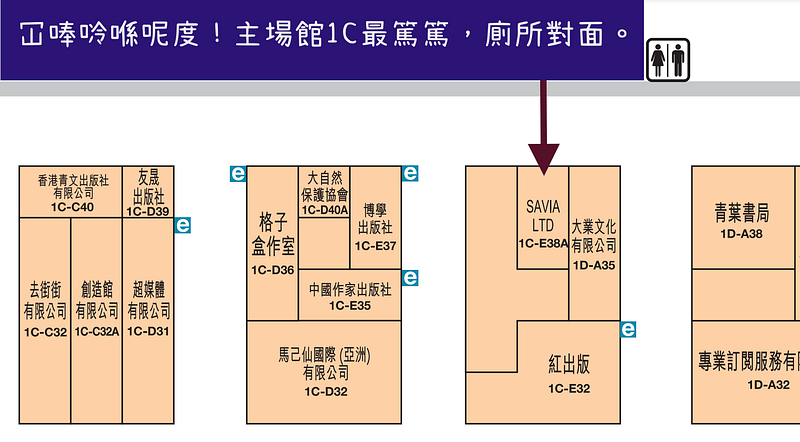
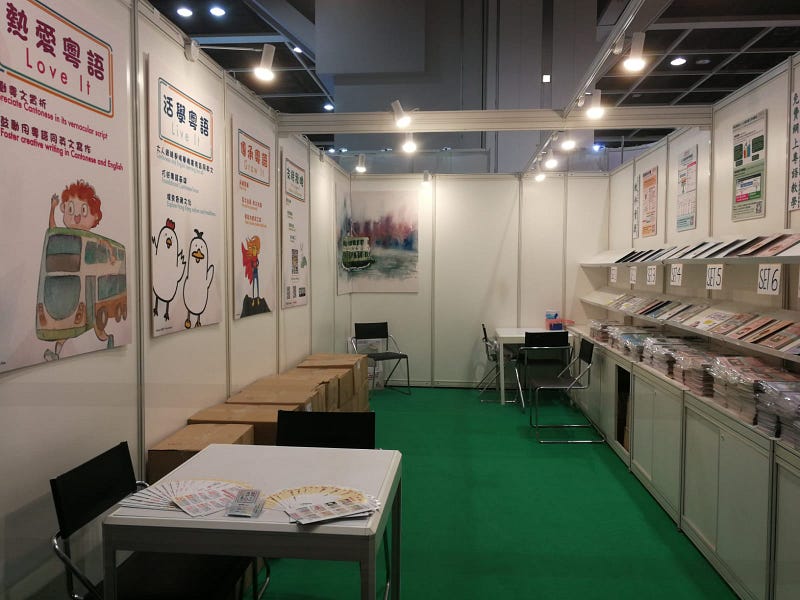
We have also set up a booth at the Hong Kong Book Fair 2021 (14–20th July, 2021) to explain our ideas to the general public.
Final Note: Other languages ought to be written down too. In the coming year I will be collecting stories in Hakka and Waitau, two endangered indigenous languages of Hong Kong. Please stay tuned.


