
Help! My Butt’s Disappeared
Learn how to save and build muscle as you get older.
For two years, I lived in a travel trailer without a full-length mirror. I worked on a farm, and trips to town involved putting on a clean shirt, hitting the feed store, and perhaps the grocery. So, I seldom dressed up or needed that last glance in the mirror before heading out.
I needed new clothes for an upcoming vacation. It had been so long since I’d shopped for jeans, I had no idea of what size I was.
Picking up a pair, I turned to the clerk, “What do you think? Do these look about right?”
“Now, honey, you are so itsy-bitsy those will be too big.” She handed me a smaller pair.
Who me? Itsy-bitsy? Nobody’s called me itsy-bitsy since the day I was born.
I’d always been muscular and strong—not tiny.
In the dressing room, in my undies, I looked in one of those three-sided mirrors. You know—the kind many of us avoid. Sure enough. I had shrunk since I turned 50. Hormonal changes combined with years of physical work had reduced not just my fat but valuable muscle.
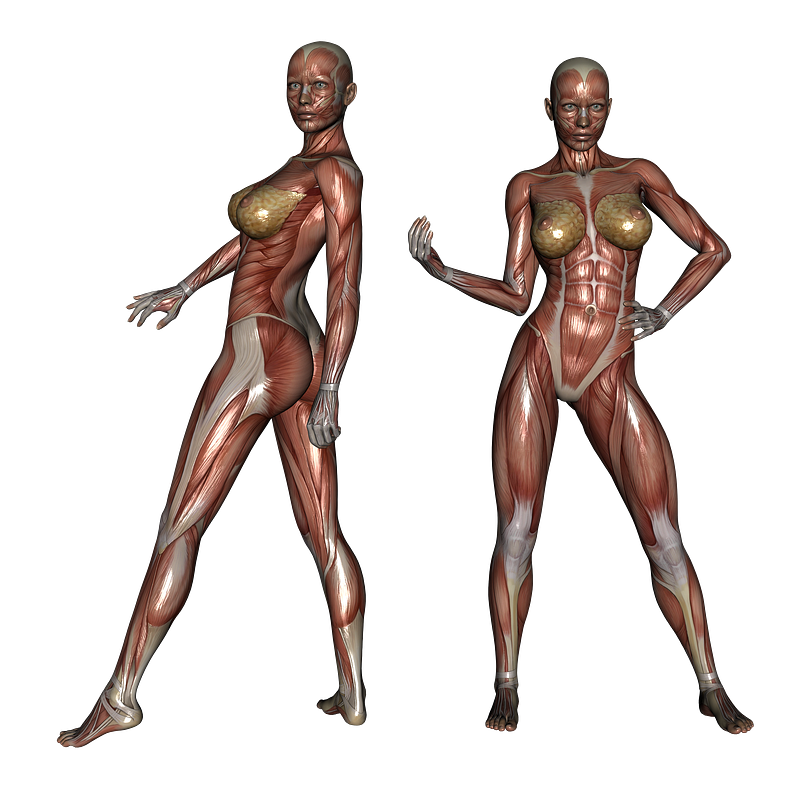
Thighs and butt muscles—those all-important glutes, hamstrings, and quads—power our stride, allow us to jump, and bounce up from the floor. Combined with sturdy calves, they improve our balance and provide stability to our knees and other joints.
I knew inactive people could lose 3% to 5% of their muscle mass each decade past age 30. I’d assumed since I was very active, I would stay strong as I aged.
I don’t want to just get old. I want to be active and healthy.
The truth is, we have to work harder to retain muscle each decade and avoid the muscle wasting syndrome known as sarcopenia. And, yes, guys, it can affect men, too.
This condition is characterized by a steady loss of skeletal muscle mass and strength, and it may be associated with an increase in body fat. So some people may not immediately notice that muscle has been replaced with fat.
Sarcopenia can lead to physical disability, poor quality of life, increased chance of falls, fractures, and even death. As people become weaker, they move less, and the condition worsens.
Risk factors include age, gender, and level of physical activity.
Researchers believe several additional factors contribute to muscle loss including lower levels of hormones, including testosterone, human growth hormones (HGH), and an insulin-like growth hormone.
A report in The Journal of Physiology discusses research showing nerve cells change with age. Signals from the brain to the muscle saying ‘move!’ don’t function effortlessly like they once did.
As humans age, our ability to turn protein into energy decreases. Experts disagree on the cause and how many grams per day of protein are optimal, but increasing plant-based protein may help.
Yes, metabolism slows with time. But if we cut calories, we might not eat enough protein each day to sustain muscle mass. There are health risks to being too heavy but don’t strive to be rail-thin, either. Plenty of vegetables, fruit, legumes, and whole grains provide nutrients and fiber.
How can you tell if your muscles are weakening?
Don’t wait until you can see your butt disappearing.
Ask yourself these questions:
- When you kneel in your garden or sit on the floor, do you use your hands to get up?
- Do you habitually push on the armrests of your desk chair to stand up?
- Are you walking slower than three miles per hour?
- Have jar lids suddenly become hard to unscrew? While arthritis can be a cause, it also may be a loss of grip strength, a significant biomarker.
- Do bags of groceries suddenly seem heavier than they were a few years ago?
You may have noticed more aching in your lower back. It’s easy to get into the habit of recruiting other muscles such as the back, quads, and hip flexors to do the glutes’ work. Now that I’m powering motion from my glutes, my back doesn’t hurt.
Take this test: can you clench your butt cheeks? And can you clench each one independently? Did you even know you can? Yeah, you’re doing it, aren’t you?
Physical activity (muscle activation) is amongst the most effective interventions known to slow the progression of aging muscle affects, including the neurological aspects.—Russell T. Hepple and Charles L. Rice.
What can you do to improve your strength?
The exciting news is that it’s never too late to improve our conditioning. Significant improvements can be seen with just a few weeks of work.
Here are some simple suggestions for getting started.
- Do some resistance training and strength work. Kettlebells are incredible and develop your core strength. Exercise bands are cheap and can be used anywhere.
- Walk. Park, at the far end of the parking lot, look for opportunities to move. Walking speed is a reliable indicator of both strength and potential longevity. Check out this Healthline article for a guideline.
- Continually use your body. Don’t avoid the stairs. Use the handrails as little as possible. Get out of a chair without the armrests! Stand up while you’re on the computer.
- Eat enough food. Muscle building occurs when there is stress to the muscle, and evidence shows our bodies don’t metabolize protein as efficiently as when we are younger. I eat a plant-based diet and find Dr. Gregor’s site a reliable source of research-based information.
- Consult a medical professional before substantially changing your diet or exercise plan.
- Don’t forget. Your entire body depends on your skeleton and your joints' fluid movement through a full range of motion. I work with a Functional Range Conditioning provider whose coaching has revolutionized my movement.
Functional Range Conditioning (FRC®) utilizes the latest advancements in scientific knowledge, combined with tried and tested training methods to increase one’s active, useable ranges of motion by simultaneously improving articular mobility, strength/resilience, and neurological control.
Good news! My muscles are returning.
I’d lost strength from natural aging and as the result of a severe accident.
However, since I realized how insidious the muscle's decrease could be, I’ve worked hard to reverse it. With guidance from my coach, I changed some daily habits and focused on strength building; I’ve made an enormous amount of progress in only a few months.
I’m happier and less anxious, too. A study in the Journal of Aging and Physical Activity documented that senior athletes had better physical, psychological, cognitive, and social functioning.
Now, with these facts to encourage us—let’s get up and get moving! Weight-bearing exercise is absolutely the most significant thing you can do to prevent the loss of muscle.
Join me in recovering your strength and your butt at the same time. Share your stories of success, no matter how small.
References:
How Fast You Walk May Predict How Long You’ll Live
Skeletal muscle protein metabolism in the elderly: Interventions to counteract the ‘anabolic resistance’ of aging
Optimal Protein Intake for Older Adults
Master Athletes: Exemplars of Successful Aging?
Grip Strength: An Indispensable Biomarker For Older Adults
Flashback Friday: Increasing Protein Intake After Age 65
Cindy has been a farmer, bookstore owner, and writer. She loves adventure and is intensely curious about life. Join the conversation.


