
Helen, a friend of mine
I have one black friend, I’m a part of the problem
I grew up in an island community, a hard-working fishing community where family income fluctuated by season. I attended a school at which one black girl attended. The school’s full attendance was more than 170 children ranging from 5 to 11 years.
The girl’s name is Helen. We were children together. She did not have black parents. We attended a predominantly white school, learning and playing with white kids, going into shops without ever being served by someone who was not white.
Helen was the one black person I knew. When it came time for me to leave the island, I was twenty years old, and never saw her again despite my frequent visits home. In those following years, 1970 through 1975, I travelled to cities with extensive black communities: London, Paris, Turin, and Munich.
I was initially quite shocked, despite what I had learned in school about racism around the world, integration into communities, civil rights, immigration, and all the rest. I was amazed how many people of colour were out in the world. I never had reason to integrate or associate with numbers of black people until I left the island; people referred to as ‘coloured’ by the community in which I had been raised.
I did wonder how Helen would have found her life different had she lived in, say, Hackney, a heavily populated black area in a suburb of London?
After being so disturbed by yet another wrongful death, this one the murder of George Floyd at the hands of the police, I was able to contact Helen, now married and living in Glasgow with her black-African husband. All three of their children, moved out and working.
She did not remember me. There was no reason she should. It is sixty years since we attended school, and close to forty years since we had any communication, which only happened then because a friend of both our families got married on the island. It was this recollection of that wedding and my role as Best Man that completed her recollection.
“You were the only black person I knew, Helen,” I said, once we were both comfortable with my reason for being in touch.
She responded by laughing down the phone, “You were one of hundreds of whites I knew, Harry.”
After the sharing of times remembered we turned to present day topics, Covid-19, of course, and then to what she had seen on tv about what is happening here in America.
“Are you really calling me from America?”
“I am, Helen,” I said, “I’m waiting on the birth of a grandchild in Colorado, Boulder, actually.”
She congratulated me and we talked for several minutes on the role of grandparents.
We got around to discussing her life, from being a schoolchild, to working, to finding someone she loved, and to the raising of her family in Glasgow.
“The problem is systemic, Harry, just as it is here, in the UK,” she said.
Her classification, using the word systemic, opened my mind. We did not simply get around to that conclusion, it was her immediate response. Her first response.
“As a child, living on the island, being raised by white parents, being regarded as different wasn’t hard, it was just life.”
But some parts of it, she explained, were harder than others. She hated the stares, the malevolent looks. She hated when certain students would ignore her after she gave a friendly hello; or worse when they threw rude comments her way. She never told her parents, it always resulted in making matters worse for her at school.
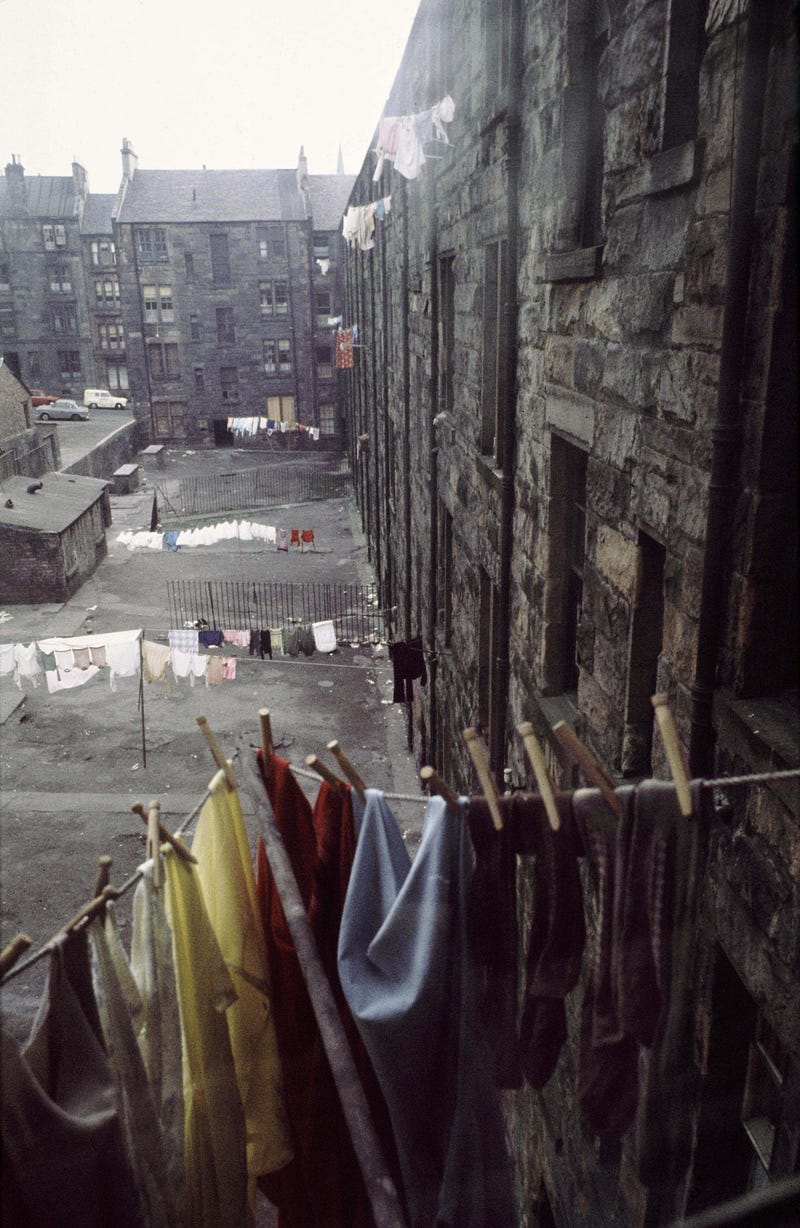
It got much harder when she left the island to find work in Glasgow. She rented her first one room apartment in the Glasgow Tenements. The poorest people lived here. Single mothers, poorly paid workers, and large families, all living in squalor.
“The city should have been ashamed to house people the way they did,” she told me.
“I don’t recall there being any kind of racism in the tenements, everyone was in trouble. It banded us together in a strange way, we helped each other. When I got out of the tenements, having struggled through three years, most of which I kept secret, not wanting to shame or worry my parents. I told them I was living with a friend.”
“When I moved into Glasgow proper, having a reasonably good job working as a typist, I became of age with hidden discrimination, which was the most difficult to deal with. Nothing is said. There is no violence. But you know it is there — perhaps in something as ordinary as a look. For that reason, it is also the most difficult to talk about. It nags at you like an ulcer and you learn to bear the discomfort. You carry on. Seriously, Harry, that same discomfort exists in me today. I am a year off being seventy-years old.”
As we talked, I began to realise what a beautiful friend had escaped my life. I felt sad, but guilty.
“I went through years of believing that I am a victim. I was never paid what other typists were paid, and my skill level was equal or superior. In work, on the street and even in romance …who would want me for me? White boys wanted me only for my perceived exoticism.”
Helen talked a lot about the stares, the comments overheard, the disbelief that she had good typist skills, all persisted, puncturing her vision of a liberal, safe, open life.
It took many years to style her hair in a natural way for her race-type, having combed through and through to keep a certain ‘white’ style. Once changed, local store assistants followed her around, failing to recognize her despite hundreds of repeated appearances. Restaurant workers used rude tones and shot sly looks.
Helen told me how she saw these slights as chances for personal growth. “Keep being kind,” she reminded herself. But it was hard to overcome what she had been facing her whole life.
During the 1980’s Glasgow was priding itself on progressiveness. It was during this time she met Linford, her Jamaican husband.
“We don’t believe in racism,” said Linford, a calm, jovial, man whose friendliness came through the phone like he was using a light sabre. “We believe in equity. But that’s not the day-to-day reality.”
“We have more white friends, than black. We have been living through the instruction of denying our inferiority, taught our children about the erasure of hundreds of years of culture and pride. There has been improvement, we were once called ‘n*g**rs’ and truthfully, in some areas of Glasgow, it’s probably still happening.”
Linford and Helen went on to talk about what they see happening in the United States, convinced a victory by Donald Trump is imminent, despite the insistence of friends that such a thing is impossible.
You do not have to live in America to feel the subtle abuses. Helen went on to explain what happened on an outing to dine out on Saturday night. “We are fortunate to choose some of the better restaurants, with our children left and doing well, and receiving a good pension.” They were shown to the back of the restaurant with a good reputation outside of Glasgow. Following a prolonged wait, and ignored after requesting better seating, despite many open tables, Helen was inclined to shake off the incident, but was outraged by the treatment, which both felt was racially motivated. “The restaurant manager characterized the incident as a misunderstanding, pointing out that the restaurant has had no other complaints.”
Helen explained, “Glasgow City feels friendlier to minorities,” she said. “It’s best explained this way, Harry: Life as a black person is one of perpetual existence under a white gaze; a gaze that can turn expressionless when the subject turns to one of black culture. Acceptance has looked different through the years, Harry, I am able to move through Glasgow freely, to exist without my colour being a topic of conversations, to shop and work and not draw stares or comments. But you know, I just want to feel like I’m a normal human being.”