
Music
You Need to Hear This Song #1
Heavy Rotation: Primal Scream, Mötley Crüe (Decade of Decadence, 1991)
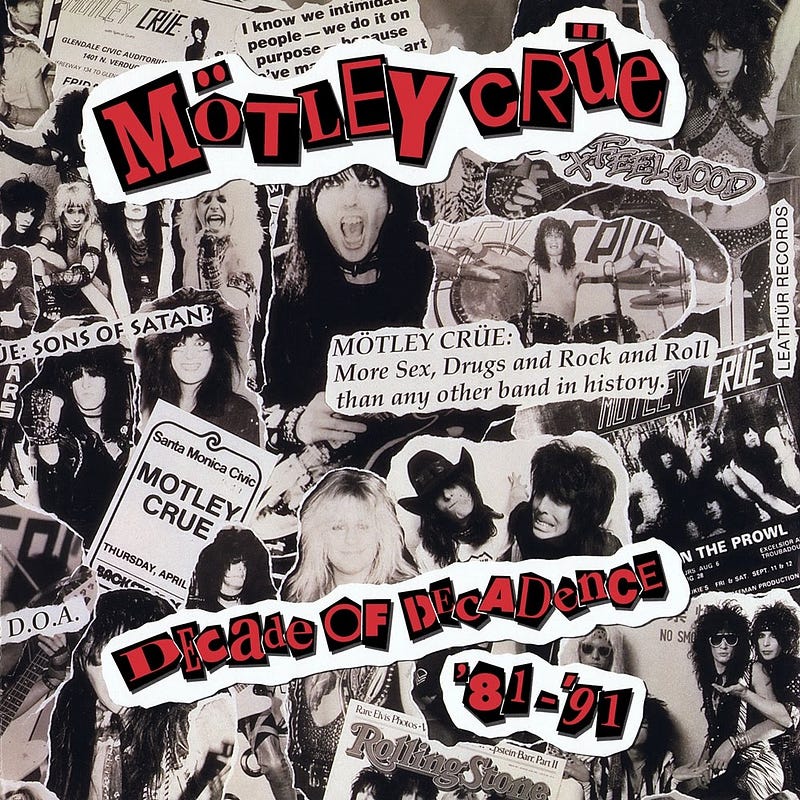
Heavy Rotation was a music industry term for songs that one way or another got a lot of airplay. It referred to the large amount of rotation that a particular record got on turntables at radio stations. Since, until the 1980s, this was the only way to get new music into the ears and brains of listeners, heavy rotation meant increased sales. Increased sales were good for the record company and artist alike.
These days, some of us still put records on at home and give them a spin. Most of us don’t. However, the term still applies, though in a different way. Streaming services like Spotify sell subscriptions to listeners and then pay artists based on listens. At least, that’s the way I think it works.
For me, heavy rotation means a song that is in my head for some reason. Maybe for a moment, maybe for a day, maybe for longer. It’s a song that you come back to from time to time and still feels just as good. This series of articles is dedicated to these songs.
In this series, I am going to highlight a particular song by a particular band or singer. I think it’s important to know a bit about the band, to know a bit about where the song fits into its history and where the song fits into what was happening in music at that time. Then there’s the song itself. Who’s playing on it, what are the lyrics getting at and why is it so good? How does it still occupy sonic space in my life?
I’ll (try to) keep it short. It shouldn’t take you any longer to read than the song itself. To that end, I’ll put a Youtube clip of the original recording at the top of the article so you can listen as you read. Or not. And because a song is often much different live than in the recording studio, I’ll stick a live clip on at the end.
What song is in your head right now? Here’s one that won’t leave mine today:
#1 — Primal Scream, Mötley Crüe (Decade of Decadence 81–91 / 1991)
In the late 1980s, Mötley Crüe was an absolute powerhouse. After a decade of well documented debauchery and hit albums (Too Fast for Love, Shout at the Devil, Theater of Pain, Girls Girls Girls), they put out their masterpiece, Dr Feelgood and ruled the world. In hindsight, just as they hit their heights, they were running out of gas. This is strange to say, since they have been on a “Last Ever” tour now since about 2004. But at the time, the band imploded in an alcoholic and drug addled haze of infighting and acrimony. It was just as well, Madchester and Grunge were upon us and most rock n roll fans were looking elsewhere and hair metal was over.
Their last gasp was a greatest hits album in 1991 before Vince Neil was turfed from the band. On it, way down on track 13 was a new song titled Primal Scream and while it’s not that much of a departure from what was already on Dr Feelgood in 1989, it sounded (and still sounds, in my opinion) brand new.
It really begins at 00:33 with the rhythm section of Tommy Lee on drums and Nikki Sixx on bass, putting down an uncharacteristically spare but pulsating beat. At 00:50, in comes the incomparable Mick Mars on slide guitar. Once the initial drum and bass line has been completed a second time with guitar, at 1:15, in comes the unmistakable voice of Vince Neil. As only he can, Neil snarls his way through the first verse and I’m reminded that I’ve always thought that in many Crüe songs, Sixx’s lyrics (he wrote the vast majority of their songs) are too much for Neil’s voice to handle. If you watch any live performance from about 2004 on, you will see that it’s not that Neil has forgotten the lyrics or lost interest, it’s just that there are too many of them to be enunciated clearly on stage.
Anyway, the song thumps away for 5+ minutes and always leaves me ready to take on the day. Even though it is about Sixx’s well documented misshapen youth, it’s also a cry to all those trying to break free from an emotionally scarred past. I don’t know if it’s their best song, but it’s the one that has stayed with me the longest.
One more thing, in the link below, skip ahead to the start of the guitar solo at 2:54. Mick Mars, who can barely move on stage owing to a degenerative back condition is absolutely wailing on his Fender, expressionless and fast fingered. Wait for it….at 3:06, see how lightning fast he gets rid of the slide and goes back to playing regular guitar. It’s unreal and just another reason why I love this song.
If you like what you are reading here and want unlimited access to thousands of writers, consider a subscription to Medium. It’s $5 a month and if you use this link, then I get a piece of that. I won’t use it for a new tattoo or leather jacket.


