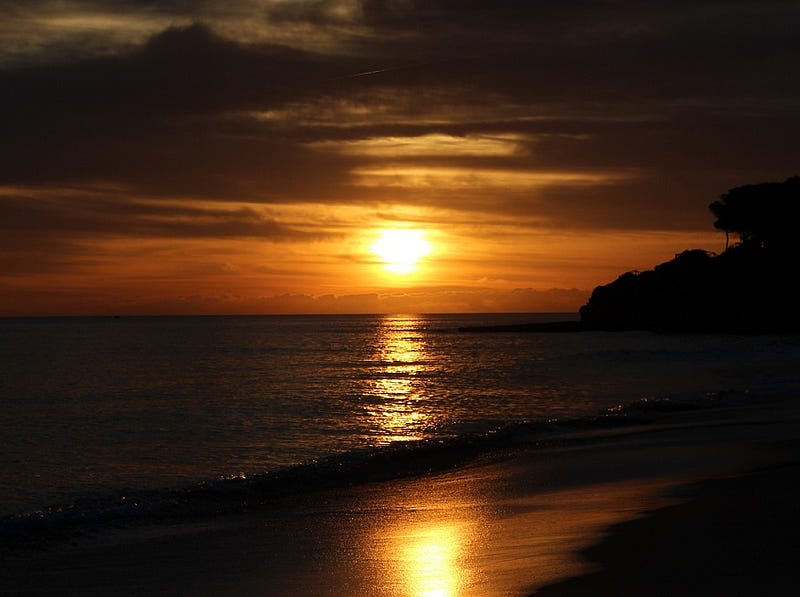
Heaven’s In The Rear-View Mirror
Cross Your Fingers and Hope
It was bound to happen. With heads bowed over screens and our hearts for sale on social media, we super-smart 21st century humans have finally relocated heaven. In our imaginations we still picture heaven in approximately the same place –somewhere above us- but in these sceptical days it is no longer ahead of us. Paradise, a reward we were once taught to expect, has become redundant, an idea vaguely remembered, like some goofy pal who got left behind when we grew up.
At least, that’s the kind of thought that makes me chuckle when I’m lolling in the hot tub with three naked beauties, nibbling chocolate and sipping champagne until it’s time to play ‘Caligula Scrabble’. If you have to die to get to heaven, forgeddaboutit. When you’re clever and brave enough to live in the present, you might as well put heaven in the past…
Okay, I’m employing an out-of-reach fantasy there (for me, at least) but you get the idea. This is a century of hedonism, a culture of indulgence, and for most of us, heaven is too unlikely to bet on, too far away to be credible. Who wants to wait their whole life for a hypothetical payoff? And there is, of course, the unpleasant issue of that unavoidable hurdle that must be crossed to reach heaven. Better not to think about it; pass me that tranquiliser. Is peace of mind a sin if you buy it at the drugstore?

I won’t be alone in having tiptoed away from formal religion while no-one execpt god was looking. I wasn’t always a cynical existentialist hiding in the middle of rural nowhere. In fact, I grew up in a busy, dirty city where the majority of people believed in some kind of heaven. (Long, long ago, in another century and a very different world.) Incredible as it might sound, our ideas of heaven were so popular and so important that regular gang-fights broke out in the city centre between men divided only by competing visions of where we all went after death. That’s what happens when Christianity gets militant.
The last time I visited, however, the churches were all closed and the city overtaken by a godless throng which appears to worship its own divine existence, if anything. To make matters worse, the ongoing Covid regulations had turned almost all public activities into rituals as solemn and quasi-spiritual as the masses I remember attending in childhood.
If the pandemic has had any positive impact, it might be as a reminder that humans will do almost any crazy thing if the death-threat is perceived to be severe enough. Remember, courtesy of a fashionable idea in the 1970’s, there are several thousand dead people (mainly in the USA) packed tightly into deep-frozen canisters and stacked up in hi-tech “facilities”. These wishful thinkers paid enormous sums to be canned (after their demise) like sardines in anticipation of a “miracle technological breakthrough” in the future that would (they hoped) allow them to be re-animated, to continue a presumably eternal life. We can safely assume these were individuals who, when it came to the crunch, simply would not entertain the possibility of a heaven. For them, what could have been a comforting glow on the horizon was merely a dwindling twinkle in the rear-view mirror.
I suspect this hi-tech terror of the inevitable is partly a reaction to our occasional and increasingly absurd adventures into space. Space is a dangerous territory. You don’t have to be a card-carrying Christian or a Koran-toting Muslim to simply imagine heaven, but space is unimaginably huge, a universe unto itself, an endless invitation to pretend there are no limitations to which all humans are subject.
To believe in heaven, however, we must first believe in death, and that is now a choice many seem determined never to confront. How sad it is that the baby of heaven goes out with the bathwater of mortality. We lose so much in rejecting the promise of an existence far superior to the short, troubled lives we enjoy on earth. When the biggest carrot that ever existed has gone, there is little left to motivate us but sticks.