
Heat Really Does Make People Hot-Headed
Anger and aggression rise with extreme temperatures. Here’s how to keep your cool.
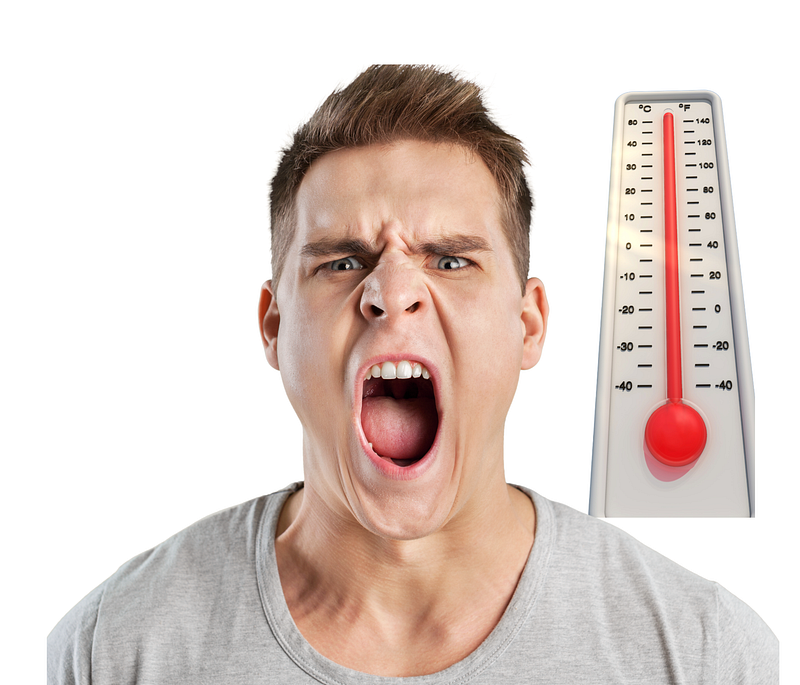
When the heat is on in a scorching summer like this one, emotions begin to sear, especially anger. Evidence suggests a hot day can make us more irritable and shorten our fuses, resulting in increased aggression, which can in turn lead to violence.
Crime increases in every city worldwide as temperatures rise, and summers warmer than average are linked to more crime than summer months with below-average temperatures, according to a study by John Simister, a senior lecturer at Manchester Metropolitan University. In the UK, 14% more violent crime occurred when the temperatures were at or above 68 degrees Fahrenheit compared with 50 degrees or cooler.
Heat and aggression play out in sports, too. A study of Major League Baseball revealed that when the temperature goes above 90 degrees, batters are more likely to be beaned by the pitcher. American football players are more likely to commit aggressive fouls during hotter weather, psychologists at Texas Tech University found.
Hot weather, whether in sport or at a family picnic or an outdoor concert, can raise the body temperature and even overheat the brain, which plays a role in aggression.
“There really is something to the idea of being ‘hot-headed,’” says Glenn Geher, PhD, director of evolutionary studies at New York State University at New Paltz. “Brain temperature, which is affected by ambient temperature, does seem to be associated with aggressive mood states and behavior.”
This is how it feels
Anger related to antagonism can result from a lack of oxygen in regions of the brain that control impulses. As the body shunts more blood to the skin’s surface in an effort to cool, Geher explains in a recent article, “you get more emotional reactions and less prefrontal, step-back, cognitive-processing kinds of actions.”
The physiological changes of arousal are similar to those of a rising body temperature, which include increased blood pressure, respiration rate, heart rate, and perspiring.
However, scientists say we often don’t recognize the arousal as heat-related. We attribute the feeling to something else, like the person that just cut in front of us at the Dairy Queen. We wrongly assign the increase in body temperature, and subsequent arousal, to anger. Researchers call this excitation transfer, which can lead to more aggression, like yelling at the person who took our spot.
The physiology of anger
Extreme heat can be perceived as a threat and, in response, the nervous system releases adrenaline and other “fight or flight” chemicals, explains clinical psychologist Joshua Kapow, PhD in an article in Self. Essentially the sympathetic nervous system has been triggered, making you more likely to be argumentative or pick a fight.
One new study found that people may get angry during the summer due to an elevation in the stress hormone cortisol, which rises in conjunction with the thermometer. Researchers measured cortisol levels in medical students during winter and summer for two season cycles. The investigators revealed that summer cortisol levels were significantly higher. The results reinforce a prior small study that revealed exposure to heat, such as a sauna, increased cortisol levels.
Why that matters: Several other studies have reported high anger levels among adults with raised cortisol levels.
The psychology of anger
Rather than physiologic causes, some scientists favor a psychological explanation for heat-induced anger. Because heat makes us feel physically uncomfortable, we’re more inclined to aggressive thoughts and interpret situations negatively, the thinking goes.
If people experience discomfort, and the discomfort causes stress and is due to something they have no control over, it can cause anger. That frustrated sense of upset is often displaced onto something or someone else, like the annoying guy taking too long to order in a fast food line.
A minor insult or an unintended jostle on a hot day, or in an overheated, stuffy, crowded space, is more likely to be perceived as a serious offense if a person’s discomfort is already heightened. Combine this with the normal stress of daily living, and the possibility of angry and aggressive reactions intensifies.
Intense summer heat can lead to fluid loss resulting in a lack of essential minerals and vitamins for optimal daily functioning. This can make us feel lethargic, irritable, and ultimately leave us feeling exasperated.
Steps to take to stop heat-induced anger
Analyze your perceptions: Examine your thinking for incorrect assumptions or misperceptions. When our thoughts are compromised by heat and fatigue, we can become angry because we assume something is true when it is not. Question what you are feeling. Don’t look for trouble where it doesn’t exist. And if you become sensitive and aroused on a hot day, consider that the people and events around you may not be the trigger. Find some shade to lower your temperature and agitation.
Think before you act: On searing days, slow down and choose actions carefully. Often, taking a moment, clearing your head, and calming down is all that is needed to avoid a hostile outburst. When you feel anger building, separate yourself from the situation. Consider what the consequences of losing your cool might be.
Breathe: If you notice tension mounting, focus on your breathing to feel grounded. Breathe consciously and rhythmically. One method is to inhale through your nose for a count of four, hold your breath for a count of four, and exhale through your mouth for a count of eight.
Replenish: Drink plenty of water and include fruit in your diet, especially those rich in vitamin C and vitamin A and those that have a high water content.
Avoid alcohol: Alcohol causes dehydration, which contributes to irritability, especially if the body is already low in fluids and struggling to stay cool. Drinking alcohol can also makes a good night’s sleep more difficult and can inhibit impulsive behavior, all of which can make you more prone to irritability and aggression.
Eat small meals: Stick to light, well-balanced, regular meals when it’s hot. Your body is trying to shunt blood to the periphery to stay cool. Diverting fluids to the stomach to aid digestion will cause more fatigue in an already stressed system and contributes to irritability. Also, consider foods with high water content, like cucumber, celery, lettuce, and cold soups.
Limit activity to cooler parts of the day: To avoid the possibility of heat-induced aggression altogether, consider changing the family or friend picnic to a champagne breakfast. Schedule that patio project with your spouse in the morning or late in the evening to avoid an argument.
Stay wet: Evaporation is an effective cooling method since heat escapes through the skin, so carry a small spray bottle or a saturated towel. Bring an umbrella to keep the sun off, and a portable fan—anything that keeps your body cool will help cool your temper.
With climate change, hotter days and extended heat waves are going to challenge our cool more and more, but there are preventive and protective steps you can take. The most important is to take a temperature check on your mood when it feels like a hellscape outside. If you start to feel agitated, do your best to remove yourself from the heat. Listen to your body, and slow down.