
Healing Ourselves, Healing our Planet: Leveraging Emerging Technologies for Regenerative Futures

If we’re going to make it through the 21st century as a species, we will need to both heal ourselves and heal our planet. Much healing has taken place personally and collectively over the past few decades, as hundreds of millions of people have woken up, grown up, cleaned up and shown up. We human beings are finally becoming conscious of our own power as conscious beings capable of shaping our personal futures as well as the future of our societies and planet.
This article is both descriptive and prescriptive. In the first part we examine the situation we are in and the context within which action needs to be taken. In the second part we explore what actions, policies and kinds of technologies are most likely to heal ourselves and our planet and avert runaway global overheating.
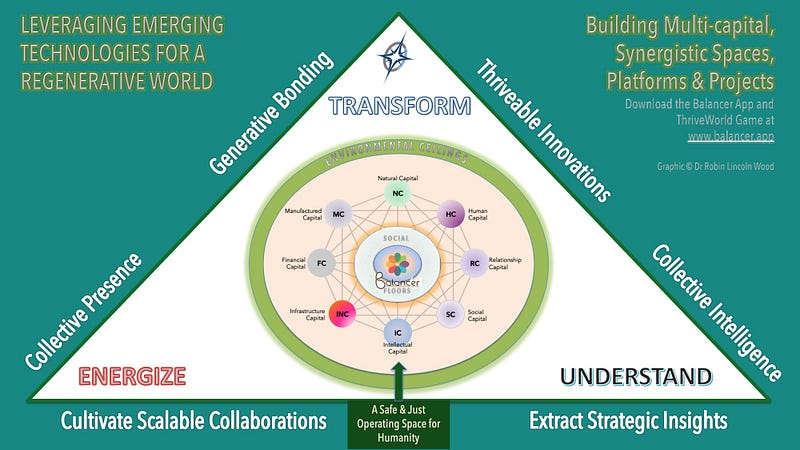
One of the key insights we explore is how we can leverage emerging technologies for regenerative futures. The model of the three key principles involved, together with the six ingredients and synergistic, multi-capital approach needed for regenerative technologies to scale, is set out below. The bottom line is: How can we create a safe and just operating space for humanity by leveraging emerging technologies for a regenerative world?
The Context and Challenges we Face
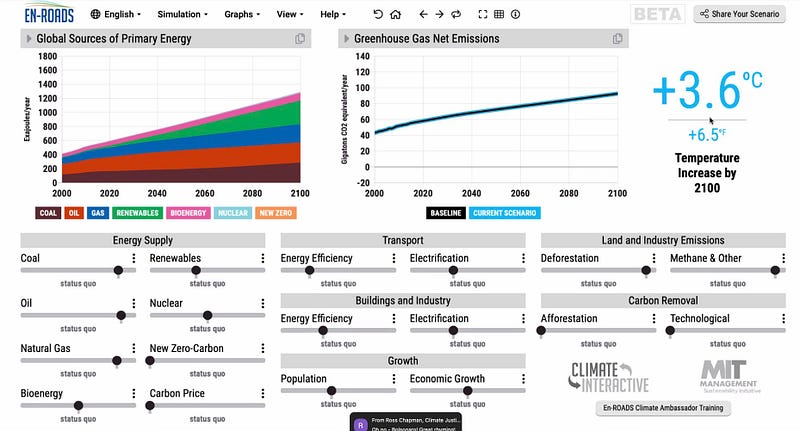
A few weeks ago I took part in a massive online simulation with 307 people around the world using the MIT EN-ROADS simulation, testing different policy scenarios for their impact on climate change. Dozens of different policy measures, from a carbon tax to renewable energy subsidies to carbon and methane capture to reforestation, were on the table, and in our game various teams competed to see which policy combinations reduced temperature to close to 1.5C by 2100.
We began with the Business-as-Usual Scenario we are currently in, which leads to 3.6C overheating by 2100, and runaway global overheating. This is the default setting for our global system if we do not halve carbon emissions by 2030.
After two hours of negotiations and experimenting with different policy options, we arrived at a scenario where we were able to reduce global overheating to 1.8C by 2100.
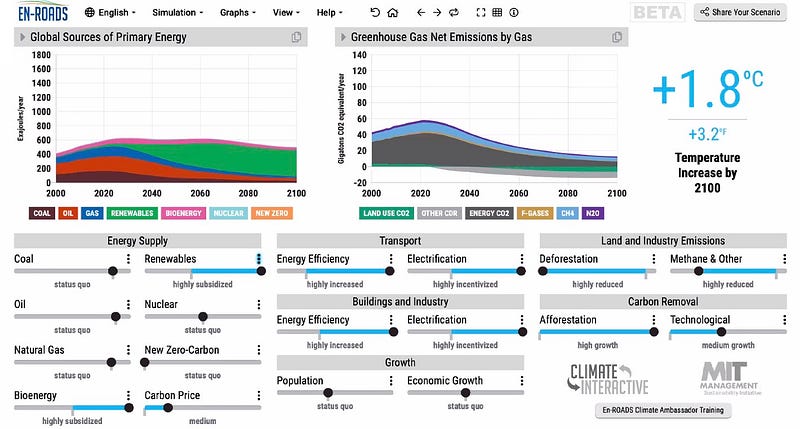
To get from 3.6C to 1.8C overheating or less by 2100 will require massive amounts of political will and alignment around key global policy measures. In turn, climate activism and the scaling of regenerative solutions and ways of living and doing business are key drivers of political will. We all need to do our part.
The obvious, yet wonderful thing, is that people are beginning to wake up to the realisation that, being part of nature and also deeply interconnected with each other, we need to take better care of both of our biosphere and each other. It’s about time, as we are on the verge of tipping our biosphere into runaway global warming and destroying 90% of species on earth including ourselves.
There are many signs of hope today. The leaders of our political economies have understood that we must halve our greenhouse gas emissions by the end of this decade if we are to have any chance of avoiding runaway global warming, even if that understanding may be delayed somewhat in showing up in reality.
The climate summit being held this week with the leaders of 40 countries is a sign that world leaders have woken up to the climate emergency, just in time. Yet the biggest job is going to be implementing all of the wonderful programmes that will be launched this week and beyond. Looking forward to the Glasgow climate summit for COP 26, there is a slim chance that the governments of the world might actually be able to agree on pathways that will deliver the 1.5 degrees centigrade target that was agreed in Paris in 2015.
There are several major challenges we need to address urgently in order for all of this to actually work and deliver the future we all know is possible in our hearts. Yet our heads may also tell us that the human weaknesses of delay , denial, distancing, dissonance and distraction are going have to be overcome if we are to succeed.
Given all this, what can you and I do to ensure that we create a viable future for ourselves and future generations? There are three levels at which we can work together to make a big difference in the next decade, as shown in diagram 1 above:
Energise
The place to begin is to energise our personal, communal and organizational energy levels. If we’re feeling weak, anaemic or helpless, we’re going to lose this battle. Regeneration begins at home through yourself, your family, friends and colleagues. Not only does your own life style and example matter; we also have to learn how to become better leaders and empower ourselves and others to wake up every morning ready to take on the major challenges the next few decades will pose.
Part of energising includes resonating with others, building rapport and seeing things from their point of view, meeting people where they’re at while creating a context in which they can see the next best version of themselves.
Understand
We live in the knowledge economy in which information is free and understanding can be accelerated dramatically through a variety of well designed media and tools that enable us to understand what the right thing to do is at any point in time, if we can be bothered to actually do a little homework. I’ve developed a simple, intuitive test for decision-making: if I have one or more options available to me, whether it is a range of food and beverages, products, services, experiences, investments, people, pathways/whatever, then I will choose the option that helps increase the ability of the most people and living beings to thrive, including myself, my friends and family.
We live in a world of instant feedback, with almost infinite amounts of data and information that are slowly coalescing into islands of wisdom and insight, if you know where to look. The challenge is to align our different values, perspectives and understandings to build coalitions and platforms for right action.
This includes taking a future backwards approach to decision-making. For example, we need to think backwards from 2030 to today in order to appreciate what the next steps on our pathways should be personally and collectively. The Balancer App, which we’ll explore at the end of this article, has been designed to do just that for us, both as individuals and organizations, while also making it fun for younger generations to play the ThriveWorld Game.
Transform
The cultures and systems we are currently living in need to be radically transformed. A great shift in our personal and social priorities is required if we are to create an open, regenerative social and political order.
Traditional approaches to change tend to focus on the exteriors of behaviors and systems. Transformation digs deeper into the mindsets and cultures that need to shift in order to produce more regenerative behaviors and systems. As Buckminster Fuller said:
“You never change things by fighting against the existing reality. To change something, build a new model that makes the old model obsolete.”
In order to replace and hospice the old order of mono-capitalism, where “only money matters” , we need to displace fossil fuels, toxic chemicals and chemistry, reckless development, carbon polluting transport, and much more.
At the same time, however, we need to remember Einstein’s famous quote:
“We cannot solve our problems with the same level of thinking that created them.”
Human evolution has been evolving through our cultural evolution, and our cultural evolution is now being driven by the evolution of our social technologies. And how we design, build and use our social technologies is a function of the worldviews, values and perspectives we bring to the party, which is why integrated, or integral, leadership is so vital to help transform our mindsets, cultures, behaviors and systems. The more complex the challenge, the more complex and holistic our thinking, leadership and practice needs to be to stand any chance of resolving that challenge, especially what are known as “wicked problems”.
Thinking, technology, markets and institutions co-evolve. To put it more simply: we co-evolve with our technologies and systems. Given how important this is to creating regenerative futures, it is clear that we need to establish some guidelines for designing and building technologies, especially those that enable social exchanges, social innovation, collective intelligence and policy making. Recent debates about how we should control and shape artificial intelligence developments, for example, have shone a spotlight on the current and potential negative impacts of AI, online shopping, social media, gaming, gambling and other potential harms accelerated by the worldwide web.
My friend and colleague Nick Jankel recently published an illuminating article on this topic here on Medium: “Regenerative Tech- Slow Down & Mend Things”. Nick offers us ten design lenses for building regenerative technologies, and why we need embodied wisdom to wield them properly.
It turns out that there is a logic to the ten design lenses and questions that aligns beautifully with the multi-capital model for building synergistic, regenerative, inclusive futures. Here is what Nick and I figured out together in blending these two ways of thinking about this topic.
Regenerative Tech and Multi-Capital Synergies
The transformation of capitalism from within, is being driven by organizations embracing a multi-capital approach to regeneration. Why multiple capitals? Surely, it is capital that is the baddy, right, as Karl Marx and hundreds of millions of socialists and communists have been telling us since Das Kapital was written? You only need to read my article on “The Giant Con Job”, written two days after the Capitol Hill invasion, to see where my sympathies lie. The question I asked there remains:
“How can we inspire billions of consumers and citizens in the developed world to change the failing habits and mindsets of a lifetime that are leading us to ruin? To enable them to see through one of the biggest con jobs of all time, perpetrated by one of the most talented con artists of all time, Donald Trump, aided and abetted by the Republican Party. The events that unfolded in Washington DC and state capitols in the past few days, months and years, were not random. Neither were the events and decisions that triggered Brexit and divided families and countries in the UK and EU- they too were well thought through in advance by an incredibly well-resourced propaganda machine.”
Yes, it turns out too much financial capital in the hands of a small, often corrupt elite, is very harmful to people and planet. This much has always been true, so no argument there. But financial capital is only one of at least eight different capitals, which are basically defined as stocks of tangible and intangible assets our biosphere and healthy human societies need to function.
Small, greedy elites have managed to capture more value from the information and knowledge economies than ever before, as the concentrating power of network dynamics demonstrate. Transport networks, electricity networks, communications networks, TV and cable networks, banking networks and internet networks represent examples of the ever increasing power that comes with the ability to dominate a network- hence the need for anti-trust regulations in every single one of these industries over the past century.
Such networks benefit from a phenomenon called “lock-in”, where, once a standard becomes pervasive in an industry, then the largest players form oligopolies and if left unchecked, monopolies. One only has to play the boardgame “Monopoly” to appreciate the dynamics of the real world game. This is known as “Game A”, the hyper-competitive race to the bottom for people and planet driven by the hunger for profit and obscene wealth that characterises elites greedy for power, status and money.
Google/Alphabet, Amazon, Facebook, Apple, Microsoft, Samsung, AT&T, Intel, IBM, Cisco, Alibaba, Walt Disney, China Mobile, Verizon- the list is a long one, with over one hundred digital players dominating markets globally. These companies also turn out, by and large, to be the most valuable and profitable companies in the world today.
The business model of these giants, and the “Unicorns” seeking to emulate them such as Uber et al, is problematic. The current dilemma presented by social media & search industries is that they are fundamentally designed as manipulation engines. Sowing discord and falsehoods has proven to be as, if not more profitable, than aligning the good and the true in our social and mainstream media.
The attention mining for advertising profit business model is destroying our civilization one click at a time. The manipulation engines don’t care about what is humane, good or true- they simply care about what generates the most profit, and mine the rabbit holes in your and my minds to “magically” feed us what we like and click on- so we end up with the “flat-earth society” and groups going viral, along with the “5G causes covid-19” and “vaccines are dangerous “ false memes.
As someone who has spent his entire adult life being hyper conscious about how media manipulation and advertising act as hidden persuaders to drive mass consumption and infinite growth on a planet with finite resources and fragile human minds, even I find it difficult to disconnect, though I do so often enough to remain sane and hopeful.
EACH AND EVERYONE OF US must use the media we have access to, to inform, educate and entertain in ways that are good, true and beautiful. We must cultivate our own abilities to find the truth behind the lies, the facts and science behind the stories, and the beauty and goodness behind the ugliness of what politics and economics have become. WE ARE THE ANTIDOTE, along with much stronger regulation around data privacy, fake news, polarizing emotional rabble rousing, and intentionally harmful and malevolent content. (For a more detailed analysis, watch The Social Dilemma film on Netflix).
As Nick Jankel points out in his article:
“…It is highly unlikely that we can meet all our true human needs across 9 billion people without high-tech solutions. We need technology to play a major role in the reduction of carbon, pollution, and waste; and in the meeting of intense needs around nutrition, safety/shelter, health, education, social connection, and more across a complex global economy of billions…
Let me be clear and candid: almost everything is stacked against the possibility of making mainstream tech regenerative. The dominant paradigm of the last few hundred years is to choices that promote alienation over connection; extraction over contribution; exploitation over restitution; and accumulation over communion.
The sheer weight of nerves within us conditioning over a lifetime to fire in ways that drive control/protection/accumulation/extraction/exploitation — within a system that is premised around rewarding such protective patterns with power, prestige, and profit — is almost too much to resist…”
Let’s explore how Nick’s ten questions highlight how this can help us slow down and mend things through regenerative technologies.
- RELATIONSHIP CAPITAL & TRUST/SAFETY — How will our technology foster vulnerable, open-hearted, curious, compassionate, authentic, and reciprocal relationships — with sharing of genuine data and insight — as opposed to stimulating posturing, patriarchal power and status games, acquisition of followers, FoMo, misinformation, righteousness, outrage, etc.?
- HUMAN CAPITAL & THRIVING -
- HUMAN NATURE — How do we surface and challenge hidden assumptions that underpin our technology about 1) human nature — especially those that disempower and diminish every human being’s innate capacity for strength, fullness, wholeness, healing, health, connectivity, love, and creativity — and 2) ecological nature — especially those that assume we can continue to drive limitless economic and industrial growth indefinitely on one shared planet?
- HEALING-THRIVING — How do we ensure we help our users transform their pain and patterning with our tech so they become more healed/whole, loved/loving, ‘full’/ embodied with our technology, rather than triggering individual and collective trauma, stress, alienation, loneliness, and addictions (that usually result in both technology producers and consumers becoming more disembodied, alienated, and dissociated)?
Or, to put it more biologically, how do we avoid over-stimulating the Executive Control Network’s desire to predict and manage away risk, frailty, chaos; and the dopaminergic reward pathways’ desire for constant surprise and anticipation (e.g. addiction-driving loot boxes and Likes) — and instead trigger more connective, curious, compassionate, creative pathways, such as those facilitated by oxytocin (love), acetylcholine (learning), and the Default Mode Network (divergent thinking)?
3. SOCIAL CAPITAL & WELLBEING- How can we use business activities, purpose/ passion/ energy, and ‘waste’ to rejuvenate and/or regenerate the complex web of life/biome within which our offices, servers, and sales and marketing touchpoints exist — and bring abundant over-flowing connection, a sense of inherent and always-existing wholeness, and life-enhancing conditions into the rhizomatic human relationships that make, service, and run our tech?
4. COMMUNITY — EQUALITY/EQUITY — How will our technology reduce or alleviate pre-existing structural injustices in our society (those driven by economic, gender, class, race, access to finance, crime, etc. etc.) — and increase access to important life-sustaining and life-affirming services that meet genuine human needs of the many, not the desires of the few?
5. FINANCES — INCLUSION/ACCESSIBILITY –
- FAIR TRUE FUTURE VALUE — How can we generate an honest exchange of value for our service/experience that is sensitive to low-income people’s capacity to afford technologies — and that avoids hijacking our human desires for content and connection to leverage personal data and eyeballs for profit in a manipulative and dishonest way?
- LEVEL PLAYING FIELDS — How do we ensure that we avoid excessive concentration of ownership and power with our tech — ensuring there is diverse and distributed ownership for genuine long-term stewardship and working to co-create ‘markets’ in an interdependent ecosystem vs. the “crush the competition” mentality of existing tech culture?
6. NATURAL CAPITAL- ZERO/NEGATIVE CARBON EMISSIONS- How do we design our technology to create very low or zero carbon emissions — and actually, ideally, being able to draw down carbon and sequester it in some way without relying on offsetting by third parties as a solution — always being prepared to downgrade service in order to minimize damage to the environment (e.g. 4K/UHD streaming generates four times emissions of standard def)
Nick’s further questions focus in on the HOW of slowing down and mending, including:
7. SLOWER-MORE REGENERATIVE- How do we slow everything down, including the rate of return to investors, so we make appropriately regenerative decisions based on reflection and intuition as much as data and information — building and expanding our tech in a patient, sustainable, nature-based (seasonal?) rhythm that is in tune with 1) the human body’s limits for toxic stress and overwhelm and 2) the planet’s limits on carbon, waste, extraction, etc.?
8. ACUPUNCTURE POINTS- How could we use our tech to stimulate acupuncture points / sweet-spots in the system where small(ish) interventions that could generate large-scale social and ecological impact — whilst, concurrently, mitigating/ avoiding “unexpected returns” of our technology (e.g. the US funding/training Usama Bin Laden to fight the Soviets in the 1980s; and the UK funding/training Mussolini to keep the Italians fighting in WW1)?
He finishes his article with a plea for developing our embodied wisdom:
“Developing and deepening our embodied wisdom is the prerequisite for truly transformational leadership. Here is a working definition of “embodied wisdom”:
When presented with problems and challenges in the outside world, we have the resources to first feel, sense, and understand — in a holistic and nuanced way — various forms of guidance within our own body and mind (what we call the 6 Is: information, instinct, intuition, insight, imagination, intelligence).
We have the capability to ensure that our felt senses, emotions, beliefs, and behaviors around an issue are grounded in a stable, grounded, and whole center — and so are free of the distortions, destabilizations, and defenses that arise when we have unacknowledged, unprocessed, and untransformed social pain, trauma, addiction, and stress. This inner wisdom then turns back towards, and into, the outer world…
As we then ‘metabolize’ the problems and challenges we are presented from the inside out, leading to coherent meaning-making, co-creative decision-making, and compassionate form-making that solves concrete problems in a way that fits the moment — and is always oriented towards fostering thriving, interdependent, and reciprocal relationships with each other and nature; and the tangible alleviation of suffering in our shared social and ecological systems.”
BUILDING MULTI-CAPITAL, SYNERGISTIC SPACES, PLATFORMS AND PROJECTS
How we can leverage emerging technologies for regenerative futures? The model of the three key principles involved, together with the six ingredients and synergistic, multi-capital approach needed for regenerative technologies to scale, is set out in diagram 5 below.
At the centre of this diagram is a simplified model of how a multi-capital approach helps us create a safe and just operating space for humanity, the latter being a phrase coined by economist Kate Raworth in her “Doughnut Model”, a visual framework for sustainable development. The outer ring of the doughnut represents the nine environmental ceilings we must honor if we are to maintain a biosphere suitable for habitation by humans and all other species.
These nine ceilings include Climate change, Ocean acidification, Chemical pollution, Nitrogen and phosphorus loading, Freshwater withdrawals, Land conversion, Biodiversity loss, Air pollution and Ozone layer depletion.
The inner ring of the doughnut represents the social floors that are inspired by the sustainable development goals of the United Nations, including Food security, Health, Education, Income and work (the latter is not limited to compensated employment but also includes things such as housekeeping, Peace and justice, Political voice, Social equity, Gender equality, Housing, Networks, Energy and Water.
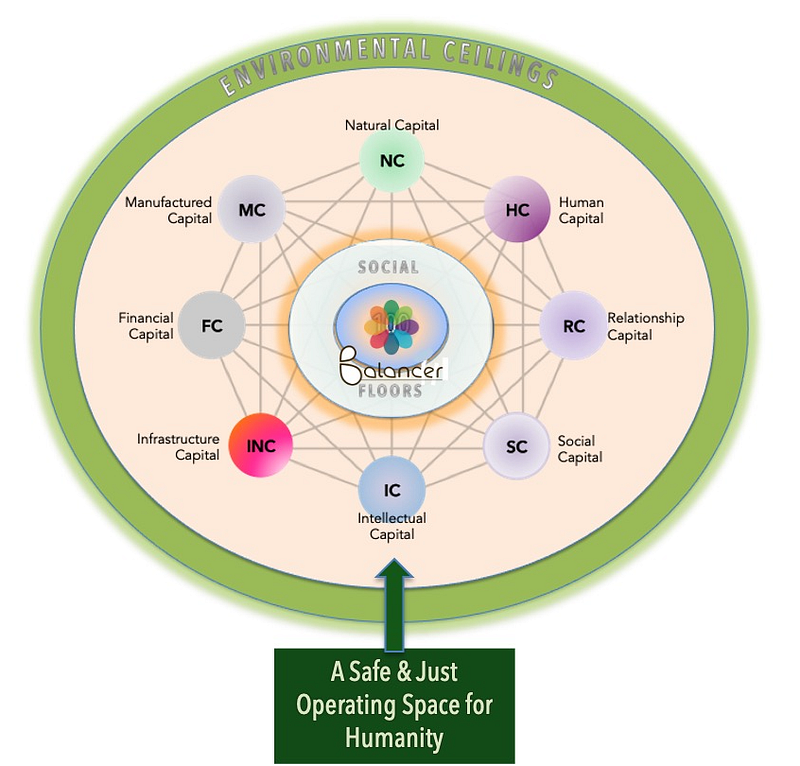
Between the environmental ceilings and social floors of the doughnut, we have the eight capitals that are generated, used and then regenerated in human activities and systems. As Nick Jankel’s ten questions eloquently reveal, if regenerative tech is to slow down and mend things, it will need to regenerate all eight capitals in the right proportions to each other depending upon the kind of human activity carried out in different industries.
In the middle of diagram 4, we have the case study of a regenerative, inclusive, collaborative technology platform called the “Balancer App and ThriveWorld Game”, currently in beta. This app and its associate big data repositories integrate the hundreds of different metrics which tell us not only which of the 14 500 major companies on our planet are “thriveable” and potentially regenerative, which are aiming to be“sustainable” but currently being incrementally “less bad”, and which are actually doing great harm and should be shut down and replaced asap.
As organizations (especially the giant corporations that run most of our global economy) become required or inspired to measure their success by how much natural, human, relationship, social and intellectual capital they regenerate, and not just the financial, manufactured and infrastructure capital they generate, the game of Monopoly changes, as does the nature of capitalism itself.
The serendipity of the situation we are in is that, despite the messes we’ve made through the excesses of industrial and financial capitalism in the past two centuries, we are able to apply our technologies for connecting, understanding, innovating, mobilising and transforming our world to regenerate the assets we’ve been ignoring for centuries- nature and her glorious ecosystems, human wellbeing, genius and connection, social wellbeing and a healthy public commons, open innovation and intellectual capital generation and sharing, together with greater inclusion equality/equity in our communities and accessibility to opportunities, markets and jobs.
I have written eight books covering these topics in great detail, so if you are interested in digging deeper, you’ll find them here: https://bit.ly/robinwoodauthor
The easiest introduction to this work is my book: “Making Good Happen- Pathways to a Thriving Future: Healing Ourselves, Healing our Planet”.
So, to return to our central question: How we can leverage emerging technologies for regenerative futures?
The model of the three key principles involved, together with the six ingredients and synergistic, multi-capital approach needed for regenerative technologies to scale, are set out in diagram 5 below.
We’ve already explored the three principles of Energize, Understand and Transform, and the multi-capital approach to transform our global economy and the organizations that hold our fate in their hands.
Next, let us turn to the six ingredients that are essential for any regenerative technology.
1. Collective Presence
Being “Present” in the moment is one of the qualities that one develops as one practices mindfulness, meditation and integrative personal development. When a coherent container is created through conscious design and facilitation, we can also experience collective presence. Put simply, “I see you seeing me”, and then “I feel you feeling me” the essence of “ubuntu”, which means “I am because you are”. In whatever group, team, gathering, a Zoom or Clubhouse call, we can create a sense of an enlarged, welcoming, energising space.
There is no substitute for human warmth, acceptance and encouragement in what becomes not only a “safe space” but also a “brave space” where we can tackle challenges together we are unable to deal with on our own. Here we are enlivening both our human and intellectual capitals, by opening up our emotional and spiritual faculties.
Presencing is key to open the space for shared and open sensemaking, so we can “let go” of the past and “let come” the future that is wanting to emerge, thus creating the conditions and relationships essential for collective intelligence. I described the essence of presencing and it’s criticality for regeneration, in “The Power of Integral Presencing and Sensemaking”,
“Our bodies are regenerating themselves all the time. … your body has an innate intelligence, so when we renew ourselves by consciously using the same principles to keep our bodies in a natural state of renewal, we enhance our lives and our years of life. Cells live in the present- they cooperate with each other; they understand that the whole is greater than the parts and they live for the whole.
The simplest way to be present is to notice when you’re distracted, stressed, angered, anxious, or bored. Then in that moment we know we all need to take a few deep breaths, center ourselves and wait quietly until we feel calm and centered again. And then we’re in the present moment again.
Another thing that’s critical for a long and happy life is being in communication every day with someone you personally value, so cooperating amongst ourselves is basically bonding, and when you bond you renew a relationship that nurtures both you and the person you’re bonding with.
The third principle is that wholeness is already there — you are already whole. The ever present origin, the source of all being, is always there, always whole, and in our wholeness we’re constantly renewed, because the field of infinite possibilities has something new to offer us every moment if we’re open alert and ready to receive…When we examine human perception, sensemaking and presencing, they all depend on an elaborate network of memories, dreams, images and sensations we recall from the past as well as images of possible futures.
Sometimes we’re awakened by a new experience, person or place — smell and touch are particularly powerful in triggering lost memories. When we experience “time stopping”, scientists call this “T0”, because the future, the past and the present are all coexistent in our minds when we presence and when we sense make — and that’s fundamentally important in our own self-integration and sensemaking. Such moments are often associated with peak experiences. Even though we say, “be here now”, what we’re saying is, sure, live in the present, but actually there’s a lot more to you in the now than just “now”. There’s you in the past, perhaps in the distant past, perhaps in previous lives, who knows? There’s you in the future.
“Theory U” is fundamentally based on this idea that presencing is in fact a journey through all of these different kinds of times that we experience. As we go down the left of the U, and we stop and listen to others and what life calls us to do, we co-sense the field of change, we go to our places of highest potential and listen again with mind and heart wide open. At the bottom of the U, in presencing, we find inspiration and common will. We go to the threshold and allow our inner knowing to emerge, which then leads us to co-create strategic microcosms for prototyping and exploring the future by doing experiments with others. And then we can realize innovations and ecosystems that facilitate seeing and acting from the whole.”
2. Cultivate Scalable Collaborations
Collective presence livens up the channels of communication and energises those who have gathered to share with each other, learn about and perhaps even resolve one or more of the demanding new challenges we face at this time. This is how networks of trust are created, building up relationship and social capitals that are vital to any successful, scalable collaboration. We all know that a chain is is only as good as its weakest link, and so it goes too for networks of relationships.
Scalable collaborations arise within OPEN SPACES. An open space is a multi-dimensional construct that enables people to convene, explore, experiment, learn, and be together. Spaces are designed to be scalable. They have porous, expandable, and malleable boundaries and can grow in terms of actors, relationships, and interactions. Importantly, the direction of growth is not pre-determined (as would be the case for a Platform), because in addressing complex problems it’s not always clear in which direction growth needs to occur.
Spaces create the possibilities of decentralised governance models. Centralised management structures often create bottlenecks, through which consortia become dependent on specific organisations to instigate and coordinate work. In contrast, Spaces can distribute leadership and decision-making across different organisations, because they are designed for agility and devolved decision-making instead of plannability and control.
Spaces “seed and structure experiences” in order to “generate intelligence that feeds into strategic arguments for innovation”. In other words, Spaces are designed to cultivate possibilities — of encounters, conversations, and collaborations — and develop the learning capabilities needed to make sense of what happens in the system of interest in order to extract insights and inform where to channel attention and resources.
Spaces are multi-dimensional and can be many things at the same time — open innovation programmes, social movements, think tanks, venture incubators, knowledge networks, capital facilitators, and the like.
3. Generative Bonding
In the process of collaboration, deep bonds begin to form between people, whether dyadic, triadic or more complex in form. Many startups, scientific discoveries, inventions and social innovations revolve around dyadic generative bonds- Steve Jobs and Steve Wozniak start Apple; Bill Gates and Paul Allen found Microsoft; Crick and Watson discover DNA; Gandhi and Nehru fight for Indian independence; Pierre and Marie Curie discover radium and radiation - the history of inventions, discoveries and innovations is replete with generative bonds that created a breakthrough or a transformation.
Generative bonds usually form around synergistic complementarities between very different individuals. Sometimes these bonds break due to the intense pressures associated with innovations and breakthroughs, but often they last for a lifetime. it is fair to say that without generative bonding and the innovations they generate, our world would be a much poorer place in every sense.
Social field effects and dynamics strongly shape generative bonds, which is why collective presence and scalable collaborations constantly nurture and also inevitably challenge such relationships. This is essential for the insights generated and the creations produced to be diffused into organizations, cultures and whole societies eventually, as the benefits of breakthroughs ultimately accrue at a social level. This process of diffusion is also accelerating rapidly as we use knowledge and collective intelligence technologies to bootstrap other inventions- for example, the ability to read and splice genes would have been impossible if it were not for the rapid improvement in the computing power and software used in genetics labs.
4. Collective Intelligence
Collective presence and scalable collaborations in turn create the conditions in which we can harness collective intelligence to solve otherwise “mission impossible” type wicked problems. Collective intelligence often forms within communities of interest and communities of practice.
Communities of Practice have members with a particular work role or expertise. These communities are focused on developing expertise, skills, and proficiency in the specialty. Communities of Interest are groups of people who want to learn about a particular topic, or who are passionate about one.
While generative bonds seed innovations, the spreading and harvesting of such innovations relies on such communities to diffuse and scale those innovations as widely as possible, through the collective intelligence required to apply innovations in new contexts.
Collective intelligence is essential for most platforms, including Open Source Software, Open Innovation, Peer-to-Peer networks, Blockchain, Google, Wikipedia and political groups, to mention only a few. Google, for example, crawls billions of websites daily, helping people share knowledge and collaborate. There are five key dynamics within Google’s teams that enhance collaboration, including psychological safety, dependability, structure & clarity, meaning of work and impact of work. Google’s approach to networks of trust, recognition and teamwork are one of the key drivers of their success — especially the application of emotional and collective intelligence to enhance coordination and collaboration between teams across the entire organization.
From the perspective of sustainability and thriveability, collective intelligence can take the form of evaluations by groups of experts (climate science, for example), the sentiment of markets (buyers avoiding/selling degenerative products, investments and firms), and networks of trust enabling the flow of vital information required to rate the progress or lack thereof in organizations being evaluated for sustainability, ESG impact, investment potential, and much more.
5. Extract Strategic Insights
Above the word “Transform” in diagram 5, is a symbol representing the North Star. My friend and colleague Ralph Thurm of R3.0 likes to quote general Omar Bradley in World War 2 when speaking about direction finding and leadership:
“If a man has character, everyone has confidence in him. Soldiers must have confidence in their leader. It is time that we steered by the stars, not by the lights of each passing ship.”
Unfortunately, the fields of sustainability, impact and ESG investing and reporting, are steering mainly by the light of passing ships, rather than by the north star. The North Star of transformation has to be limiting global overheating to 1.5C while slowing biodiversity loss; mitigating the most severe climate change impacts; motivating the majority of humankind to live lives that do not cost the earth; and incentivising/regulating organizations to ensure that they are moving toward a regenerative north star in their respective industries rather than simply “less bad” incremental improvement, hollow CSR bragging and marketing greenwashing.
It is in this context that we speak of extracting strategic insights. We can extract strategic insights rapidly through strategic gaming and simulation which involves testing strategic options for robustness, regenerative potential and thriveability; generating a regenerative strategic focus for the organisation, based on its core capabilities and the markets/ ecosystems it finds most attractive; articulating a coherent vision of a desirable, regenerative future; and finally, developing a shared, regenerative strategic intent between the organization and its key stakeholders.
This capability is being built into the professional version of the Balancer App, known as Balancer PRO.
6. Thriveable Innovations
Despite forty years of environmentalism, as the seventh continent of floating plastic and other garbage known as the mid Pacific gyre attests, we are still pumping unprecedented amounts of pollution into our ecosystems. As architect Bill McDonough, the co-inventor of the “Cradle to Cradle” approach to sustainability and design points out, we need to redesign our industrial and social systems so that one systems waste is another systems food. This “circular economy” trend is growing rapidly as companies seek to save money, energy and resources in their attempts to become more sustainable.
As the most imperfectly adapted species on the planet, innovation has literally been the lifeblood of our progression from hunter gatherers in the Holocene to planet shapers in the Anthropocene, driven by over 10 000 life-changing and synergistic innovations in as many years.
The first European Renaissance gave us the power to eradicate much disease, discomfort, hunger and ignorance through innovations in science, technology, organizations, culture and governance, making us the most prolific top predator in our biosphere- and with the same wand, also gave us the power to eliminate much of life on earth as we know it, either deliberately through weapons of mass destruction, or inadvertently through our sheer numbers and over-consumption. Can we catalyse a global, second renaissance in time?
For the past few centuries we have grown our global civilisation by burning fossil-fuels for our energy needs and developing a global trading system based on a linear take/make/dispose business model that rewards ruthless efficiency and an obsession with accumulating stuff and money while generating incredible amounts of waste. This is the system we are now transitioning out of, which historians and futurists alike call a “Level Zero” civilisation, as we take our first steps toward a “Level One” civilisation, powered by renewable energy, a circular economy and global collaboration. This is a risky time for our species and our biosphere, yet also a time of massive opportunity, as people wake up to the need for transformation and regeneration at scale.
To make the transition from “less bad” through “sustainable/better” and “net positive/good” to “thriveable/very good” involves identifying robust innovation pathways based on principles and metrics that clearly identify how to maximize the thriving of human and social capital for the least natural and manufactured capital footprint possible. The effective allocation of funds by capital markets to organizations, cities and projects that deliver thriveable innovation by harnessing their intellectual and financial capital to this end would then be much more likely, and the trillions needed to ensure we close the sustainability and sustainable development gaps much better targeted.
As they say in popular music, “It’s a journey”. The journey from bad to less bad to better to good to very good, that gets us from going extinct in a dying level zero system to thriving as a level one global civilisation powered by the sun and human ingenuity.
An Example of a Regenerative Platform
Creating a regenerative, inclusive, collaborative future is without doubt the single biggest challenge our species has faced to date. The amount of data, competing perspectives, metrics and programs required to even begin to spot the acupuncture points that offer opportunities for regenerative innovation, is gigantic and often bewilderingly complex and contradictory. This is made more difficult by the siloed nature of most organizations and sustainability programs.
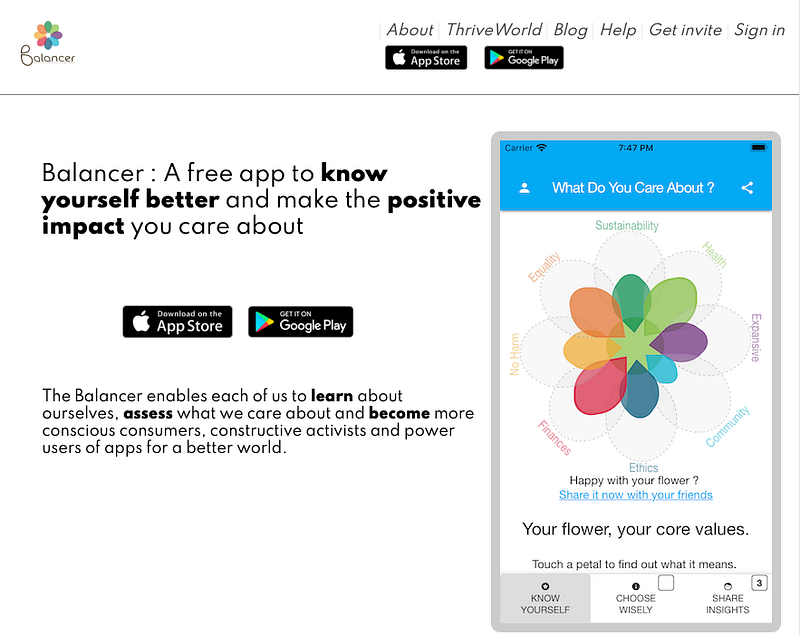
The Balancer App and ThriveWorld Game are embedded in a robust, integrated, open platform and big data repository that enables individuals, teams and organizations to make the essential positive impacts they are capable of. It does this in several ways:
Accelerated learning and decision support
The personal Balancer App:
- Inspires desirable consumer behavior at scale through collaborative gaming, raising awareness of the causes, apps, brands, and actions that lead to thriveable lifestyles. The app and game derive their power from values-based transformation principles which are also applicable in leadership and organizational development;
- Helps individuals gain deeper insights into themselves and their priorities, so that they can choose wisely what to engage in and then share insights into what’s hot and what’s working well with their friends, family and colleagues;
- Features simple, social, fun interactions between Balancer App users and ThriveWorld Game players that build transformative relationships and regenerative thrusts that can spread rapidly through communities, organizations and business ecosystems.
- Offers both implicit and explicit rewards for doing the right thing, including the TREE Ethereum currency in partnership with Ecologi. Regular users of the app and players of the game win tokens that drawdown carbon through tree planting programs.
Catalyze regenerative innovations at speed and scale
The BalancerPRO App:
- Enables rapid, context based ESG Impact Assessment through its integrative multicapital analytical methodology;
- Connects conscious consumers, stakeholders, true impact navigators and enterprise innovators to drive innovations that deliver measurable regenerative impacts;
- Supports professionals and businesses in integrating their sustainability, communications and innovation agendas, programs and metrics;
- Delivers large scale transformations in easily digestible, bite-sized interactive experiences.
While healing ourselves and healing our planet turns about to be the single most complex challenge our species has ever faced, it also represents the biggest opportunity we have ever had to reshape what it means to be human and live in a regenerative, inclusive, collaborative global civilization.

It is my hope that you have gained a useful overview of the maps and models that can help us navigate our way through the next few decades. Thanks for reading this far, and please clap and share if you’ve found it helpful.
For further reading and the underlying research that this article and the Balancer App are based on, please visit https://bit.ly/robinwoodauthor.


