
Headlines: Half the Story
For a brand, story or book, your headline is half the work
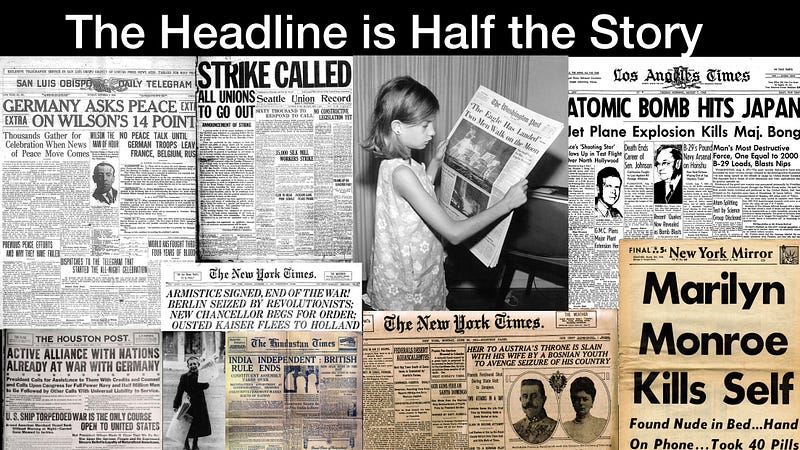
Whether you’re writing a short story, a book or naming a brand, your headline — your title — is half the work.
That’s even more true today with readers scanning more than reading, spending an average of 15 seconds looking at a typical online page before moving on.
“They don’t necessarily read a page from left to right and from top to bottom,” says Don Tapscott, author of Grown Up Digital: How the Net Generation Is Changing Your World. “They might instead skip around, scanning for pertinent information of interest.”
Your headline, book title or brand name implies the work’s mission or purpose. Get the headline just right and anything is possible.
Your headline is your roadmap showing where you are going
Get the headline or name wrong and no one will even bother to read past it. As advertising legend David Ogilvy said, “unless your headline sells your product, you have wasted 90 percent of your money.’’
With digital media, changing a single word in one headline can increase clicks by 46 percent so headline writers are taught to remember the “four u’s,” or headlines that are:
- Unique.
- Ultra-specific.
- Urgent sounding.
- Useful.
Great headlines are great SEO
Great headlines are great Tweets, great social media posts and make for great Search Engine Optimization (aka SEO, winning searches).
Decades of research show the shorter your sentence, the more words the readers will retain (and good meta descriptions are 150 characters).
Some secrets to making good headlines great and winning online: Spend about half your time focused on that great headline and lede (the introduction to your story or thesis).
Great headlines and great names are also great brands
In “The Founder,” Ray Kroc says he knew when he saw the little California burger stand that McDonald’s was the perfect name for his empire. He readily admits his own name would never fit:
“It’s not just the system, Dick. It’s the name. That glorious name, McDonald’s. It could be, anything you want it to be… it’s limitless, it’s wide open… it sounds, uh… it sounds like… it sounds like America. That’s compared to Kroc. What a crock. What a load of crock. Would you eat at a place named Kroc’s? Kroc’s has that blunt, Slavic sound. Kroc’s. But McDonald’s, oh boy. That’s a beauty. A guy named McDonald? He’s never gonna get pushed around in life.”
Why I Miss Copy Editors
When I worked for newspapers, reporters were the cowboys going out into the world, meeting people, finding the stories and explaining that “big picture.’’
Line editors were always there to second guess reporters and ask the big questions to make sure we had everything the story needed. Finally, the copy editors were there to go through every detail with a fine-tooth comb to make sure you got everything right.
Most importantly, the copy editors wrote the headlines. Headlines, like book titles, determine whether readers will read further.
For example, I truly believe this great headline had much to do with my winning a national journalism award for a story detailing nepotism, abuse of resources and mismanagement at a national nonprofit I covered in the late 1990s. The powerful headline read:
“Rising Son Casts Shadow.’’
Four words explained all sorts of questions about an executive bringing in her inexperienced son and a host of other management concerns.
The copy chief, playing on a classic Ernest Hemmingway title, had yet another idea for a headline that would have also been equally powerful: “The Son Also Rises.’’ The story had great impact. The son stepped down.
As I sat on a panel discussion on the winning stories, it occurred to me that the story wouldn’t have won without that powerful headline. I miss copy editors even more as I write online because today’s writers need to be able to tell stories and get the headlines just right.
“The best writers seeks surprise, delight in what they do not expect to see,’’ Donald Murray writes. “They come to the story with a focus, an expectation, but they treasure the contradiction, the traitor fact, the quotation that goes against the grain, the unexpected that reveals.’’


