
JAPANESE HORROR | JUNJI ITO
Headless Sculptures
Caution: Contains elements of horror that may be unsettling for some readers
In a school’s art department, Shimada and Rumi are assisting their teacher Mr. Okabe, a sculptor known for his headless statues. Okabe believes that removing faces from his sculptures allows for more interpretations, arguing that faces aren’t essential to art.
Despite Okabe’s suggestion to leave, Shimada insists on staying to help.
The next day, when Rumi gets to school, she finds the schoolyard crowded with students and police officers. Her classmates Sanae and Masami break the news that Okabe was killed the previous night.
He was murdered around midnight and decapitated, just like his statues. Rumi decides not to mention that Shimada stayed back to assist Mr. Okabe, fearing it might implicate him.
After school, Rumi heads to Shimada’s house. When he answers the door, she notices he’s dressed for winter despite the summer weather. His face is hidden behind a surgical mask, which is common when someone’s sick in Japan.
In a strange conversation, Shimada suggests that love changes how people behave. He compliments Rumi’s beauty and admits he used to wait for her in the art room.
He suggests that they go for a walk. As they stroll, Rumi brings up the murder, expressing her shock. Shimada interrupts, asking if she thinks he’s the killer. He denies any involvement, insisting that Okabe is alive but hiding due to personal issues. Shimada claims they’re meeting later that evening.
When Rumi questions whose body was found if it wasn’t Okabe’s, Shimada offers to show her.
Meanwhile, Sanae and Masami arrive at the art room because the latter had left her English study guide in the art room. While discussing the horrific way Okabe was murdered, Sanami searches for her study guide.
Suddenly, they hear thumping noises from the other room. They see someone standing on the other side, and as the door opens, they are horrified to find Okabe’s dismembered head, frozen in terror, with his jaw open and glasses askew.
Rumi walks into the art room and is hit by a strong smell of rotting meat. She notices that all the statues except one are gone, leaving only the pedestals behind. Shimada then locks the door and removes his mask, revealing his face with blood dripping from his lips and his eyes looking lifeless.
He talks, but his mouth doesn’t move. Rumi grows worried and begins questioning Shimada about Okabe’s whereabouts. Shimada uncovers a female statue, exposing Okabe’s head on it. He removes Okabe’s head and drops it to the floor, then moves toward Rumi. Now, Shimada aims to swap Okabe’s head with Rumi’s for the statue.
She attempts to escape and strikes Shimada as he approaches her. However, her blow accidentally dislodges his head from his body, exposing that he’s also a statue. Rumi grabs a chair and defends herself against Shimada’s statue, causing it to stumble and break apart.
She’s struggling with the key to open the door when she spots the female statue advancing towards her with a machete. Just as she unlocks the door, she narrowly escapes the art room. Outside, she encounters another headless statue blocking her path, while the one with the machete pursues her, aiming for her head.
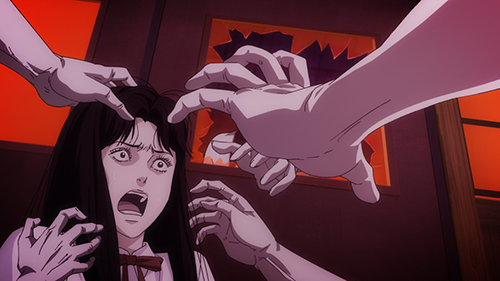
The girls saying that Rumi is pretty and they want her head to replace theirs. They corner her in a room and the statue with the machete breaks in through a window. All three statues arguing over Rumi, reaching out to grab her head as she screams in terror.
My Interpretative Reflection
There’s danger in equating beauty with worth.
The headless statues represent an insatiable desire for physical beauty, so much so that it becomes monstrous and murderous.
This reflects our own societal tendency to equate beauty with worth, leading to unhealthy fixations and sometimes harmful actions.
By focusing solely on heads as defining beauty, the story highlights the way we often judge people based solely on outward appearances.
This is a warning against the dangers of obsession, be it with beauty, power, or any other fleeting ideal. It reminds us that unchecked desires can lead to monstrous outcomes, both for ourselves and others.
True horror lies in its reflection of our own societal flaws.
Available on Netflix
I’m just a humble fan who loves all things Japanese and hopes to bring a little bit of that love to you. Arigatou gozaimasu!
Your support holds immense significance for a disabled neurodivergent. If you’d like to show your support, you can consider buying me a coffee here. My collection of eBooks and classic titles is available here. Your kindness is greatly appreciated.
All photos belong to their respective websites, as indicated in
the captions. For more information, you may click to visit the provided
sources, which will lead to external websites, unless stated otherwise.
Source Headless Sculptures | Junji Ito Wiki | Fandom 伊藤潤二『マニアック』 各話情報 #11 | 株式会社スタジオディーン (deen.co.jp) 伊藤潤二傑作集 7 首のない彫刻 — 伊藤潤二 — 漫画・ラノベ(小説)・無料試し読みなら、電子書籍・コミックストア ブックライブ (booklive.jp)