
avatarMastafa Foufa

Free AI web copilot to create summaries, insights and extended knowledge, download it at here

3056

Abstract

e id="7f35"><p>Build trust with executives by solving the highest value problems.</p></blockquote><p id="bf38">____</p><p id="1e9a">If you get delegated to build reports for business associates. Dashboards for people that report to people that report to people.</p><p id="4a5d">It either means 1) <b>the company doesn’t care about data</b>, or 2) <b>you’re not focused on the right problems for the right people.</b></p><p id="f607"><b>What do you do?</b>

  1. Give up and try to build ‘self-service’ analytics (because otherwise, it’ll be impossible to create value in the company)
  2. Spend your time fighting for a seat at the table with the executives</p><p id="6c76">Personally, I recommend fighting for a seat at the table with executives.</p><blockquote id="76bc"><p><b>You’ll learn. You’ll grow. You’ll find the most valuable problems to solve. You’ll become indispensable.”</b></p></blockquote><figure id="d6bb"><img src="https://cdn-images-1.readmedium.com/v2/resize:fit:800/0*3hT9xCMqwD4I7ACY"><figcaption>Photo by <a href="https://unsplash.com/@honza_kahanek?utm_source=medium&amp;utm_medium=referral">Jan Kahánek</a> on <a href="https://unsplash.com?utm_source=medium&amp;utm_medium=referral">Unsplash</a></figcaption></figure><h2 id="8074">My notes are below.</h2><p id="7fa1"><b>Week 1. </b>TOP-3 questions for executives.</p><ul><li>Can we get automated answers to those questions?</li><li>How easy is it to find such questions?</li><li>What are core questions to executives? Satisfaction (NPS), Retention, Churn, Overall Usage?</li></ul><p id="3b86"><b>Week 2.</b> List datasets and ongoing scenarios/business problems.</p><ul><li>It is important to understand what kind of data the startup has in hand.</li><li>I would classify existing datasets into several “master” categories and link those categories to their importance to executives.</li></ul><p id="9bae">During this week, I would also evaluate the feasibility of crossing those datasets (signals) together. Questions I would therefore ask my team and myself:</p><ul><li><b>How easy is it?</b></li><li><b>How valuable is it?</b></li><li><b>Is it helping executives create a more robust story and understand better users to improve products and KPIs?</b></li></ul><p id="afdd">It’s a complex question but there can be estimates for such a question. For example, if two datasets (Usage and Satisfaction) live in two completely distinct data warehouses and lack a common identifier for a future join, that may be critical and suggest something is off with the current architecture.</p><p id="5540"><b>Week 3.</b> Top 3 ideas for executives</p><p id="7717">Exec 1 — Top 3 ideas to make their life easier Exec 2 — Top 3 ideas to make their life easier Exec 3 — Top 3 ideas to make their life easier</p><p id="8286">Each idea should clearly improve the business in the exec’s eyes. A sentence should help identify whether it is the case or not. “Solving this problem will help us get 10% more users next fiscal.”</p><p id="46f7">Practical implementation leveraging Week 2. Build the foll

Options

owing mapping: <b>Idea </b><-> <b>Data </b>: <i>What datasets are useful to solve each idea?</i></p><p id="db6f"><b>Week 4. </b>Solving problems.</p><p id="54ba">Starting to solve problems with:</p><ul><li>Data Engineering — standing a data warehouse — e.g. on Azure.</li><li>Analytics & Visualisation — e.g. Power BI</li></ul><p id="cf44">There is no mention of framing some DS and Machine Learning problems. <b>I would include that here myself.</b></p><p id="21eb">There could be some important A/B testing starting to be framed here. Though, I don’t know how important AB testing is to executives. In a startup, it may be super important intuitively — between one Netflix view to another, you may confuse or not your users and ultimately lose them (cf. <i>retention</i>/<i>churn</i>).</p><p id="2b20">The author mentions Portable here. I am not familiar with it. <b>How good is it?</b></p><figure id="94dc"><img src="https://cdn-images-1.readmedium.com/v2/resize:fit:800/1*E98UpMpfGfz3Y5FkWeezJQ.png"><figcaption>Some feedback to help us understand what <a href="https://portable.io/">Portable is about.</a></figcaption></figure><p id="2b73"><b>Week 5. </b>Getting quick wins.</p><p id="ed9d">Starting to answer questions from Week 3. Getting quick wins by picking the easiest questions to answer first.</p><p id="b604">Again, I would slightly adapt what Ethan suggests. I would leverage the below graph to select those “quick wins”. I would select projects with the highest impact and fastest to achieve first. Always having this 2-D execution space in mind is good I believe. It’s called an action priority matrix and Ethan might had it in mind. But I know some of us may forget about it.</p><figure id="79ff"><img src="https://cdn-images-1.readmedium.com/v2/resize:fit:800/1*JwusU-7CpcRdP0uJN_1u-A.png"><figcaption><a href="https://www.productplan.com/glossary/action-priority-matrix/">Action priority matrix.</a> Rank your projects according to the above matrix.</figcaption></figure><p id="6c7b">Integrate a feedback loop with the executives themselves. Do they like it or do they like “something else”? If you did a good job in Week 3. This “something else” should be something new as you shouldn’t have missed it in the important items. Add it to your list if it’s a new important thing. <b>Share, and overshare until you see some smiles :)</b></p><h2 id="9fe4">Overall recommendation I remember.</h2><blockquote id="d1aa"><p>Fight for a seat at the table with executives.</p></blockquote><blockquote id="f3b1"><p><b>You’ll learn. You’ll grow. You’ll find the most valuable problems to solve. You’ll become indispensable.”</b></p></blockquote><h1 id="b7af">👋 One last thing — be among my special readers.</h1><p id="2bc7" type="7">I am a Data Scientist at Microsoft and an ex-teacher at EPITA Paris. I have 8 patents in AI and continuously push AI to the edge.</p><p id="eb4e" type="7">I would love you to be among my followers. I will do my best to help out.</p><p id="9ab5" type="7">Also, follow me on LinkedIn.</p></article></body>

Photo by Per Lööv on Unsplash

Head of data in a startup

My startup note. What do you need to know to become head of data?

This Monday, we will learn what it takes to start well in a startup as the head of data. If you have been in the industry for a while now, that may be a role you are interested in. As a junior, that may be something you have been targeting for a while now. Overall, it is great to understand how a head of data should do when joining a startup. To do so, will analyze a LinkedIn post from Ethan Aaron, CEO of Portable.

First, I will slightly reformat the content proposed by Ethan Aaron for readability purposes.

Second, I will share with you my raw notes and my personal takeaways.

Original post

“You join a 100-person company as the head of data. What should you do?

Week 1 1) Schedule a meeting with everyone in the C-suite 2) Identify the top 3 questions each executive needs an answer to 3) Figure out if they have a manual answer, have an automated answer, or don’t have an answer to those questions

Week 2 1) Ask the IT team for the full list of business applications in use across the company 2) Ask engineering for a list of the databases across the company 3) Ask the people maintaining spreadsheets for key KPIs where the data is coming from

Week 3 1) Create a simple spreadsheet of the top initiatives from each exec (let’s assume 3 ideas from 7 execs = ~20 initiatives) 2) Include the general business value (even a quote is good enough) 3) List where the data would need to come from to answer the question in an automated manner (databases, business applications)

Week 4 1) Pick a data visualization tool (find a free or cheap one, low risk) 2) Stand up a data warehouse (find one with a free tier) 3) Put in place an EL solution with a free tier like Portable

Week 5 1) Start answering questions. Get some quick wins. Pick the easiest questions to answer first. 2) Go back to the executives. Ask for feedback. Are they urgently trying to get their hands on the data? Or distracted by a higher priority? If they have a higher priority, add it to your list. 3) If they give lots of feedback that’s good. If they ask for access to the dashboards, that’s great.

____

When setting up a data team, the overall goal should be:

Build trust with executives by solving the highest value problems.

____

If you get delegated to build reports for business associates. Dashboards for people that report to people that report to people.

It either means 1) the company doesn’t care about data, or 2) you’re not focused on the right problems for the right people.

What do you do? 1) Give up and try to build ‘self-service’ analytics (because otherwise, it’ll be impossible to create value in the company) 2) Spend your time fighting for a seat at the table with the executives

Personally, I recommend fighting for a seat at the table with executives.

You’ll learn. You’ll grow. You’ll find the most valuable problems to solve. You’ll become indispensable.”

Photo by Jan Kahánek on Unsplash

My notes are below.

Week 1. TOP-3 questions for executives.

  • Can we get automated answers to those questions?
  • How easy is it to find such questions?
  • What are core questions to executives? Satisfaction (NPS), Retention, Churn, Overall Usage?

Week 2. List datasets and ongoing scenarios/business problems.

  • It is important to understand what kind of data the startup has in hand.
  • I would classify existing datasets into several “master” categories and link those categories to their importance to executives.

During this week, I would also evaluate the feasibility of crossing those datasets (signals) together. Questions I would therefore ask my team and myself:

  • How easy is it?
  • How valuable is it?
  • Is it helping executives create a more robust story and understand better users to improve products and KPIs?

It’s a complex question but there can be estimates for such a question. For example, if two datasets (Usage and Satisfaction) live in two completely distinct data warehouses and lack a common identifier for a future join, that may be critical and suggest something is off with the current architecture.

Week 3. Top 3 ideas for executives

Exec 1 — Top 3 ideas to make their life easier Exec 2 — Top 3 ideas to make their life easier Exec 3 — Top 3 ideas to make their life easier

Each idea should clearly improve the business in the exec’s eyes. A sentence should help identify whether it is the case or not. “Solving this problem will help us get 10% more users next fiscal.”

Practical implementation leveraging Week 2. Build the following mapping: Idea <-> Data : What datasets are useful to solve each idea?

Week 4. Solving problems.

Starting to solve problems with:

  • Data Engineering — standing a data warehouse — e.g. on Azure.
  • Analytics & Visualisation — e.g. Power BI

There is no mention of framing some DS and Machine Learning problems. I would include that here myself.

There could be some important A/B testing starting to be framed here. Though, I don’t know how important AB testing is to executives. In a startup, it may be super important intuitively — between one Netflix view to another, you may confuse or not your users and ultimately lose them (cf. retention/churn).

The author mentions Portable here. I am not familiar with it. How good is it?
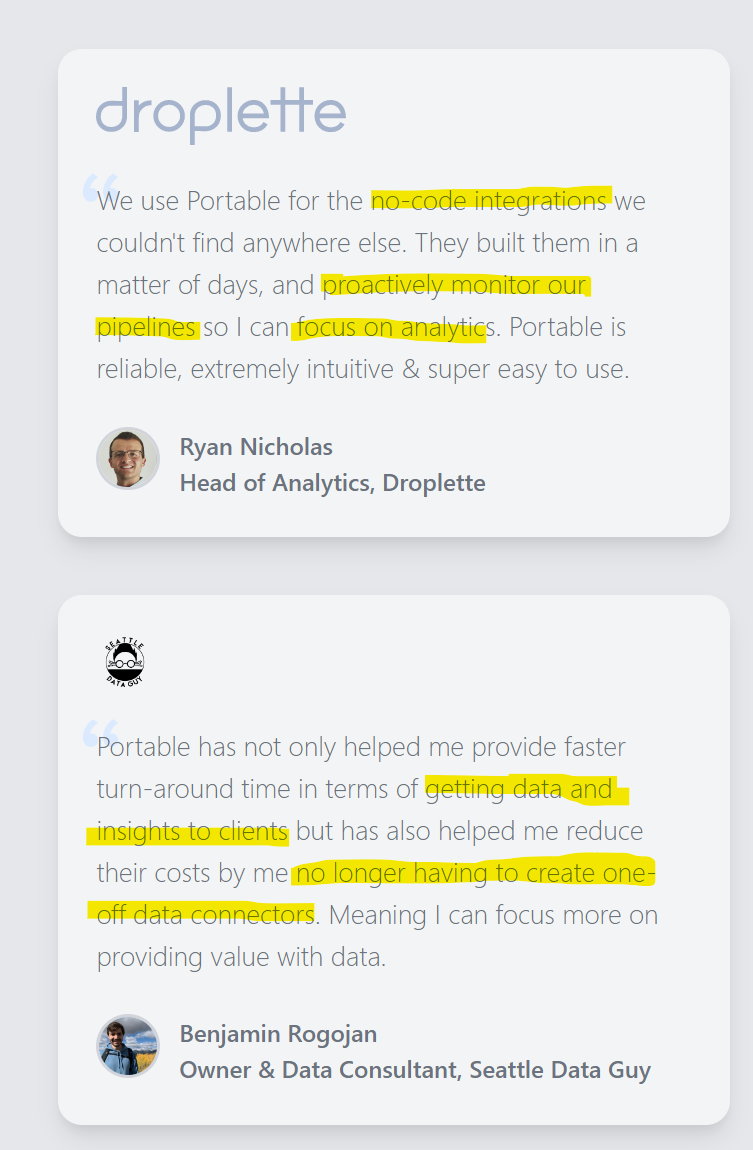
Some feedback to help us understand what Portable is about.

Week 5. Getting quick wins.

Starting to answer questions from Week 3. Getting quick wins by picking the easiest questions to answer first.

Again, I would slightly adapt what Ethan suggests. I would leverage the below graph to select those “quick wins”. I would select projects with the highest impact and fastest to achieve first. Always having this 2-D execution space in mind is good I believe. It’s called an action priority matrix and Ethan might had it in mind. But I know some of us may forget about it.
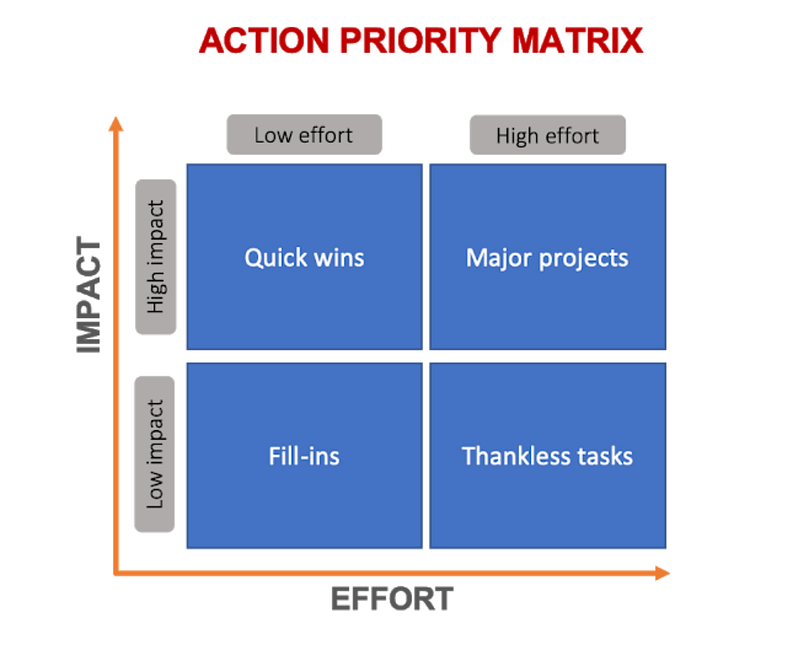
Action priority matrix. Rank your projects according to the above matrix.

Integrate a feedback loop with the executives themselves. Do they like it or do they like “something else”? If you did a good job in Week 3. This “something else” should be something new as you shouldn’t have missed it in the important items. Add it to your list if it’s a new important thing. Share, and overshare until you see some smiles :)

Overall recommendation I remember.

Fight for a seat at the table with executives.

You’ll learn. You’ll grow. You’ll find the most valuable problems to solve. You’ll become indispensable.”

👋 One last thing — be among my special readers.

I am a Data Scientist at Microsoft and an ex-teacher at EPITA Paris. I have 8 patents in AI and continuously push AI to the edge.

I would love you to be among my followers. I will do my best to help out.

Also, follow me on LinkedIn.

Startup
Cto
Data Science
Recommended from ReadMedium